

Today most technologies work in one unit to provide better patient care but doctors are spending too much of their time on documentation, resulting in less time for patient care. On average most of the physicians spend 1 hour on documentation for every 5 hours of patient care. This impacts physicians as well as patients, overall affecting the quality of care. For many healthcare start up practices, the main problem arises when they can’t afford enterprise solutions so they continue on manual documentation. This results in burnout among doctors, increases late-night work and all-over patient frequency decreases. This is where Ambient AI with multi-agent systems can make a real difference and improve patient care by assisting physicians.
Imagine a world where average physicians don’t have to work continuously 24 hours a day, to eliminate burnout risk and making this imaginable concept a reality, ambient AI is introduced to handle charting, coding and auditing the data throughout the process when the doctor is assessing the patient. This Ambient AI will help eliminate the documentation crisis and helps clinicians in supporting data work so that they increase the patient care.
Ambient AI and Documentation Crisis:
Ambient AI is a type of artificial intelligence which works in the background, listening and understanding the real-world interactions without interrupting the user. Instead of a doctor typing the note in EHR, the AI listens to the conversation between the physician and the patient and automatically updates the notes in EHR maintaining the structured medical documentation. In traditional EHR, a doctor manually enters the data while in an ambient AI system, a smart research assistant listens, understands and writes notes and assists the clinician.
It is important to understand the documentation crisis and its impact as doctors spend hours after work completing notes resulting in burnout leading to decrease patient compliance and even in some cases staff turnover. The effective way to deal with such a crisis is to integrate ambient AI solutions which are affordable, scalable and easy to integrate in the clinical workflow.
How does Ambient AI work?
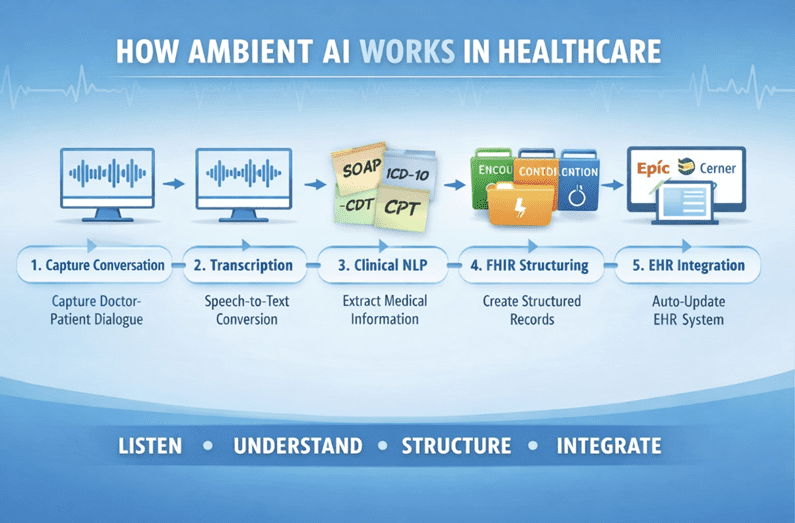
Ambient AI listens to the conversation between the doctor and the patient and starts to create structured clinical notes. Microphone captures the conversation between physician and patient and the speech is converted into text; this is the process of transcription. AI analyses the transcript text and extracts the medical information and important details to create notes automatically. This data is then automatically saved in the Electronic Health Record (EHR). This removes the need for manual typing and saves a lot of time for the physician and indirectly impacts the patient compliance.

Inside the multi-agent ambient AI system (LangGraph Architecture):
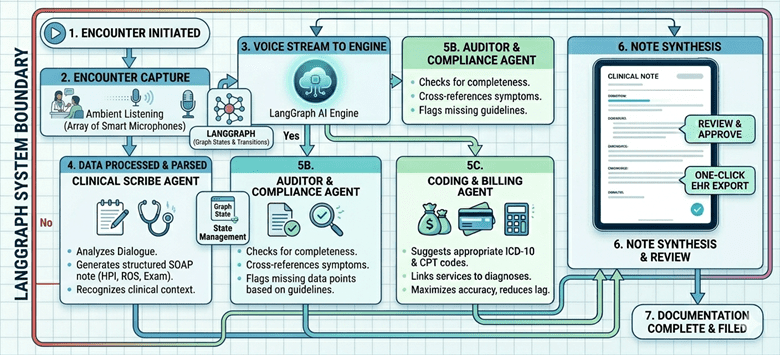
To make the ambient AI system reliable and to have an orchestrated workflow system, it uses LangGraph which helps organize multi-AI agents into a structured step-by-step workflow. Instead of one large AI model doing everything it allows different specialized agents handling a specific task. It makes the system more accurate, scalable and easier to control in complex healthcare environments.
LangGraph enables the system to manage multiple specialized AI agents working together in a structured workflow. It starts with a transcription agent, which converts speech into text by capturing the doctor–patient conversation and turning it into usable data. Once the data is captured, the Clinical NLP agent processes the text and extracts important medical information such as SOAP notes and diagnosis codes, helping the system understand the clinical context accurately. Next, the FHIR Mapping agent transforms this unstructured information into standardized, healthcare-ready structured records, making the data suitable for clinical systems. After that, the EHR Integration agent sends this structured data to the hospital’s EHR system, where the patient’s records are automatically updated as needed.
By dividing tasks across multiple agents, the system becomes more efficient, accurate, and reliable, ensuring smooth data flow and reducing the burden of manual documentation for healthcare providers.

Features of Ambient AI:
Non-Intrusive
Ambient AI works quietly in the background without interrupting the consultation. Doctors do not need to pause and type during patient interactions, allowing the conversation to flow naturally. This enables doctors to stay fully focused on the patient instead of the screen.
Context-Aware
Ambient AI understands the difference between casual conversation and clinically relevant information. It filters out unnecessary dialogue and captures only important medical details. For example, a question like “How are your kids ” is ignored, while a statement such as “Pain in the knee for 3 days” is recorded as clinical data.
Auto-Structuring
Ambient AI automatically organizes the captured information into a structured medical format. It generates SOAP notes, including Subjective (what the patient reports), Objective (clinical observations), Assessment (diagnosis or condition), and Plan (treatment or next steps), ensuring accurate and consistent documentation.
Impact of Ambient AI Technology
Improved Efficiency and Time Savings
Ambient AI reduces the time doctors spend on manual documentation. By automatically generating clinical notes physicians can see more patients and manage their schedules more effectively.
Better Patient Care
With less focus on documentation, doctors can give their full attention to patients. This leads to meaningful interactions, better understanding of patient concerns and results in increased patient care and compliance.
Reduction in Physician Burnout
Ambient AI eliminates the need for after-hours documentation commonly known as “pajama time.” This helps reduce stress and improves work-life balance for healthcare providers.
Compliance and Data Security
Ambient AI supports healthcare regulations by maintaining accurate and structured records ensuring secure handling of patient data. This helps organizations stay compliant with standards like HIPAA.
Transform Clinical Documentation with Ambient AI
The clinical documentation is no longer just an operational challenge, it affects provider efficiency, patient care, and compliance. Ambient AI, combined with multi-agent systems, offers a smarter way to automate documentation, improve accuracy, and allow doctors to focus more on patients.
At WinFully on Technologies, we help you design and implement tailored Ambient AI solutions from LangGraph-based multi-agent systems to seamless EHR integration and HIPAA-compliant workflows.
Reduce documentation workload, enhance patient care, and stay compliant without added complexity.Get in touch with WinFully on technologies to build your AI-powered clinical workflow today.