








Your demand planning team works hard. Your forecasting tools cost a fortune. And yet, you still burned capital on expedited freight last quarter, still wrote off overstock, still heard “that SKU was out of stock” from your top retail accounts.
This is not a talent problem. It is an architecture problem.
Today’s demand is driven by a TikTok video, a competitor markdown, a cold front hitting the Southeast, and a macroeconomic print , simultaneously and without warning. The forecasting systems deployed across most enterprise supply chains were engineered for a world that no longer exists.
| 30-50% Forecast Error Reduced | ~20% Safety Stock Freed | 4-8% Stockout Revenue Saved | Real-Time Market Response |
The $1.7 Trillion Structural Failure
The global retail and CPG industry loses approximately $1.7 trillion annually to the combined impact of out-of-stock events and overstock liquidations. More telling than the number itself is why it persists despite billions invested in demand planning technology.
Legacy statistical models ,even sophisticated ones share a fundamental constraint: they reason backward from history to forecast forward. In environments defined by volatility, this produces forecast error rates of 20–30%, forcing planners to choose between carrying costly safety stock or absorbing stockout losses. Neither is acceptable at scale.
The Core Problem in One Sentence Historical data tells you what customers bought. Agentic AI tells you what they are about to buy and why.
What Agentic AI Demand Sensing Actually Means
Agentic AI for demand sensing is not another forecasting algorithm or a bolt-on ML layer. It is a coordinated system of specialized AI agents each continuously processing a specific category of market signal orchestrated by a reasoning engine that synthesizes their outputs into real-time demand intelligence.
Think of it as the difference between one generalist analyst reviewing last month’s data, and deploying a specialist team that never sleeps, never misses a signal, and updates its conclusions every hour.
The Agent Roster | Specialized Signal Processing
| POS Stream Agent | Ingests real-time point-of-sale transactions; detects regional SKU-level anomalies before they surface in planning reports. |
| Social Trend Agent | Applies LLM-based sentiment analysis to social media, reviews, and influencer activity; identifies demand inflection points before they register in sales data. |
| Weather Intel Agent | Correlates weather forecast data with historical demand patterns for climate-sensitive categories like beverages, apparel, HVAC, seasonal consumables. |
| Competitive Agent | Monitors competitor promotions, pricing moves, and stock availability; alerts to demand transfer events before they impact your POS. |
| Macro Signal Agent | Tracks economic indicators : consumer confidence, inflation, regional shifts, to adjust demand baselines for macro-driven category movements. |
| Supervisor / Orchestrator | Routes workflow via LangGraph state machine; validates signal synthesis; triggers downstream inventory actions; logs every decision for full auditability. |
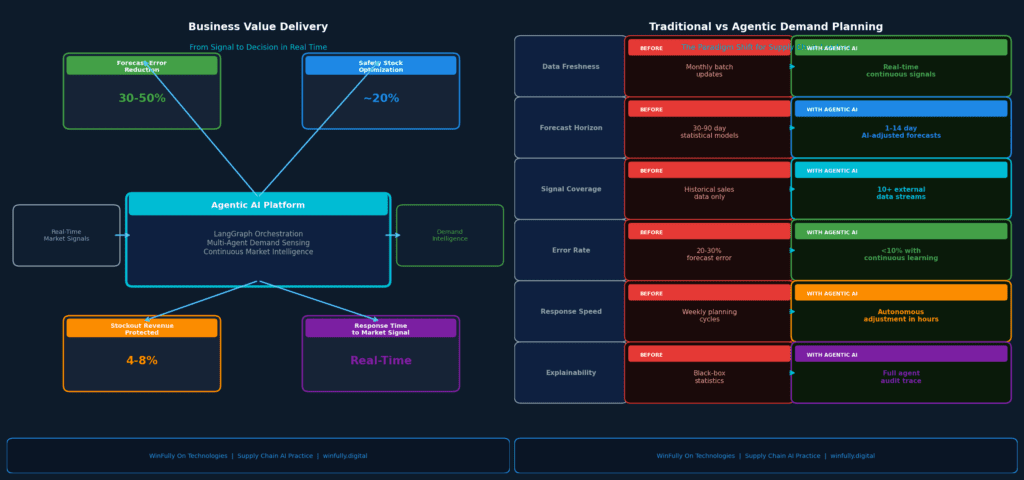
Figure: LangGraph-Orchestrated Multi-Agent Demand Sensing Pipeline — Signal Sources to Actionable Outputs
Why LangGraph ? The Engineering Rationale for Decision Makers
Enterprise supply chain leaders do not need to become AI engineers. But understanding the why behind LangGraph as the orchestration framework shapes your evaluation criteria and vendor conversations.
Traditional ML pipelines are stateless each inference runs independently, with no memory of prior signals or decisions. Supply chain environments require the opposite: a system that remembers that last Tuesday’s social spike preceded a 40% demand surge, that the last time a competitor ran a promotional campaign in Q3, your category saw demand compression for 11 days.
LangGraph provides four capabilities that make it the right infrastructure for this use case:
• Persistent workflow state the system maintains contextual memory across agent interactions, enabling compounding intelligence over time.
• Conditional decision branching , a social sentiment spike activates deeper trend analysis; a weather anomaly reroutes inventory positioning logic.
• Human-in-the-loop checkpoints, high-impact decisions are surfaced for planner validation before execution, maintaining governance without slowing throughput.
• Full execution trace logging , every demand adjustment is traceable to the specific signals and agent reasoning that produced it. This is non-negotiable for enterprise adoption.
The Business Case: What This Changes in Your P&L
The ROI conversation for agentic demand sensing is not abstract. It lives in four measurable line items:
Forecast Error Reduction (30-50%). Short-term forecast error rates drop materially when real-time signals replace lagged statistical extrapolation. For a $500M revenue supply chain, a 30% improvement in forecast accuracy translates to tens of millions in inventory cost avoidance annually.
Safety Stock Optimization (~20%). Better signal coverage reduces the uncertainty buffer that drives excess inventory. Companies consistently demonstrate 15-20% reductions in safety stock requirements freeing working capital without increasing stockout risk.
Stockout Revenue Protection (4-8% of category revenue). Demand sensing identifies surges 24-72 hours ahead of their impact on POS, enabling proactive inventory positioning. Preventing a single stockout event during peak demand can recover millions in lost sales.
Logistics Cost Reduction. Fewer expedited shipments, more efficient warehouse positioning, and reduced inter-DC transfers compound the financial return across your distribution network.
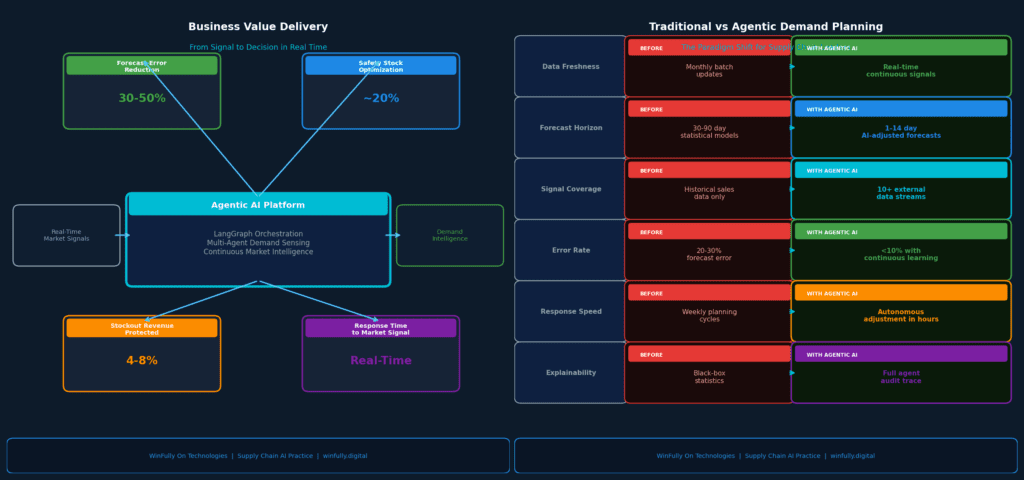
Figure: ROI Impact Model and Traditional vs Agentic Demand Planning Comparison
Implementation Reality: What to Expect
The architecture is designed for phased integration, not rip-and-replace. Most organizations reach full production capability within 16 weeks.
Phase 1 (Weeks 1-4): POS Stream Agent and Social Trend Agent deployed against two or three priority product categories. Baseline forecast comparison established.
Phase 2 (Weeks 5-10): Weather Intelligence and Competitive Agents activated. Signal Bus integrated with ERP/demand planning platform via API connectors.
Phase 3 (Weeks 11-16): Supervisor Agent governance layer enabled. Human-in-the-loop workflow configured with planner validation thresholds. Full audit logging activated.
Phase 4 (Ongoing): Macro Signal Agent and additional category expansion. Model performance measurement against baseline forecast error KPIs.
Built for Enterprise Integration The LangGraph architecture supports native connectivity to SAP IBP, Oracle Fusion SCM, Blue Yonder, and major POS/ERP platforms. Deployment augments your existing planning stack, it does not replace it.
The Decision in Front of Supply Chain Leaders
Supply chain leaders who will define competitive advantage over the next three years are not waiting for certainty before adopting agentic AI. They are building the capability now, in controlled phases, against measurable baselines. The question is not whether autonomous signal processing will replace static forecasting. That transition is already underway across retail, CPG, and distribution. The question is whether your organization captures.
the inventory efficiency and revenue protection benefits in this planning cycle , or concedes that ground to competitors who do.
WinFully On Technologies partners with supply chain organizations to architect and implement production-grade agentic AI demand sensing systems. Our practice combines deep supply chain domain expertise with modern AI engineering, LangGraph, LangChain, RAG architecture, and enterprise integration to deliver solutions that are operational, auditable, and built for the scale of your business.
About WinFully On Technologies
WinFully On Technologies is an Alpharetta, GA-based IT consulting firm specializing in Healthcare IT, Supply Chain & E-Commerce, FinTech, and Government Contracting. Our Supply Chain AI practice delivers end-to-end implementations across demand intelligence, inventory optimization, and enterprise system integration.
winfully.digital | Alpharetta, Georgia | Supply Chain & AI Practice
Discover more from WinFully on Technologies
Subscribe to get the latest posts sent to your email.
