







A technical and strategic primer for fintech executives, risk officers, and lending technology leaders
By WinFully On Technologies | FinTech & Banking Practice
“Your borrower has never missed a rent payment in four years, earns $7,400 a month across three gig platforms, and maintains a healthy savings buffer, yet your scoring model just declined them. The problem is not the borrower. It is the model.”
This scenario plays out millions of times every year inside lending institutions across the country. The conventional credit scoring apparatus -built for a W-2 world-is increasingly misaligned with the financial realities of today’s workforce. For Chief Risk Officers, Heads of Lending Technology, and FinTech product leaders, this misalignment is not just a fairness concern; it is a direct revenue problem.
The addressable market of thin-file and credit-invisible borrowers in the United States alone exceeds 45 million individuals. Most are not high-risk ,they are under-measured. And closing that measurement gap has become one of the most commercially significant opportunities in financial services.
The mechanism to close it is now viable at production scale: multi-agent AI systems, orchestrated through stateful workflow frameworks like LangGraph, can synthesize real-time financial signals from open banking feeds, alternative data sources, and behavioral patterns into explainable, regulator-ready credit decisions, in minutes, not days.
The Structural Problem with Static Credit Scoring
Traditional underwriting relies on a narrow and backward-looking data set. The FICO model, still dominant across most lenders, was designed in an era when employment was stable, income was predictable, and bank accounts contained one stream of earnings. The modern borrower looks very different.
Today, a borrower’s true financial profile is scattered across a dozen data environments: gig platform earnings dashboards, digital wallet transaction histories, buy-now-pay-later accounts, subscription liabilities, peer-to-peer payment apps, and alternative savings vehicles. None of this reliably surfaces in a credit bureau pull.
Three structural consequences flow directly from this data blind spot:
- Missed lending revenue from creditworthy but data-thin applicants incorrectly declined or offered suboptimal terms
- Elevated default rates from approved borrowers whose real-time financial deterioration is invisible until delinquency
- Slow decisioning cycles, often 24 to 48 hours that introduce abandonment risk in digital lending channels where applicants expect near-instant responses
The solution is not incrementalism, slightly wider data pulls or slightly tuned scorecards. The structural answer requires rethinking the underwriting decision as an orchestrated, multi-source intelligence operation. That is exactly what agentic AI enables.
Introducing the Agentic Underwriting Architecture
An agentic credit underwriting system replaces the monolithic scoring model with a coordinated network of specialized AI agents. Each agent is purpose-built to interrogate a specific data domain like cash flow, income classification, liability exposure, credit history, alternative signals, and fraud patterns and contribute structured findings to a shared, stateful decision graph.
The orchestration layer governing these agents is built on LangGraph, a framework designed specifically for stateful, conditional multi-agent workflows. LangGraph models the underwriting process not as a linear pipeline but as a directed graph of decision nodes, where conditional branches route applications dynamically based on evolving risk signals.
Figure 1 — Technical Process Flow
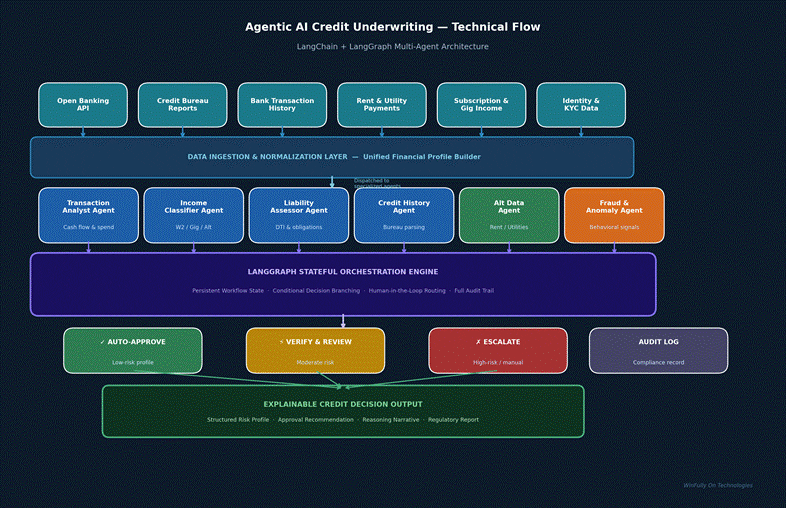
Figure 1: End-to-end agentic credit underwriting flow from multi-source data ingestion through specialized agent analysis, LangGraph orchestration, and explainable decision output
The workflow begins with a unified data ingestion layer that normalizes inputs from Open Banking APIs (Plaid, MX, Finicity), credit bureau pulls, bank transaction histories, and alternative sources including rent payment platforms, utility records, and gig income feeds. This normalized profile is the shared context on which all downstream agents operate.
The Agent Layer: Specialized Intelligence at Every Dimension
Each LangChain agent operates as a domain specialist. The Transaction Analyst Agent examines 12 to 24 months of bank transaction data to identify income volatility, spending discipline, and cash flow cyclicality. The Income Classifier Agent categorizes earnings by source , W-2, freelance, gig, rental, investment and applies stability weighting to each stream.
The Liability Assessor Agent computes real-time debt-to-income ratios by parsing not just reported credit obligations but also subscription services, recurring transfers, and buy-now-pay-later commitments that traditional models miss entirely. The Alternative Data Agent processes rent and utility payment histories, which are statistically predictive of repayment behavior but entirely absent from conventional bureau data.
The Fraud and Anomaly Detection Agent runs behavioral pattern analysis against known fraud signatures, synthetic identity indicators, rapid account cycling, inconsistent income-to-spending ratios adding a risk-gating function before any decision is reached.
Key architectural advantage: Because each agent writes its findings to a shared LangGraph state object, all agents operate with full awareness of upstream conclusions. The Liability Assessor, for example, can adjust its DTI thresholds dynamically in response to income volatility flags raised by the Transaction Analyst. This inter-agent contextual reasoning is not possible in rule-based systems
Figure 2 : System Architecture Block Diagram
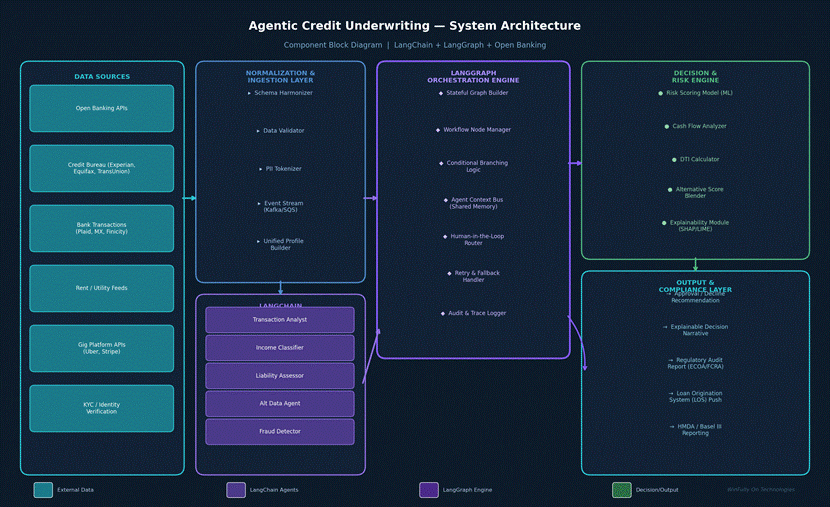
Figure 2: Component architecture of the agentic underwriting system — data normalization, LangChain agent layer, LangGraph orchestration engine, and compliance-ready output layer
LangGraph: The Orchestration Engine That Changes Risk Decisioning
LangGraph’s stateful graph architecture is the enabling technology that transforms a collection of individual agents into a coherent underwriting system. Its four critical capabilities for lending applications are worth examining in detail.
Persistent Workflow State
Unlike stateless API chains, LangGraph maintains a live state object throughout the entire underwriting session. Every agent reads from and writes to this shared context, enabling downstream agents to reason about upstream findings rather than operating in isolation. This produces significantly more accurate risk profiles, particularly for complex borrower profiles.
Conditional Decision Branching
LangGraph routes applications through dynamic decision paths based on real-time risk signals. Low-risk profiles ,stable income, clean payment history, low liability-to-income ratio, are flagged for automated approval. Moderate-risk cases trigger a verification workflow, prompting requests for additional documentation or manual analyst review. High-risk cases are escalated with full agent reasoning attached.
Human-in-the-Loop Integration
For borderline cases, LangGraph surfaces the full agent context , every signal analyzed, every threshold triggered, to the reviewing credit analyst. This is not a black-box recommendation with a score attached; it is a structured briefing that enables faster, better-informed human decisions. Analysts stop being data processors and become judgment exercisers.
Regulatory Compliance by Design
Every agent action, data access event, and decision node is logged automatically through LangGraph’s audit trail. For compliance with ECOA, FCRA, and emerging AI fairness regulations, this produces the documentation trail that examiners require, without manual reconstruction.
Business Impact: The Measurable Case for Adoption
| Metric | Traditional Underwriting | AI-Agentic System | Improvement |
| Decision Time | 24 – 48 hours | 5 – 15 minutes | 60–80% faster |
| Operational Cost | Baseline | Reduced | 30–50% savings |
| Loan Approvals | Baseline | Expanded | +20–35% approvals |
| Default Detection | Baseline | Improved | 25–40% accuracy |
These are not theoretical projections. The components of this architecture are Open Banking API integration, LangChain agent frameworks, LangGraph orchestration are production-proven technologies. The question for lending technology leaders is not whether this architecture works; it is how quickly your institution can deploy it.
The competitive pressure is real. Digital-native lenders and fintech challengers are already leveraging real-time financial data to approve borrowers that traditional institutions decline. Every percentage point of conversion improvement in digital lending channels translates directly to revenue growth and market share.
Implementation Pathway for Lending Institutions
Deployment can be structured across three phases to manage integration risk while delivering measurable value at each stage.
- Phase 1: Data Foundation (Weeks 1–8): Establish Open Banking API integrations, normalize data schemas across bureau and alternative sources, and deploy the unified profile builder. This phase de-risks the data layer that all subsequent agent capabilities depend on.
- Phase 2: Agent Deployment (Weeks 9–16): Deploy the Transaction Analyst, Income Classifier, and Liability Assessor agents against new application volumes. Run parallel scoring against existing models to validate performance and calibrate agent parameters.
- Phase 3: Orchestration and Compliance (Weeks 17–24): Activate LangGraph orchestration with conditional branching, human-in-the-loop workflows, and the full regulatory audit trail. Deploy to production underwriting volumes with monitoring dashboards.
The Strategic Imperative
Credit underwriting is one of the highest-value decisions a financial institution makes and it is currently being made with incomplete information, static models, and multi-day cycle times. The gap between what your current system knows about a borrower and what an agentic AI system can know is, at this point, a directly measurable competitive disadvantage.
The technology stack to close that gap LangChain, LangGraph, Open Banking APIs, and explainable ML risk models is available, integrated, and deployable within a standard enterprise implementation timeline. The institutions that move now will establish a durable underwriting capability advantage over those that wait.
| WinFully On Technologies delivers end-to-end agentic AI and FinTech solutions , from architecture design and agent development through regulatory compliance consulting and cloud deployment. Our FinTech practice works with banks, credit unions, and digital lenders to modernize underwriting, fraud detection, and risk decisioning infrastructure. Reach us at contactus@winfully.digital or visit winfully.digital. |
WinFully On Technologies | winfully.digital | FinTech & Banking Practice
Discover more from WinFully on Technologies
Subscribe to get the latest posts sent to your email.
