








INTECH INSIGHTS | COMPLIANCE AUTOMATION
From 15 Days to 15 Minutes: How Agentic AI Is Redefining KYC/AML Compliance
A practical look at multi-agent workflow orchestration with LangGraph and why your compliance team deserves a better architecture.
WinFully On Technologies, LLC | FinTech Practice | March 2026
| 15 min Avg. onboarding with Agentic AI vs. 15 days manual | 50–70% Reduction in manual compliance workload | 30–50% Fewer false positives from AI-powered screening |
The Real Cost of Manual KYC/AML Is Not What You Think
Every compliance leader knows the headline numbers: onboarding backlogs, rising headcount, and escalating regulatory scrutiny. But the less-discussed cost is strategic. When your compliance infrastructure cannot scale intelligently, every growth milestone , a new product launch, an expanded market, a surge in digital applications becomes a hiring event. That is not a compliance problem. It is a business architecture problem.
Consider the compounding effects: a mid-sized digital bank processing 10,000 monthly onboarding applications allocates 60–80% of compliance analyst time to repetitive verification tasks document review, watchlist screening, PEP cross-checks. These are deterministic, rule-following activities. They are also the activities most vulnerable to human error, inconsistent application of standards, and audit gaps.
The business case for rethinking this architecture has never been stronger. The question is no longer whether to automate compliance workflows it is whether your automation approach is intelligent enough to be defensible.
The question is no longer whether to automate compliance workflows, it is whether your automation approach is intelligent enough to be defensible.
What Agentic AI Brings to Compliance That RPA Cannot
Traditional robotic process automation (RPA) and rule-based screening engines introduced efficiency gains but they created a new set of problems. Brittle decision trees that break when regulations change. High false-positive rates that overwhelm analysts. No contextual reasoning across multiple data signals. And critically, limited auditability when regulators ask why a decision was made.
Agentic AI takes a fundamentally different approach. Instead of a single model executing a linear checklist, an agentic system deploys multiple specialized AI agents each with a defined role, access to relevant data sources, and the ability to reason, escalate, and collaborate with other agents. The result is a compliance engine that mirrors how your best human analysts think, but operates at machine speed with full traceability.
A mature agentic KYC/AML pipeline orchestrates five specialized agents working in concert:
- A Document Intelligence Agent that uses LLM-based OCR to extract, validate, and flag anomalies in identity documents
- A Sanctions Screening Agent that checks global watchlists including OFAC, UN, EU by using fuzzy matching to cut false positives
- A PEP & Adverse Media Agent that cross-references political exposure databases and real-time media feeds
- A Risk Scoring Agent that aggregates multi-source findings into a weighted, explainable compliance score
- A Supervisor Agent that makes the final routing decision: auto-approve, escalate to human review, or flag and reject
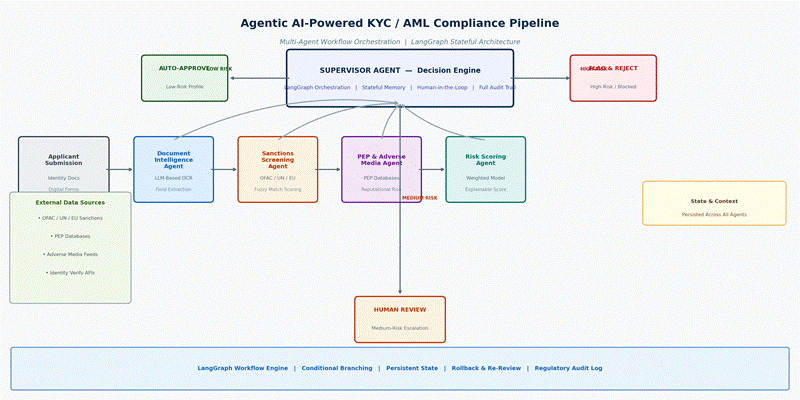
Figure 1: Multi-Agent KYC/AML Pipeline Flow , Five Specialized Agents Orchestrated by LangGraph Supervisor
Why Orchestration Architecture Is the Differentiator
Individual AI agents are powerful. Orchestrated AI agents are transformative. The difference lies in how context, state, and decisions are managed across the workflow, and this is precisely where most point solutions fall short.
LangGraph addresses this as a graph-based workflow framework purpose-built for stateful, multi-agent LLM applications. Unlike linear pipelines, LangGraph structures compliance workflows as graphs where nodes represent specialized agents and edges define conditional transitions based on risk signals. This architecture delivers capabilities that directly address enterprise compliance requirements:
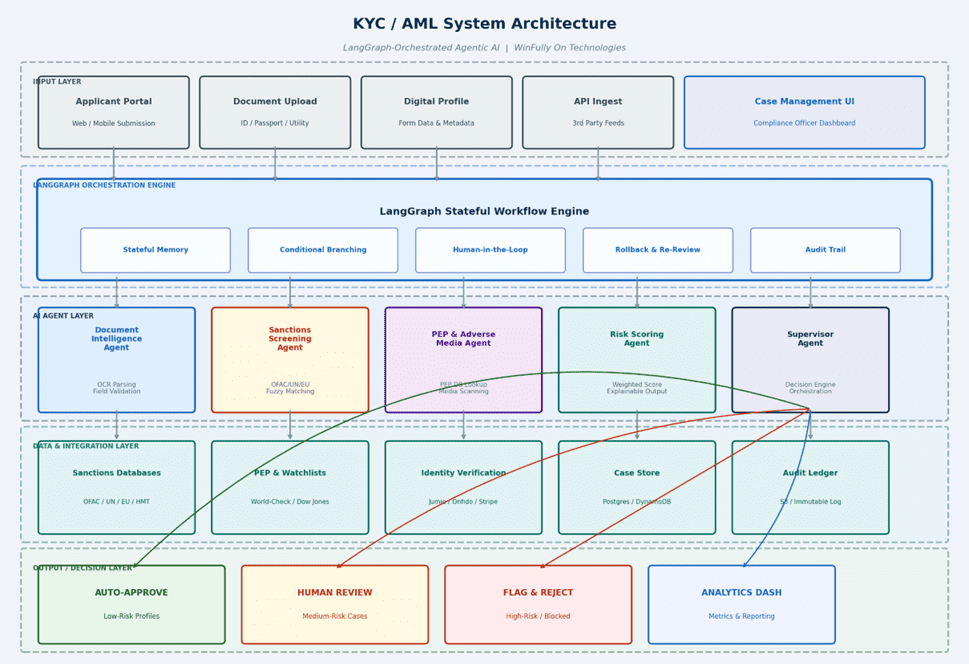
Figure 2: System Architecture Block Diagram, Five-Layer Design from Applicant Input to Compliance Output
The ROI Case: Speed, Cost, and Risk Reduction
Enterprise technology investment decisions live and die on business outcomes. The ROI case for an Agentic AI KYC/AML pipeline is direct and measurable across three dimensions.
Onboarding Velocity. Processing time compresses from 5–15 business days to 10–20 minutes for standard-risk profiles. For digital-first banks and FinTech platforms where onboarding conversion is a direct revenue driver, a 30–40% improvement in completion rates translates to measurable top-line impact, not a future projection, but an immediate operational change.
Compliance Cost Structure. Automating 50–70% of repetitive verification tasks does not eliminate your compliance team, it elevates it. Analysts shift from routine document reviews to high-value investigation and edge-case reasoning. Organizations implementing agentic compliance workflows have reported 40–60% reductions in per-case processing cost while improving decision accuracy.
Audit Readiness and Regulatory Risk. The 2024 regulatory environment has made explainability non-negotiable. Every AI-assisted decision must be documentable, traceable, and defensible. LangGraph’s architecture logs the complete decision chain by default. Organizations using fully traceable AI compliance pipelines have reported a 20–30% reduction in audit remediation costs and significantly faster examination cycles.
What This Means for Your Compliance Roadmap
Implementing an agentic KYC/AML pipeline is not a single-sprint project. It is an architectural decision that reshapes how your compliance function scales. The organizations moving fastest are starting with a targeted deployment, typically the document verification and sanctions screening agents, demonstrating measurable ROI, and then expanding the agent graph incrementally.
Key implementation considerations for compliance and technology leaders include:
- Model Selection and Prompt Engineering: The quality of agent reasoning depends heavily on LLM choice and system prompt design. Fine-tuning for compliance-specific terminology and regulatory frameworks significantly improves output reliability.
- Integration Architecture: Agent workflows must connect to live sanctions databases, PEP registries, and identity verification APIs. The orchestration layer, LangGraph in this architecture and manages these integrations, but they require careful API design and fallback logic.
- Human-in-the-Loop Design: The threshold between automated approval and human escalation is a policy decision, not a technical one. Defining risk scoring bands in collaboration with your compliance and legal teams before implementation is essential.
- Regulatory Alignment: In regulated markets, AI-assisted compliance decisions may require explainability documentation. Ensure your architecture logs are formatted to meet examination standards in your primary jurisdictions, BSA/AML, MiFID II, GDPR, or others as applicable.
The organizations moving fastest are starting with targeted deployments , proving ROI with two agents then expanding the architecture incrementally.
The Competitive Imperative
Digital banking is a conversion game. Every friction point in the onboarding funnel is a competitive disadvantage. And in an environment where compliance failures carry both financial penalties and reputational consequences, the margin for error is shrinking.
Agentic AI-powered compliance is not a luxury for well-resourced institutions. It is becoming the baseline expectation for any FinTech or digital bank competing for customers who expect account opening in minutes, not weeks. The technology is mature, the implementation patterns are established, and the ROI evidence is compelling.
The real question for compliance and technology leaders is not whether to modernize, it is whether to lead the transition or manage it reactively.
About WinFully On Technologies
WinFully On Technologies is an IT consulting and implementation firm specializing in Healthcare IT, FinTech/Banking, and Supply Chain/E-Commerce solutions. Our FinTech practice delivers AI-driven compliance automation, digital banking architecture, and regulatory technology implementations for institutions navigating complex, high-stakes environments. To explore how an Agentic AI KYC/AML pipeline applies to your organization, contact our team at winfully.digital.
Discover more from WinFully on Technologies
Subscribe to get the latest posts sent to your email.
