







WinFully on Technologies | Healthcare AI & Interoperability Insights
March 2026
Introduction: The Administrative Bottleneck in Home Health
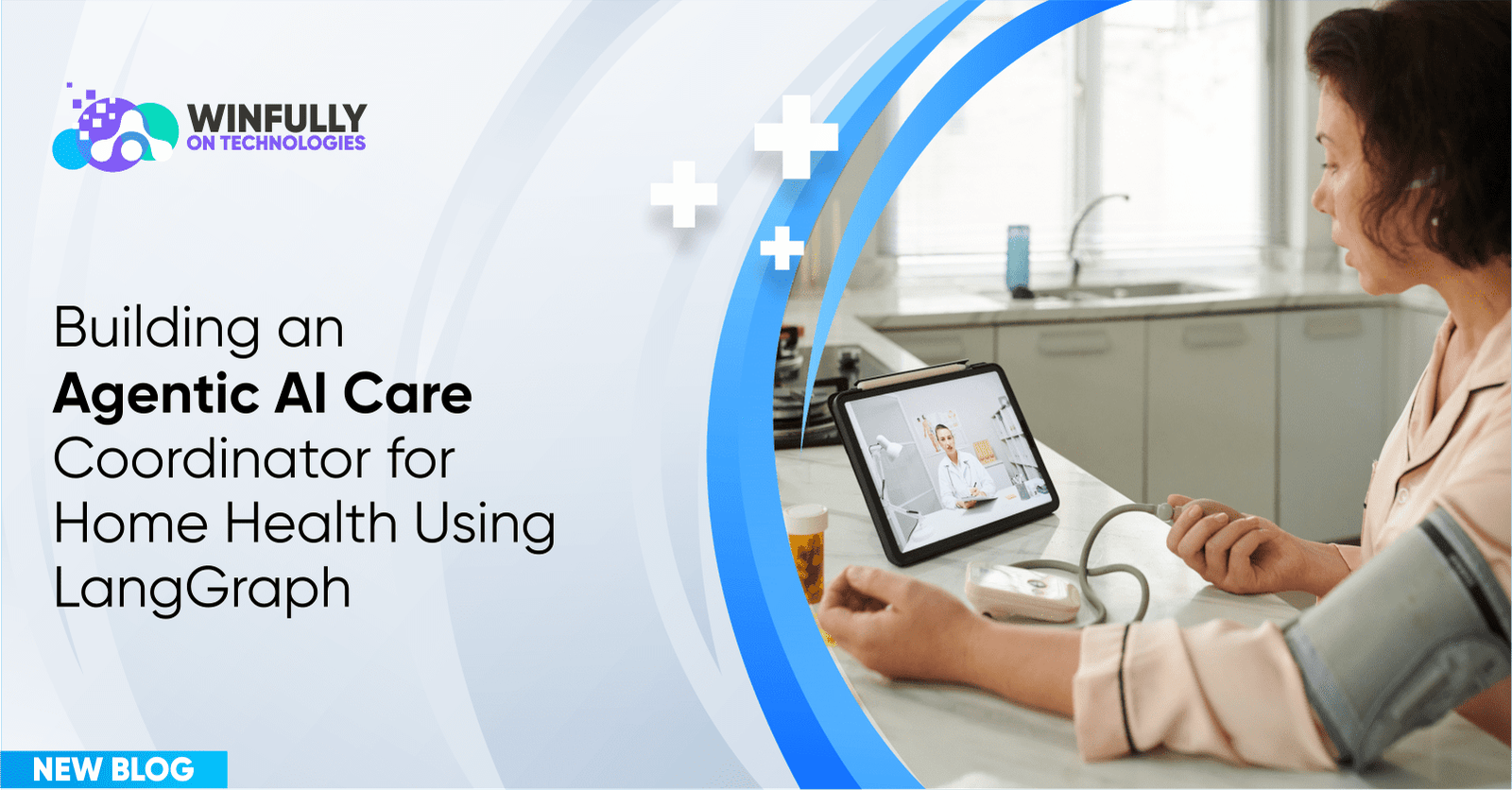
Home health agencies are the backbone of patient-centered care delivery, providing personalized medical services in the comfort of a patient’s home. Yet behind every successful patient visit lies an enormous administrative burden care plan creation, nurse scheduling, clinical documentation, progress tracking, and regulatory compliance. These operational tasks consume up to 40% of staff time, diverting clinicians from what matters most: direct patient care and meaningful clinical engagement.
The healthcare industry is now at an inflection point. According to Deloitte’s 2026 US Health Care Outlook Survey, over 80% of healthcare executives expect both agentic AI and generative AI to deliver moderate-to-significant value across clinical, business, and back-office functions. Meanwhile, Microsoft’s research published in the New England Journal of Medicine found that 60% of healthcare leaders believe agentic AI will meaningfully improve the provider-patient experience. The question is no longer whether to adopt AI, but how to deploy it strategically and responsibly.
This is where Agentic AI powered by LangGraph enters the picture, offering home health agencies an intelligent, autonomous care coordination system that goes far beyond traditional software tools.
What Is Agentic AI and Why Does It Matter for Home Health?
Agentic AI represents a fundamental shift from passive, prompt-driven tools to autonomous, goal-oriented systems. Unlike generative AI – which creates content such as clinical summaries or documentation drafts agentic AI can plan, reason, execute tasks, and manage entire workflows across multiple systems without constant human intervention.
In the context of home health care, the difference is transformative. A traditional AI tool might respond to a query such as “What is this patient’s blood pressure trend?” with a summary. An agentic AI system, by contrast, proactively monitors the trend, cross-references pharmacy records, identifies a missed medication refill, sends a reminder to the patient, and schedules a telehealth check-in with the nurse all autonomously.
For home health agencies, agentic AI can autonomously generate patient-specific care plans based on medical history and current conditions, schedule and optimize nursing visits while balancing workload and geography, trigger real-time alerts for follow-ups or urgent clinical interventions, and update electronic health records (EHR) and documentation without manual data entry.
61% of healthcare organizations are already building or have secured budgets for agentic AI initiatives (Deloitte, 2026)
Why LangGraph? The Framework Behind Intelligent Care Workflows
LangGraph is a graph-based AI orchestration framework within the LangChain ecosystem, purpose-built for constructing stateful, multi-step agent workflows. Unlike linear automation chains, LangGraph structures tasks as nodes in a directed graph each node representing a decision point, an action, or a data source connected by edges that define conditional execution paths.
This architecture is uniquely suited for healthcare because clinical workflows are inherently non-linear. A patient’s Admit-Discharge-Transfer (ADT) event does not follow a simple sequence; it triggers a cascade of interconnected actions: updating the care plan, notifying the assigned nurse, scheduling a follow-up visit, reconciling medications, and potentially alerting the physician about abnormal lab results all of which depend on contextual data from multiple systems.
Key LangGraph Capabilities for Healthcare
Graph-Based Reasoning: Links patient events (ADT, vitals, lab results) to clinical actions through structured knowledge graphs, maintaining context across multi-step processes.
FHIR & HL7 Integration: Processes standardized healthcare data through FHIR APIs, connecting EHR, LIS, RIS, and HIE systems for seamless interoperability and real-time data exchange.
Persistent State Management: Maintains patient context across sessions, ensuring continuity of care coordination even as conditions evolve over days or weeks.
Conditional Routing: Dynamically adjusts workflows based on clinical outcomes for example, escalating a routine follow-up to an urgent intervention if new lab results indicate deterioration.
How the Agentic Care Coordinator Works: A Step-by-Step Workflow
Step 1 | Real-Time Data Ingestion: Patient ADT events, clinical notes, vitals, and prior visit data are collected in real time through FHIR-compliant APIs. The system integrates with existing EHR platforms and healthcare data exchange networks, pulling structured data from HL7 feeds and CCDA documents.
Step 2 | Graph-Based Clinical Reasoning: LangGraph creates a dynamic knowledge graph that links each patient event to potential clinical and administrative actions. A hospital discharge event automatically triggers follow-up visit scheduling, medication reconciliation, care plan updates, and home safety assessment coordination.
Step 3 | Autonomous Action Execution: The AI agent executes routine tasks autonomously: scheduling visits, sending alerts to nurses, updating care plans, and generating clinical documentation. For critical decisions, a human-in-the-loop checkpoint ensures clinical oversight.
Step 4 | Continuous Learning and Feedback: Completed tasks and nurse confirmations feed back into the graph, refining future decisions. The system identifies workflow bottlenecks, optimizes scheduling patterns, and adapts care protocols based on patient response data over time.
Measurable Impact: ROI and Performance Metrics
Implementing an agentic AI care coordinator delivers quantifiable results across operations, clinical quality, and financial performance. Industry data from Deloitte shows that 98% of surveyed healthcare executives expect at least 10% cost savings from agentic AI within two to three years, with 37% expecting savings above 20%.
30-40% Reduction in Administrative Workload: Automating care plan generation, scheduling, and documentation cuts manual data entry significantly, freeing nurses to increase patient visit capacity.
20-30% Improvement in Scheduling Accuracy: Intelligent scheduling optimization reduces missed, delayed, or duplicate visits while balancing nurse workload and travel efficiency.
10-15% Reduction in Hospital Readmissions: Real-time patient monitoring and proactive clinical alerts ensure timely interventions that prevent complications and unnecessary re-hospitalizations.
15-25% Operational Cost Savings: Efficiency gains across workflows reduce overtime costs, while increased patient capacity enables revenue growth without proportional staffing increases.
Healthcare Interoperability: The Foundation for Agentic Intelligence
Agentic AI is only as powerful as the data infrastructure that supports it. Seamless healthcare interoperability connecting disparate systems through standardized protocols like HL7, FHIR, DICOM, and CCDA is the critical foundation that enables AI agents to access, interpret, and act on patient data across the care continuum.
For home health agencies, this means connecting EHR platforms, practice management (PM) systems, laboratory information systems (LIS), radiology information systems (RIS), and health information exchanges (HIE) into a unified data layer. Without robust interoperability, even the most sophisticated AI agent cannot function effectively, it would lack the real-time patient context needed to make autonomous clinical decisions.
Organizations like WinFully on Technologies (winfully.digital) specialize in precisely this intersection of healthcare interoperability and AI innovation. With deep expertise in FHIR-based integrations, healthcare data exchange, and compliance frameworks (HIPAA, HITECH, SOC-2), they help healthcare providers, payers, and life science organizations build the data infrastructure that makes agentic AI possible.
Beyond Home Health: Agentic AI Across Healthcare Segments
While home health agencies stand to gain enormously from agentic care coordination, the same technology framework applies across the broader healthcare ecosystem:
Healthcare Providers (Hospitals, Clinics, Specialty Care): Automated prior authorization, discharge planning, post-visit follow-ups, and clinical documentation coding ,all orchestrated by AI agents that connect with EHR, scheduling, and billing systems.
Health Plans and Payers: Claims processing automation, utilization management, and member engagement workflows. Gartner predicts that all surveyed payer organizations plan to deploy agentic AI by 2028.
Life Science and Pharma: Clinical trial patient recruitment, adverse event monitoring, drug interaction analysis, and regulatory documentation automation powered by AI agents working across research databases and FHIR-compliant health records.
Conclusion: From Reactive to Proactive Care Delivery
Agentic AI powered by LangGraph represents more than an incremental technology upgrade for home health agencies it is a paradigm shift in how care is coordinated, delivered, and optimized. By combining autonomous AI agents with graph-based clinical reasoning and FHIR-compliant healthcare interoperability, organizations can transform their operations from reactive task management to proactive, intelligent care orchestration.
The evidence is compelling: administrative burden drops by up to 40%, clinical outcomes improve through timely interventions, scheduling accuracy increases by 20-30%, and agencies can scale patient capacity without proportional staffing increases. For leadership teams evaluating their digital transformation roadmap, agentic AI is no longer a future aspiration , it is a present-day imperative.
As healthcare moves toward a future where intelligent automation handles routine complexity and clinicians focus on high-value patient interactions, the organizations that invest in the right interoperability infrastructure and AI capabilities today will define the standard of care tomorrow.
Ready to Build Your Agentic AI Healthcare Solution?
WinFully on Technologies helps healthcare organizations design and implement interoperability infrastructure, AI-powered workflows, and compliant digital solutions.
Contact us at contactus@winfully.digital | Visit winfully.digital
Discover more from WinFully on Technologies
Subscribe to get the latest posts sent to your email.