
Automating PO Exception Handling: Agentic AI Approach to Procure-to-Pay Friction
Agentic AI built with LangChain and LangGraph resolves 70-80% of purchase order exceptions automatically, cutting procure-to-pay costs and delays.
Enterprise procurement is supposed to run efficiently: keep costs down, keep suppliers in sync. In practice, procure-to-pay (P2P) workflows keep hitting the same wall, purchase order (PO) exceptions that need someone to step in by hand. Between 40 and 60 percent of purchase orders end up needing that kind of intervention, usually because of a pricing inconsistency, a quantity mismatch, a delivery schedule conflict, or a specification that doesn't line up.
Every one of those exceptions costs something. Resolving a single one runs $50 to $200 and pushes the procurement cycle out by three to seven days. Now scale that to an enterprise processing more than 100,000 purchase orders a year: the hidden costs run into the millions, operations slip, and supplier relationships take the hit.
Traditional ERP systems were never built for this kind of moving-target complexity. They lean on static rules and human oversight, so they can't adapt on the fly. What procurement needs instead is a system that understands context, reasons across several data sources at once, and can act on its own. That's the gap Agentic AI, built on LangChain and LangGraph, is designed to close.
Limitations of Traditional PO Exception Handling
When an exception comes up, traditional systems put a person on it. Someone cross-checks the PO against the contract, validates pricing against the catalog, gets on the phone or email with the vendor, and edits the order by hand. It's slow, and every manual step is another chance for an error to creep in.
Fragmented data makes it worse. The information you need to resolve an exception is spread across ERP platforms, contract lifecycle management systems, supplier catalogs, email threads, and logistics tools. Those systems rarely talk to each other, so pulling the picture together takes time and leaves gaps in consistency and visibility.
Then there are the rules themselves. Most systems validate against fixed thresholds, a hard price ceiling, a set quantity tolerance. That works for the easy cases. It falls apart the moment contracts carry variable pricing, a supplier negotiates a one-off, or the market moves. The rigidity leaves teams without a good way to handle the messy, real situations that actually show up.
Supplier communication is the last snag. Sorting out an exception usually means several rounds of email, clarifications, and back-and-forth negotiation. All of it is manual and unstructured, which drags things out and wears on procurement teams and suppliers alike.
What Is Agentic AI for Procurement?
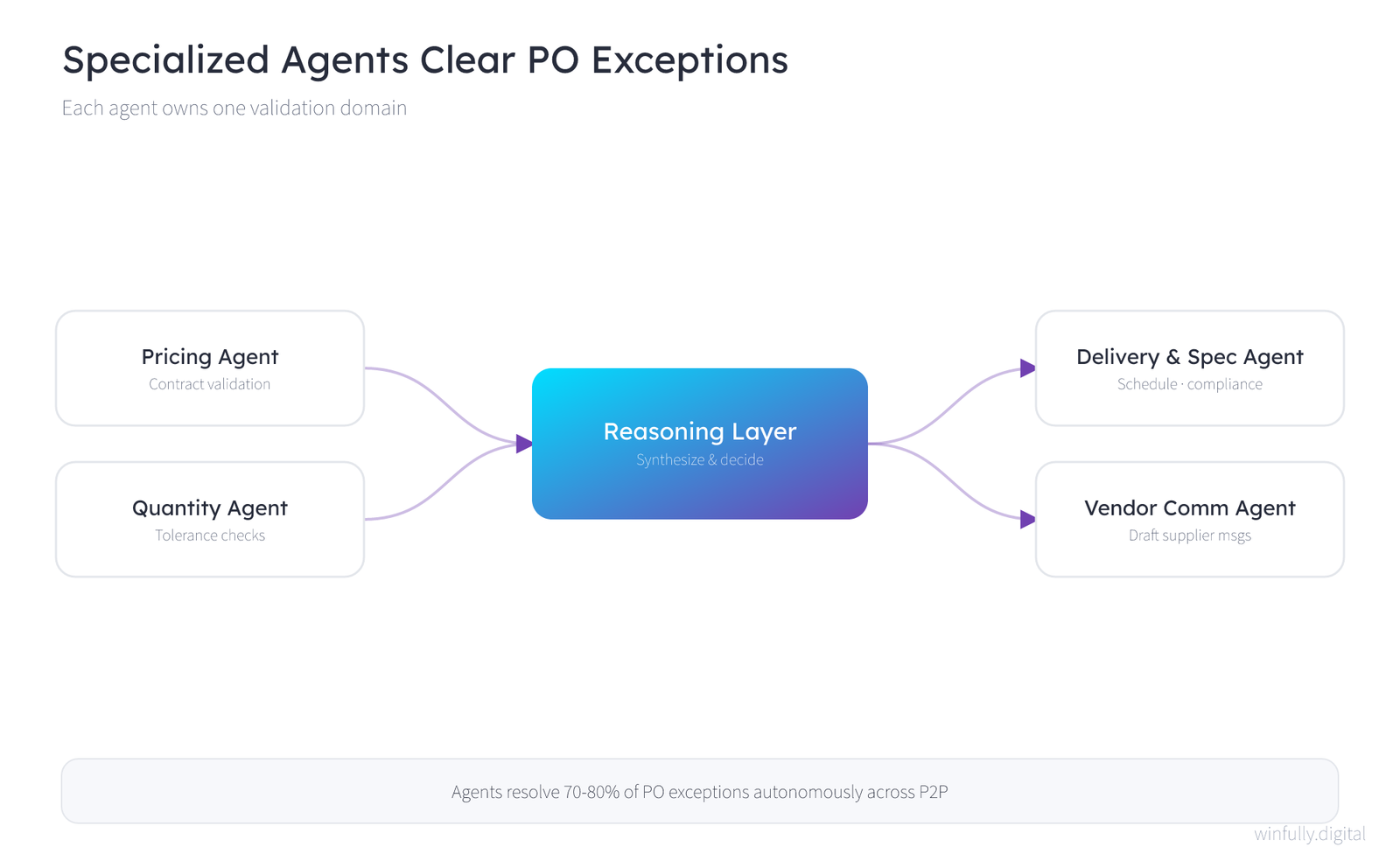
Agentic AI turns exception handling into a multi-agent system. Rather than static rules or one process making every call in isolation, it runs a network of specialized agents that work together to analyze, interpret, and resolve exceptions on their own.
Each agent owns a piece of the validation. One checks pricing against contracts and past orders. Another weighs quantity tolerances or delivery constraints. Others confirm specification compliance, and one handles vendor communication by drafting and managing the responses. Above them sits a reasoning layer that pulls all the inputs together and picks the right move, whether that's auto-approval, an adjustment, a negotiation, or an escalation.
The effect is a system that behaves less like rigid automation and more like an experienced buyer, adapting to context instead of forcing every case through the same rule.
What Is LangGraph and Why It Matters for P2P Workflows
LangGraph is what makes this practical. It's a framework for building stateful, multi-agent workflows. Where a traditional pipeline runs in a straight line, LangGraph models the process as a graph: each node is a task or agent, and each connection is a decision path.
That fits procurement well, because exception handling is conditional by nature. A pricing issue might need contract validation; a delivery conflict might kick off a supplier negotiation. Different situations call for different paths, and LangGraph lets the system pick one while holding onto context the whole way through.
It also remembers. The system carries knowledge of past transactions, how a given supplier tends to behave, and how similar exceptions were resolved before, so its decisions get sharper over time. And every action it takes is traceable, which is exactly what you need for compliance, auditing, and enterprise governance.
Technical Approach: Agentic AI Workflow with LangChain and LangGraph
Workflow Overview
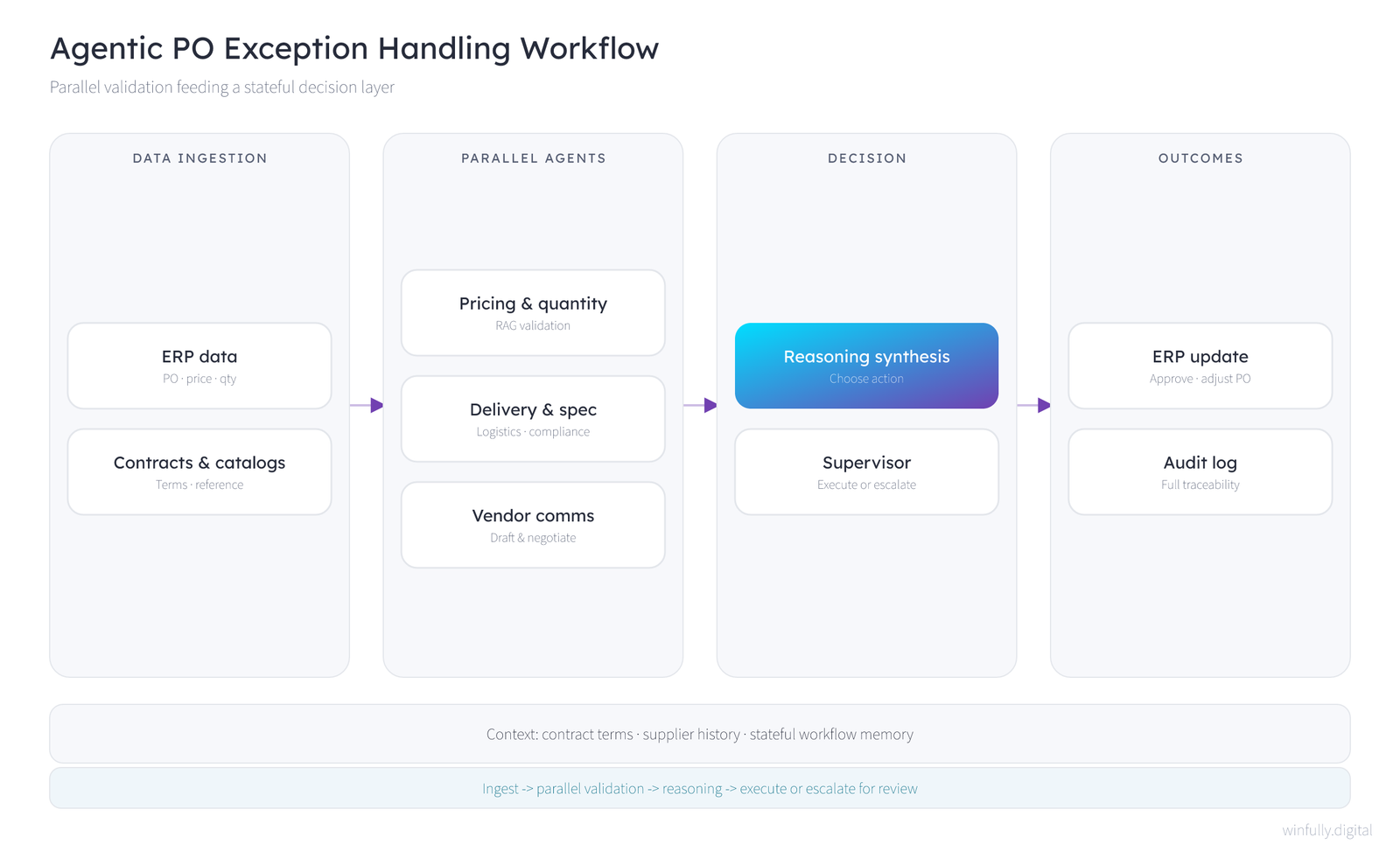
The system pairs LangChain's data processing with LangGraph's orchestration to run exception handling as a structured, intelligent workflow. It works as a continuous pipeline, each step building on the one before it.
Step 1: Data Ingestion from ERP Systems
It starts by pulling purchase order data from ERP systems: pricing, quantities, delivery schedules, and supplier details. Everything downstream builds on this.
Step 2: Parallel Agent Analysis
Several specialized agents process the data at once, each on its own area, pricing, quantities, delivery, specifications. Running them in parallel keeps things both fast and accurate.
Step 3: Pricing and Contract Validation
Pricing is checked with a retrieval-augmented approach: the system references contracts, supplier catalogs, and historical data to confirm it matches the agreed terms.
Step 4: Quantity and Tolerance Checks
Quantity deviations are weighed against past purchasing patterns to decide whether they're acceptable or need a closer look.
Step 5: Delivery and Specification Validation
Delivery schedules are checked against logistics constraints and dependencies, and product specifications are verified against contract and catalog requirements.
Step 6: Vendor Communication Handling
A communication agent drafts and manages the supplier back-and-forth, clarifications, negotiations, updates, so people don't have to chase it.
Step 7: Reasoning and Decision Synthesis
A central reasoning agent takes in everything the others found and settles on the action, approve, adjust, or escalate.
Step 8: Supervisory Control and Execution
A supervisory layer carries out the final decision: updating the ERP, approving the PO, or sending the tricky cases to a person for review.
Step 9: Auditability and Continuous Tracking
Every step is logged, which gives you a complete audit trail. That keeps the process transparent, supports compliance, and gives the system a record to learn and improve from over time.
Key Capabilities of LangGraph for PO Exception Handling
- Unified Multi-Agent Validation: Several agents evaluate pricing, quantities, schedules, and specifications together, so decisions stay accurate and consistent.
- Context-Aware Decision Making: Decisions weigh contract terms, supplier history, and business priorities, not just fixed thresholds.
- Automated Vendor Communication: The system writes clear, context-aware messages to suppliers, cutting delays and manual effort.
- Stateful Workflow Memory: It holds onto past interactions and learns from patterns to handle the next exception better.
- Explainable Decision Logging: Every decision is recorded with its reasoning, which makes auditing straightforward.
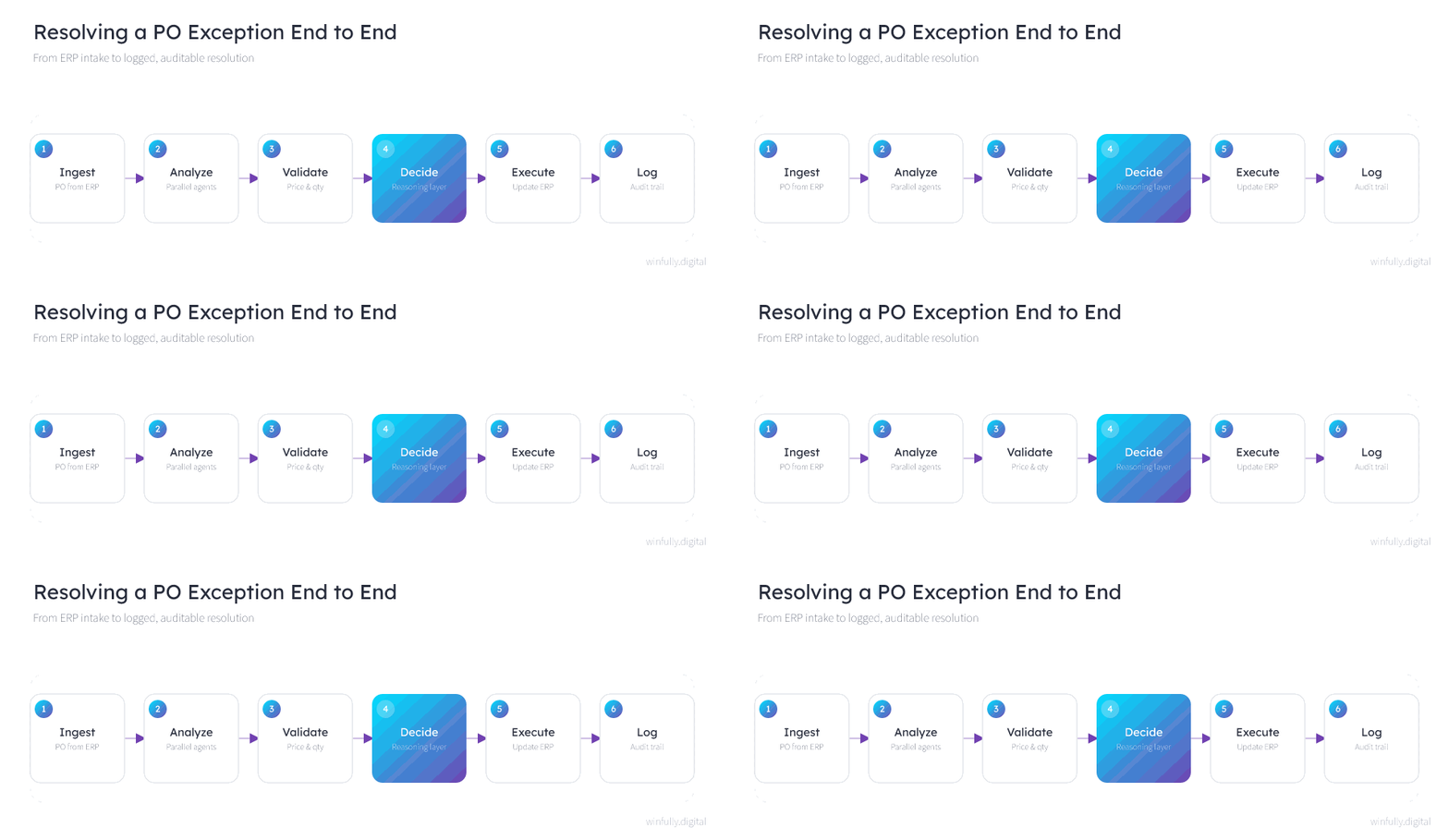
Put end to end, these steps form a single autonomous loop that carries a flagged purchase order from ERP intake to a logged, auditable resolution.
Business Value and ROI
Automated Exception Handling — Resolve 70–80% of PO exceptions automatically and take that load off the team.
Faster Cycle Times — Cut procurement cycle time by around 40%.
Cost Savings — Save $3–5 million a year at large enterprises through better efficiency and less manual work.
Better Supplier Experience — Faster, clearer communication means smoother collaboration and fewer delays.
Scalable Operations — Take on more PO volume without adding headcount.
Conclusion
PO exception handling has been a quiet drain on procurement for years. The individual costs and delays are easy to miss, but they add up to something real.
Agentic AI, with LangGraph handling stateful orchestration and LangChain handling data integration, is a strong answer. Turn exception handling into an intelligent, autonomous process and you take out the friction, bring costs down, and lift procurement performance across the board.
This is more than automation. It's a different model of procurement, one where the system reasons, adapts, and keeps tuning its decisions as it goes.
For procurement leaders and enterprise technology teams, this isn't just an upgrade. It's a step toward a procurement operation that's genuinely intelligent and hard to knock off course.