
Autonomous Supplier Risk Monitoring: From Reactive Firefighting to Predictive Resilience with LangChain
Agentic AI built with LangChain and LangGraph enables continuous, autonomous supplier risk monitoring, detecting disruptions before they hit operations.
Supply chains have never been more exposed. Volatility, geopolitical friction, climate events, and financial instability all land on the same doorstep, and most large organizations depend on supplier networks that stretch across regions, logistics providers, and regulatory regimes. Those networks buy you efficiency and lower costs. They also multiply the ways things can go wrong.
A supplier problem can start almost anywhere: financial distress, political upheaval, a new regulation, a shipping delay, an ESG violation, or a reputational story that spreads on social media before your team ever hears about it. Yet most companies still lean on periodic supplier assessments and manual monitoring, which simply can't keep pace with threats that move this fast.
Industry studies suggest that supply chain disruptions cost companies an average of $184 million annually, and most organizations only find out about supplier issues after the damage is done. The core problem is structural: traditional risk management gives you static snapshots when what you need is a live feed.
What you actually want is a real-time intelligence layer, something that watches supplier risk signals around the clock, makes sense of emerging threats, and tells you what to do about them before they turn into a fire.
That is exactly what agentic AI systems built with LangChain and LangGraph make possible.
Limitations of Traditional Supplier Risk Management
Most risk management programs are built on periodic reviews, static scorecards, and manual monitoring. They give you a baseline, but they were never designed for the speed and sprawl of a global supply chain. Four weaknesses show up again and again.
Periodic Assessments Create Blind Spots
Plenty of organizations still review supplier risk once a quarter or once a year, through audits and questionnaires. The trouble is that a supplier's condition can shift in days: a bankruptcy signal, a regulatory penalty, a broken logistics link. By the time any of that surfaces in a formal assessment, the disruption is usually already in motion.
Fragmented Risk Signals Across Systems
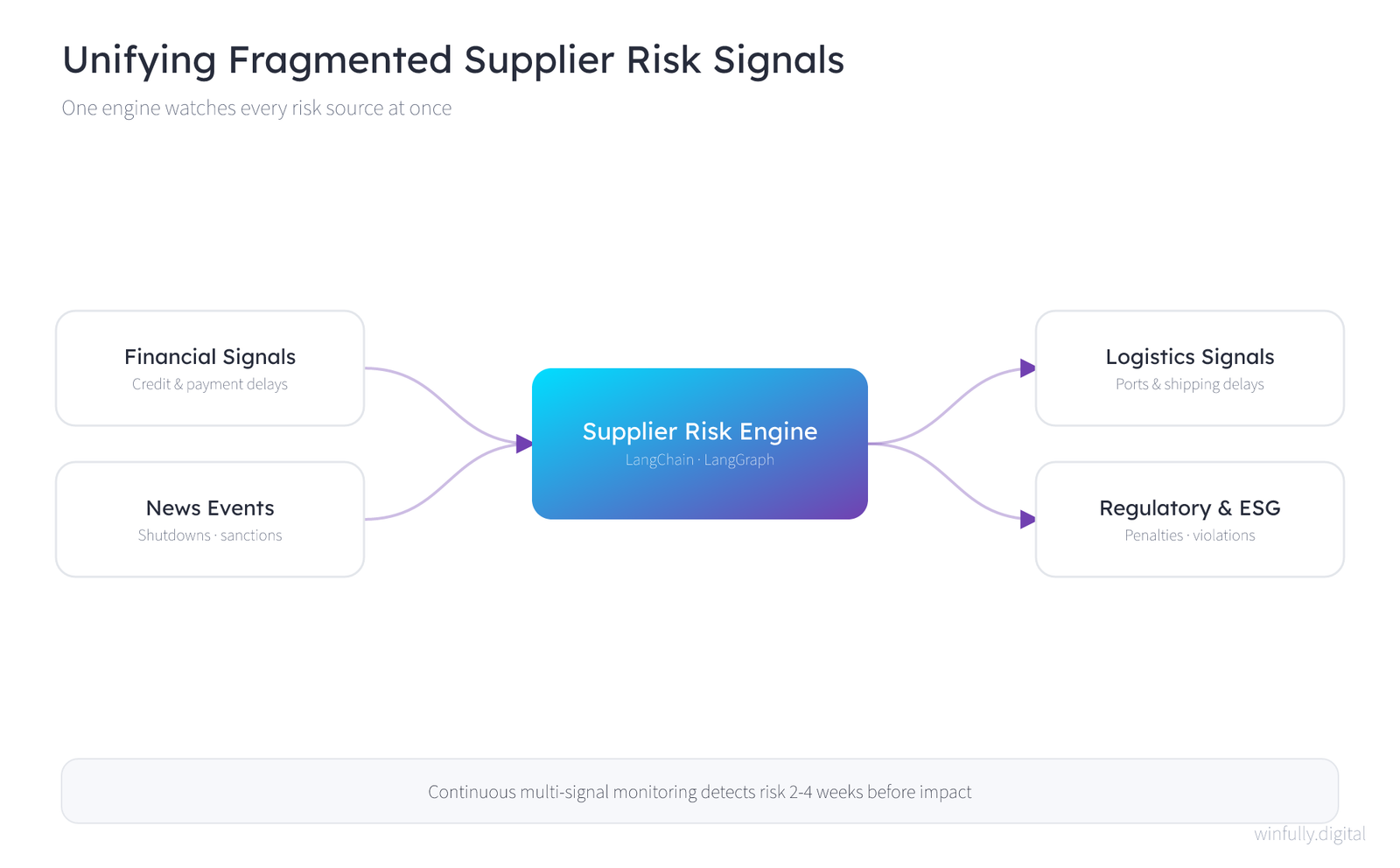
The warning signs are real, but they live in different places: credit monitoring platforms, logistics tracking tools, news feeds, regulatory alerts, ESG databases, and social media. Nobody stitches them together. Without a unified view, it's nearly impossible to see a supplier's full risk picture in real time.
Reactive Crisis Management
With no continuous monitoring in place, procurement teams tend to learn about a supplier failure only once it hits operations, when a line stops, a shipment slips, a contract falls out of compliance, or a product runs short. At that point you're managing a crisis, not preventing one.
Manual Investigation Bottlenecks
Even when a signal does surface, someone has to chase it down. Analysts pull data from system after system to figure out whether the threat is real and how bad it could get. That work can take days or weeks, and every day of delay pushes back the decision. As supplier networks grow, this manual approach stops scaling.
Key Capabilities of Agentic Supplier Risk Monitoring
Continuous Multi-Signal Monitoring
The agents watch financial data, logistics networks, regulatory updates, and news events at the same time, all day, every day. Together they form a single real-time view of supplier risk instead of a dozen disconnected dashboards.
Early Detection of Disruptions
Weak signals are the whole point. A subtle financial distress indicator or an early regulatory rumble often shows up weeks before anything reaches your operations, and the system catches it while there's still time to act.
Context-Aware Risk Scoring
Risk scores here aren't frozen numbers on a scorecard. They move as new signals arrive and as the relationships between those signals change, so a supplier's rating reflects where things stand today, not last quarter.
Automated Impact Assessment
When something does trip a risk event, the system maps the fallout on its own: which products depend on that supplier, which manufacturing lines are exposed, where inventory might run short, and which geographies you rely on. You get to a decision faster because the homework is already done.
Technical Approach: Agentic AI with LangChain and LangGraph
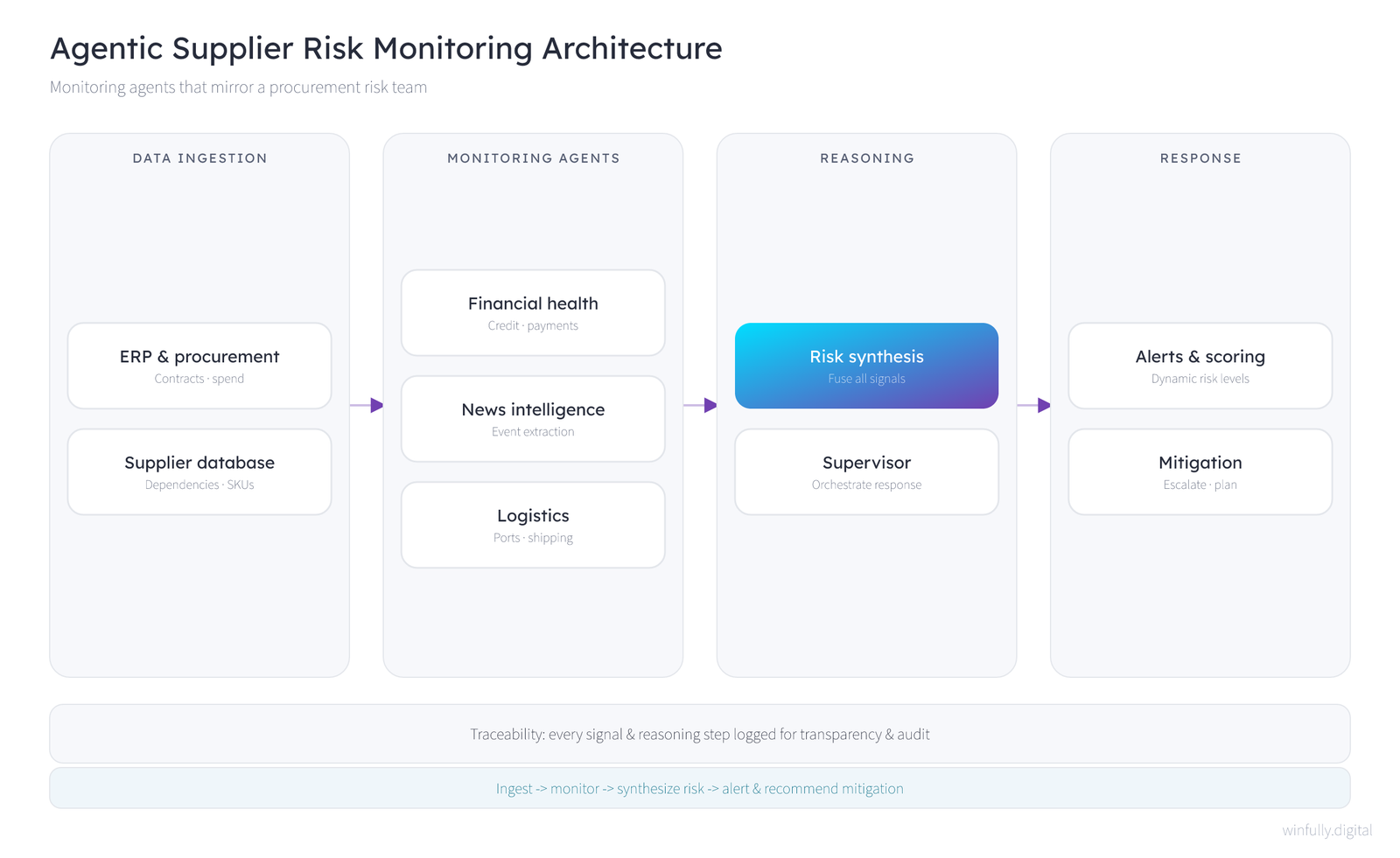
With LangChain and LangGraph, you can build a monitoring architecture that reasons about supplier threats the way a seasoned procurement risk team does. Rather than one person tracking everything by hand, the work is split across a set of specialized agents, each responsible for a slice of the problem.
Step 1: Supplier Data Ingestion Agent
This agent pulls supplier information out of your enterprise systems: ERP platforms, procurement tools, and supplier databases. From there it maps out who supplies what, which products depend on which vendors, and the contract terms behind each relationship.
Step 2: Financial Health Analysis Agent
This one keeps an eye on the money side, tracking credit ratings, payment delays, and financial disclosures for the early cracks that signal a supplier in trouble.
Step 3: News Intelligence Agent
Using LLM-based event extraction, this agent reads through global news feeds and trade publications, flagging events that touch your suppliers: a factory shutdown, a regulatory action, a geopolitical flare-up.
Step 4: Logistics Disruption Monitoring Agent
This agent watches shipping network data, port congestion alerts, and transportation snags that could hold up a supplier's deliveries.
Step 5: Risk Synthesis Agent
Here the signals come together. This agent weighs the inputs from every other agent, looks at how they combine and reinforce each other, and settles on an overall risk profile for the supplier.
Step 6: Supervisor Agent
The Supervisor Agent runs the endgame: it decides what happens next and coordinates the response. Through LangGraph it can trigger risk alerts, recommend mitigation strategies, escalate to the right people in procurement, and kick off contingency planning.
Every signal and every reasoning step is logged, so you can trace exactly how the system reached a given conclusion.
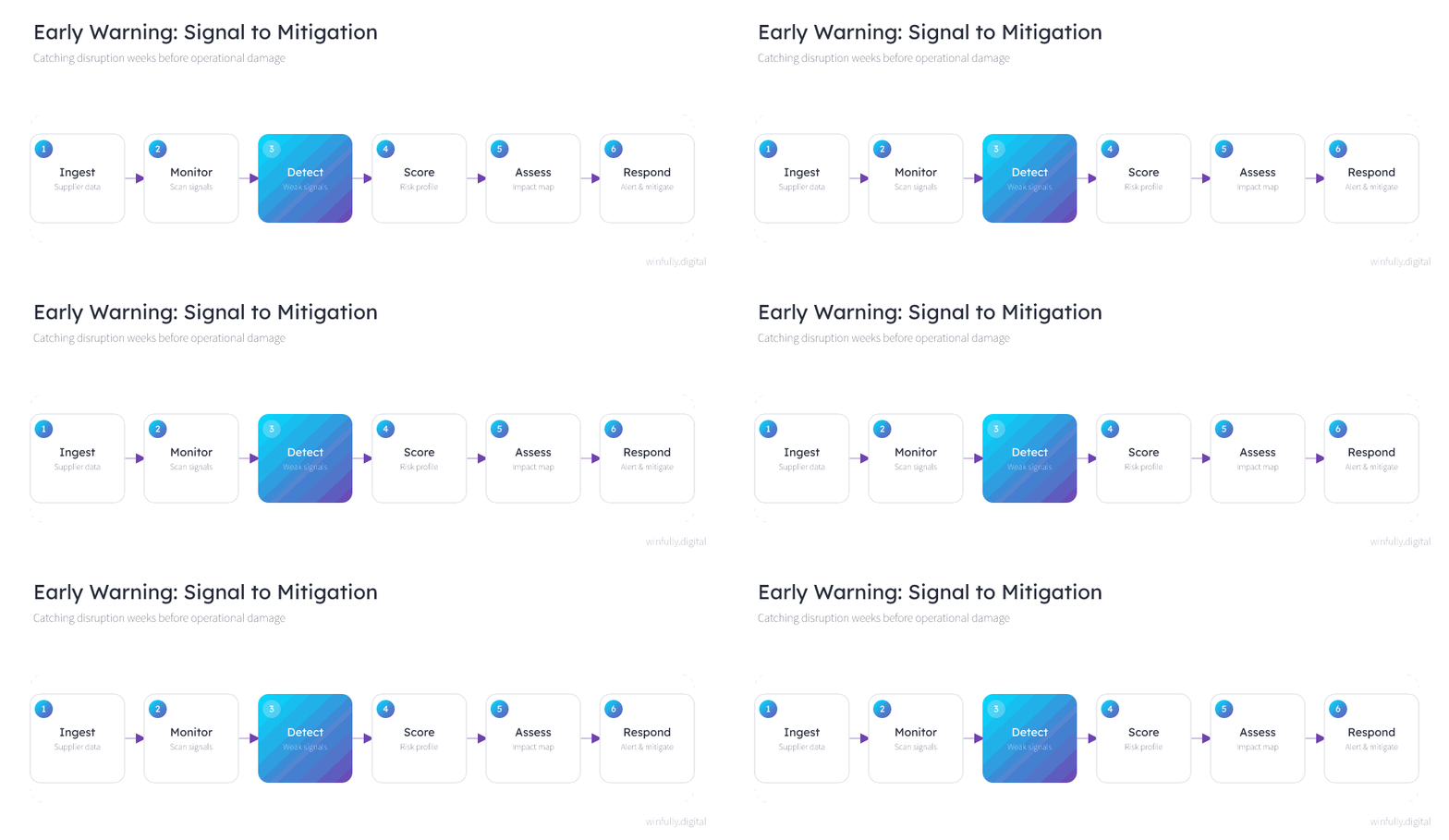
The payoff of this architecture is an early-warning cycle that runs continuously, moving from raw supplier data to a recommended mitigation before disruption hits operations.
Business Value and ROI
2–4 Week Early Warning on Supplier Disruptions
Continuous monitoring surfaces the early signs of trouble 2–4 weeks before they reach operations, which is usually enough runway to line up an alternative and act.
40–60% Reduction in Disruption Costs
Catching risks sooner and responding faster pays off directly. Organizations can cut disruption-related losses by 40–60%.
Automated Supplier Due Diligence
The ongoing evaluation of supplier risk indicators runs itself, taking a large chunk of manual assessment work off your team's plate.
Stronger Supply Chain Resilience
With real-time visibility into supplier health, supply chain leaders can make sourcing decisions on current facts and build in more resilience where it counts.
Improved Executive Risk Reporting
Because everything feeds a single intelligence platform, you can generate board-level resilience reports straight from live supplier analytics rather than assembling them by hand.
Conclusion
Global supply chains keep getting more tangled, and the old ways of watching supplier risk can't keep up. Periodic reviews and scattered tools leave you exposed to disruptions that move faster than any manual process can catch.
Agentic AI built on LangChain and LangGraph changes the equation. Set autonomous agents to work continuously across financial, regulatory, logistics, and reputational signals, and you can spot supplier threats before they harden into operational crises.
The results speak for themselves: disruptions caught weeks earlier, smaller financial hits when things go wrong, and supplier networks resilient enough to bend without breaking in a volatile world.
For chief supply chain officers, procurement leaders, risk managers, and enterprise architects, this is where supply chain intelligence is heading next.