
Intelligent Warehouse Slotting: LangGraph Agents That Dynamically Reorganize Inventory Placement
How LangGraph agentic AI enables dynamic warehouse slotting, continuously analyzing data to optimize inventory placement and cut operating costs.
In a warehouse, demand, order patterns, and inventory mix are always shifting. Yet plenty of distribution centers still run on static slotting: products get a spot when they arrive and rarely move again.
That mismatch costs you. As ordering patterns change, high-demand items can end up stranded in far corners of the building, so pickers walk farther for the things they grab most. The waste is small on any single trip but adds up fast across a shift, and warehouse productivity drops with it.
Agentic AI built on LangGraph and LangChain offers a better way. By analyzing warehouse data continuously and reorganizing inventory placement on the fly, these systems keep slotting close to optimal and give operations a real efficiency boost.
The Problem: Static Slotting Inefficiency
Slotting decides where each product lives in the building. Traditionally those decisions get made at setup or during occasional manual reviews, and they go stale quickly.
A few things drive the inefficiency:
- Changing order patterns: popular products shift with seasonal demand and promotions.
- Growing product catalogs: warehouse frequently add new stock keeping units
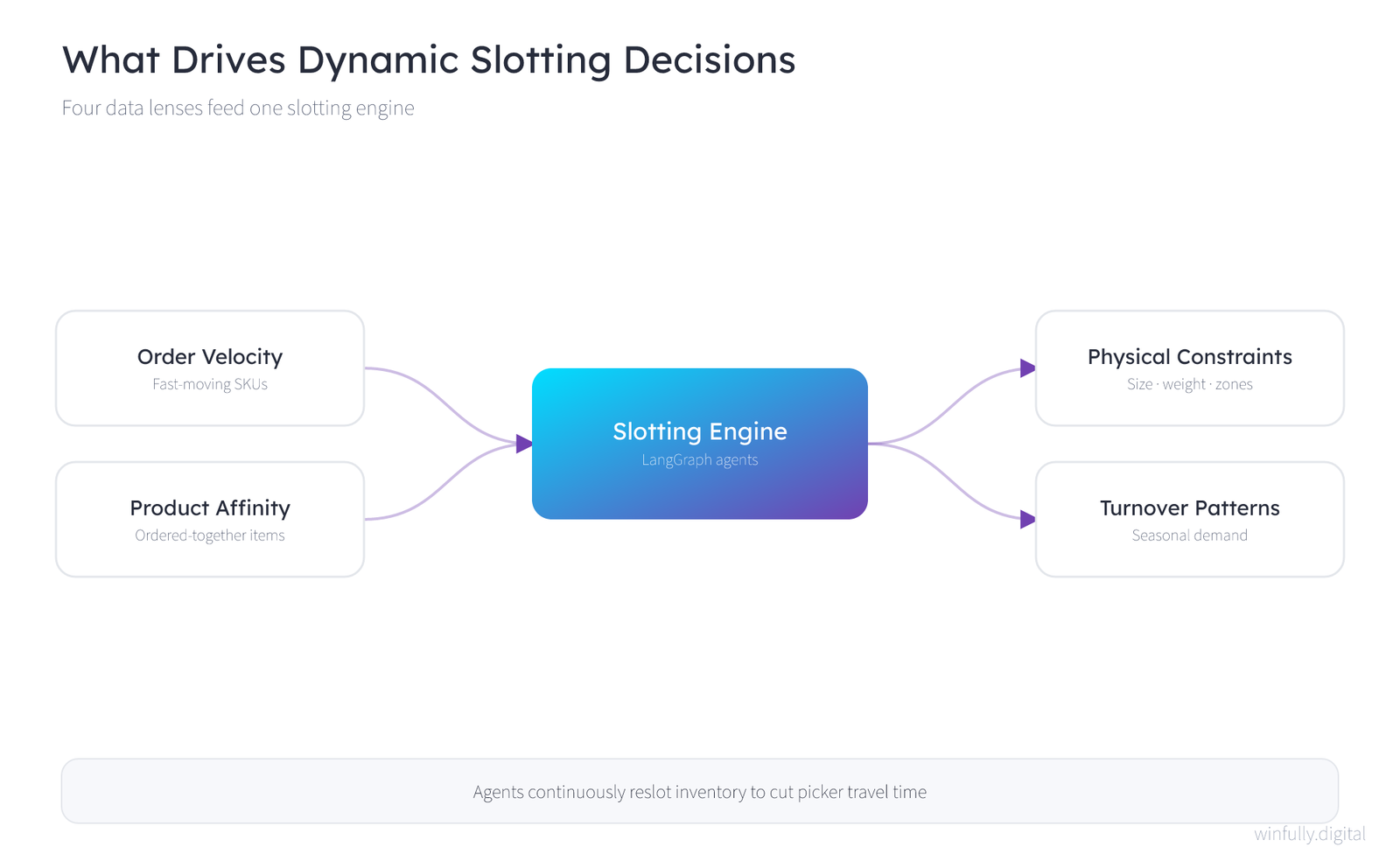
- Product affinity: certain products are often ordered together but stored far apart.
- Physical constraints: size, weight, and handling requirements limit placement options.
Add it up and warehouses see 30–40% excess picker travel time from poor placement alone. In a large distribution center, that can mean 2,000–5,000 wasted labor hours a year.
And it's not only a labor bill. Longer pick paths slow fulfillment, cut throughput, and turn into real bottlenecks when demand spikes.
Technical Approach: Agentic AI with LangGraph
The fix is an agentic slotting optimization system built on LangGraph and LangChain. Autonomous agents analyze operational data as it comes in, simulate different slotting scenarios, and recommend where inventory should go. Instead of a fixed plan, you get one that adapts to changing order patterns, seasonal swings, and operational constraints. LangGraph orchestrates the specialized agents into one coordinated workflow that turns raw data into concrete slotting decisions and plugs straight into the systems you already run.
Data Analysis Agents
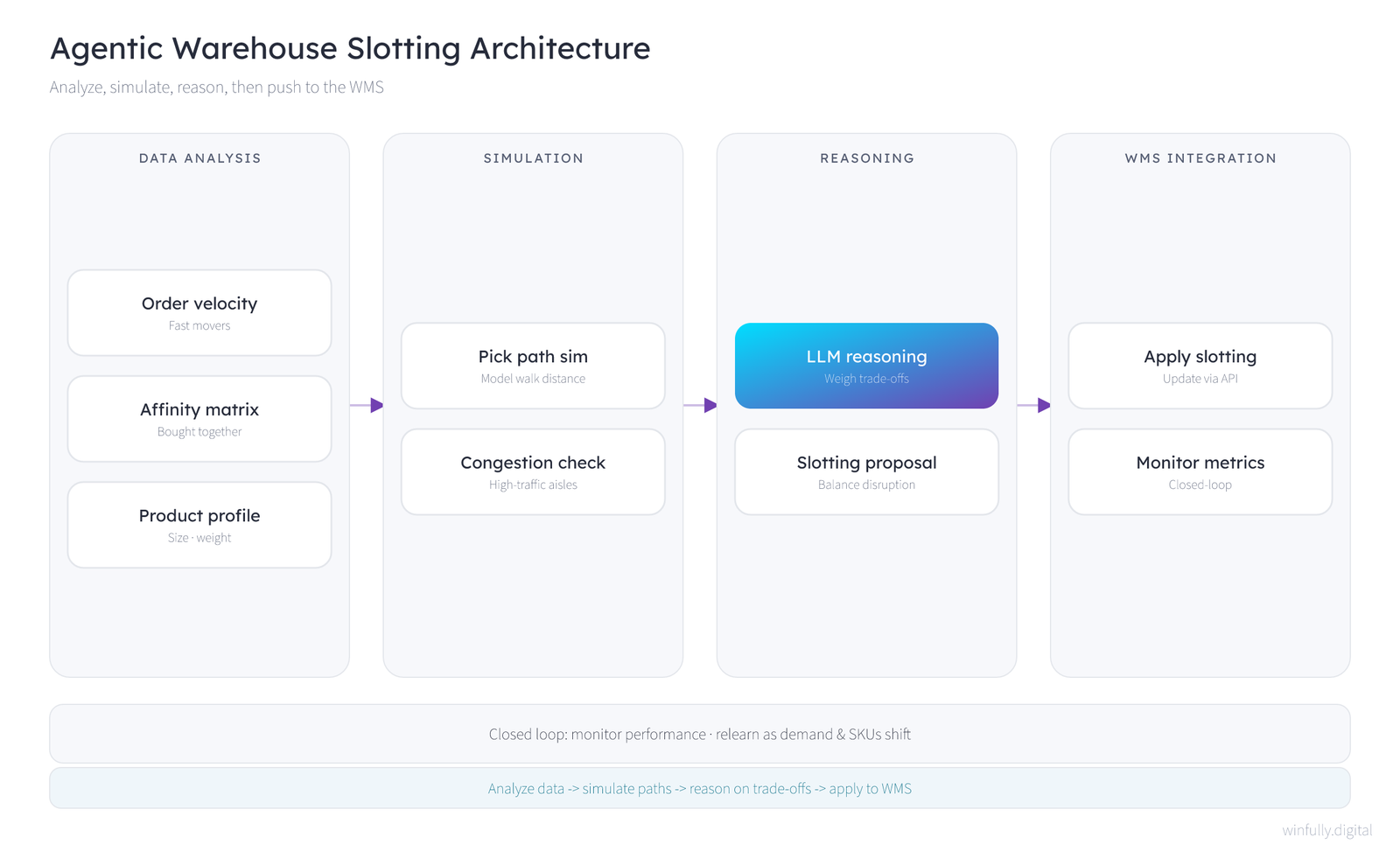
The first layer is a set of data analysis agents that collect and make sense of the warehouse's key datasets. They track order velocity to find fast-moving SKUs that belong in easy-to-reach spots. They build product affinity matrices to spot items that sell together and should sit near each other so pickers don't crisscross the floor. They factor in physical characteristics, size, weight, and storage needs, so a recommended placement actually fits the layout. And they watch inventory turnover to catch seasonal swings. Together these agents turn a flood of operational data into insights that drive the slotting decisions.
Pick Path Simulation Agent
With that data in hand, a pick path simulation agent models the layout and tests how different slotting configurations change picker movement. It estimates walking distances, checks pick-sequence efficiency, flags congestion in busy aisles, and looks for batch-picking opportunities. By running thousands of arrangements, it finds the configuration that cuts travel time without breaking anything operationally, all before you move a single pallet.
LLM Reasoning Agent
At the center sits an LLM-powered reasoning agent, orchestrated by LangGraph, that weighs the trade-offs before recommending any change. It asks the practical questions: How much efficiency would moving these SKUs actually buy? How disruptive is the reslotting work itself? Is there labor to do it? What do replenishment constraints allow? Balancing those, it produces proposals that improve efficiency without upending the daily operation, so the decisions are both practical and worth making.
LangChain Integration with WMS
To put the recommendations into action, LangChain connects to your Warehouse Management System (WMS) through APIs. That link lets the system pull real-time order and inventory data, apply the slotting updates it recommends, and kick off replenishment tasks when needed. Once changes are in place, it keeps watching performance metrics to see whether they worked. The result is a closed loop: placement keeps improving as new data arrives, so the warehouse stays efficient even as demand shifts.
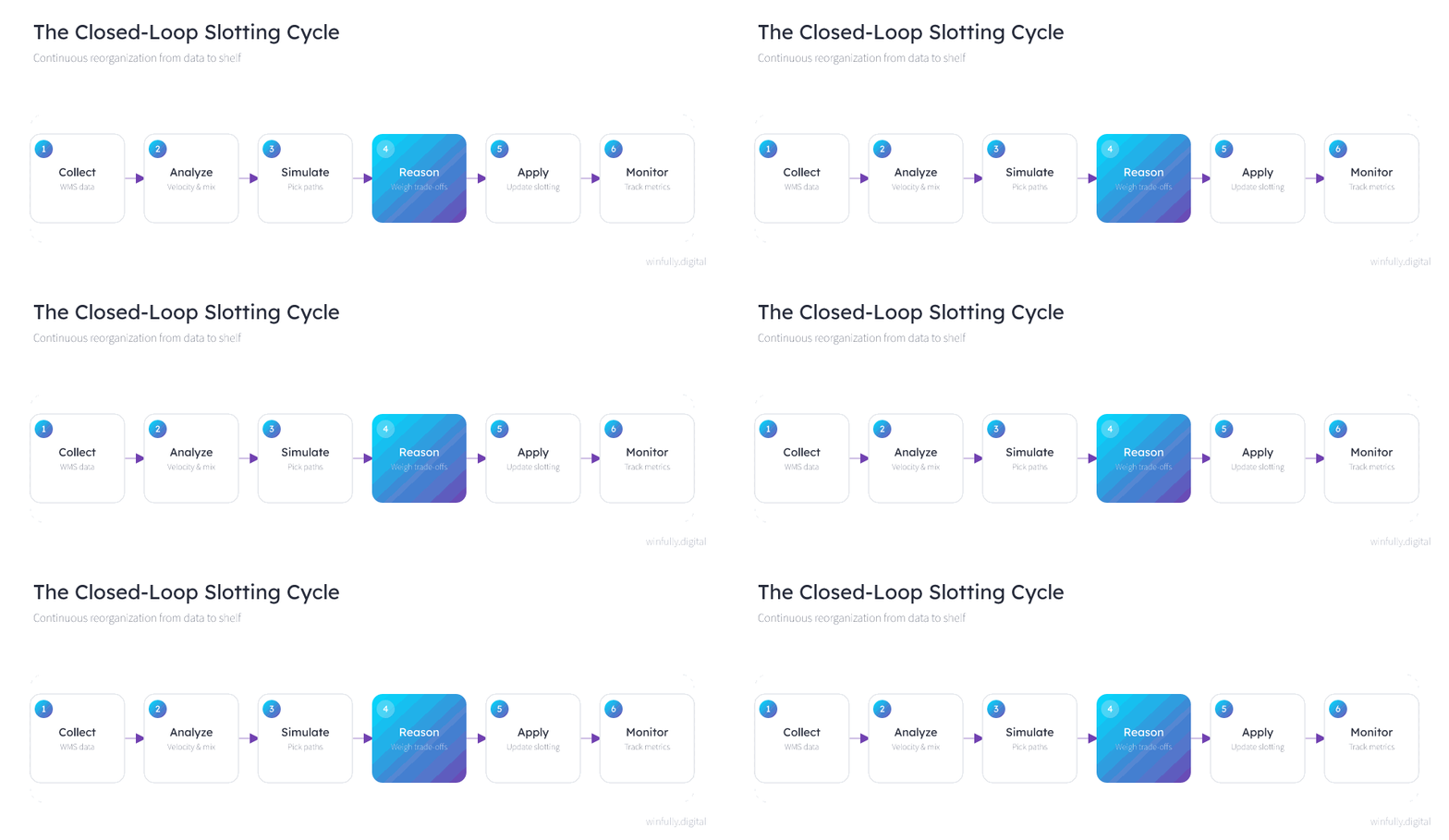
These agents operate as a continuous, closed-loop cycle, turning live warehouse data into applied slotting changes and then measuring the result.
Business Value and ROI
Implementing intelligent slotting with LangGraph provides measurable operational improvements across multiple warehouse metrics.
Key benefits include:
- 25–35% reduction in picking time — Optimized product placement shortens travel paths for warehouse workers.
- 15–20% increase in throughput — Faster picking enables more orders to be processed without expanding warehouse space.
- 18–25% reduction in labor cost per order — Reduced travel distance allows teams to fulfill more orders with the same workforce.
- Automatic seasonal adaptation — The system continuously adjusts slotting based on demand changes, promotions, and product launches.
Because labor is one of the largest operational costs in warehouse operations, these improvements typically produce ROI within 3–6 months of deployment.
The Future of Warehouse Optimization with Agentic AI
Most warehouse optimization tools run on static algorithms or periodic batch analysis. They can produce useful recommendations, but they can't weigh operational trade-offs on an ongoing basis or react fast when conditions change. As demand moves, new SKUs show up, and order patterns shift, tools that depend on manual reviews and scheduled updates fall behind.
Agentic AI on LangGraph works differently. Rather than following fixed rules, autonomous agents read warehouse operations in real time and decide based on the current data. The system continuously watches order velocity, product affinity, congestion, and labor availability, then pairs autonomous decision-making with the context-aware reasoning of large language models (LLMs) to suggest changes that respect real constraints. Placement and workflows adapt without someone having to step in each time.
Supply chains keep getting more complex and delivery expectations keep tightening, which means warehouses have to run leaner and react faster. Frameworks like LangGraph point to a new class of operational systems that make decisions in real time, integrate across systems, and optimize on their own. Because they learn from operational data and adjust over time, performance tends to compound.
For large distribution centers handling thousands of SKUs and high order volumes, AI-driven slotting is on its way to becoming table stakes. The organizations that adopt it will be in a far better position to absorb demand swings, get more out of their labor, and stay ahead in a tougher supply chain environment.
Conclusion
Static slotting just doesn't hold up in modern distribution. As demand patterns move and SKU catalogs grow, fixed placement means longer pick paths, higher labor costs, and less throughput.
Agentic AI on LangGraph lets warehouses reorganize placement continuously, driven by real-time data and real constraints. You get faster picking, more productive labor, and smoother fulfillment.
Adopt intelligent slotting now and you set yourself up for a smarter, more adaptive supply chain that scales as demand grows.