
Intelligent Invoice Reconciliation: Agentic AI Eliminates the Accounts Payable Bottleneck
How agentic AI with LangChain and LangGraph automates invoice extraction, validation, and reconciliation to clear accounts payable bottlenecks.
Accounts payable (AP) teams play a critical role in maintaining financial accuracy and vendor relationships. One of their most time-consuming responsibilities is invoice reconciliation, the process of verifying that supplier invoices match purchase orders, delivery records, and payment terms before releasing payments.
For many mid-market companies, this process remains heavily manual. Organizations processing 5,000–50,000 invoices per month often rely on spreadsheets, ERP lookups, and manual document checks to reconcile invoices against purchase orders and goods receipts. This creates a significant operational bottleneck for finance teams.
The complexity increases because 30–40% of invoices typically contain discrepancies such as mismatched amounts, missing purchase order numbers, incorrect tax calculations, duplicate invoices, or quantity mismatches between delivered goods and billed items. Each exception requires manual investigation by AP staff.
These inefficiencies create several operational challenges:
- Slow invoice processing cycles that delay vendor payments
- Increased risk of duplicate or incorrect payments
- Limited visibility into real-time liabilities and cash flow
- Significant manual workload for finance teams
In many organizations, 15–20 full-time equivalent (FTE) hours per week go to resolving invoice mismatches and chasing down exceptions, and that number climbs as invoice volumes grow.
Agentic AI built on LangChain and LangGraph offers a way out. By orchestrating specialized agents that extract, validate, and reconcile financial data on their own, you can turn a manual reconciliation process into an automated financial workflow that runs with far less hands-on effort.
What Is an Agentic AI-Powered Invoice Reconciliation System?
It's a multi-agent architecture: several specialized agents work together to analyze invoices, match them against financial records, and resolve discrepancies on their own. Rather than a person checking each invoice by hand, the agents read documents, pull ERP data, and check financial consistency across systems.
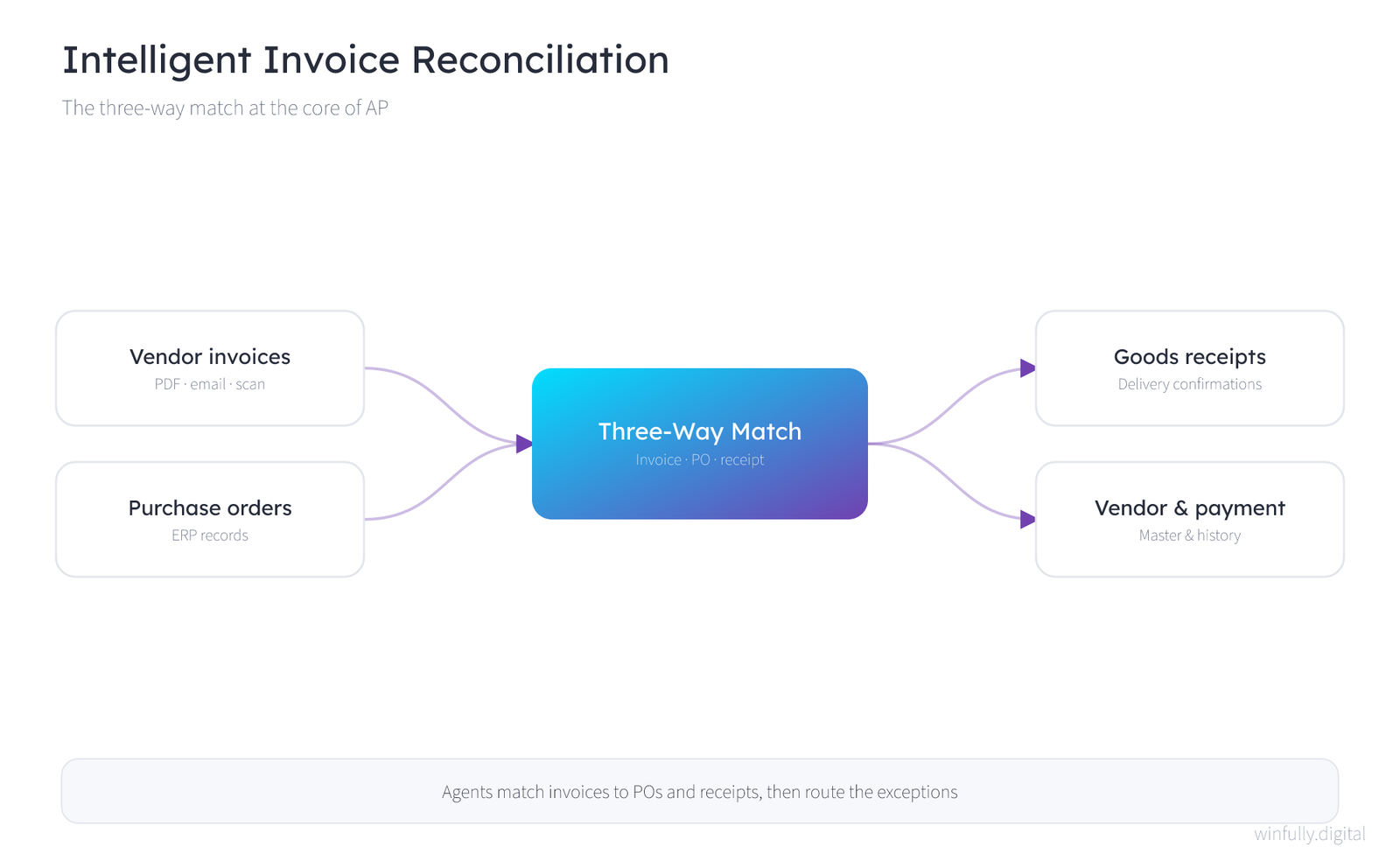
The system draws on a range of sources: vendor invoices (PDFs, emails, scanned documents), purchase order records from ERP systems, goods receipt confirmations from procurement, payment history and banking records, and vendor master data and contract terms. Each agent handles one specific task inside a workflow that LangGraph coordinates, which is what makes the decision-making structured and the exception handling automatic.
What Is LangGraph and Why It Matters for Invoice Reconciliation
Invoice reconciliation is rarely straightforward. Every invoice runs through several validation steps, and the path branches the moment a discrepancy turns up. LangGraph handles that messiness by modeling the whole process as a graph of connected agents and decision nodes.
Each node is a task, such as document parsing, purchase order validation, or anomaly detection, and the transitions between them depend on what each validation finds. For finance operations, that graph-based structure buys you:
- Multi-agent collaboration across document processing and financial validation
- Persistent workflow state to track invoice processing status
- Conditional routing for exceptions and discrepancies
- Human-in-the-loop review for unresolved cases
- Complete audit trails for financial compliance
The net effect is that reconciliation stops being a manual accounting chore and starts working like a real-time view of your finances.
For the business, that means faster processing and payment cycles, less grunt work for AP teams, better accuracy and fraud detection, and a clearer picture of vendor liabilities and cash flow.
Key Capabilities for Accounts Payable Automation
Multi-Agent Workflow Orchestration
LangGraph enables specialized AI agents to collaborate within a structured workflow, handling document parsing, financial validation, and anomaly detection simultaneously.
Financial Data
The system maintains invoice processing data throughout the workflow, ensuring that document data, ERP records, and validation results remain accessible to all agents.
Conditional Exception Handling
Invoices that pass validation can be automatically approved, while discrepancies trigger investigation workflows or manual review.
Financial Compliance
Every validation step, decision, and data source interaction is logged, creating transparent audit trails for internal controls and regulatory compliance.
ERP and Banking Integration
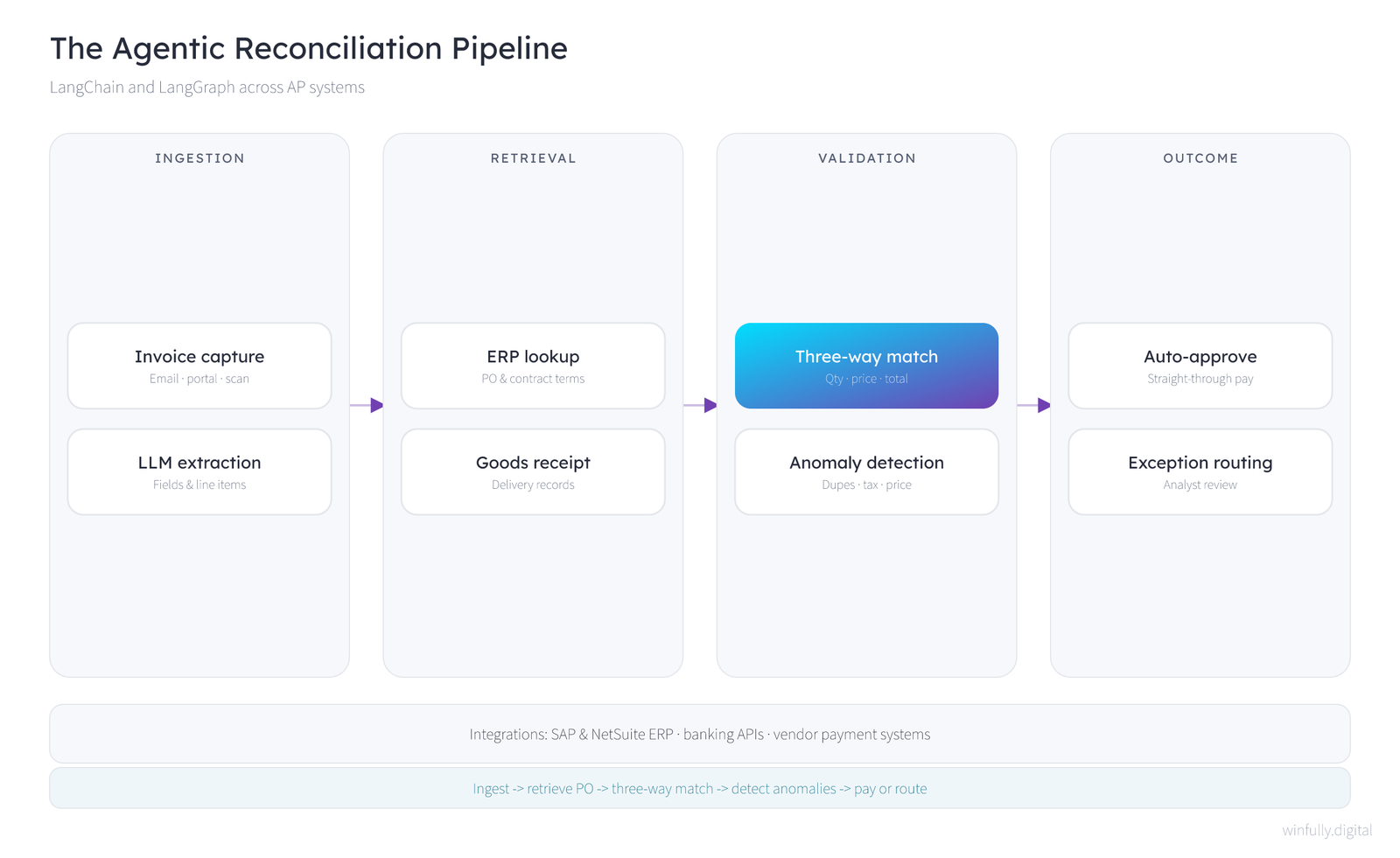
LangGraph workflows can integrate with ERP platforms such as SAP or NetSuite, along with banking APIs and vendor payment systems.
Technical Process Flow for Intelligent Invoice Reconciliation
Invoice Data Ingestion
Invoices are captured from email inboxes, vendor portals, or document management systems. LLM-powered parsing tools extract key fields such as vendor name, invoice number, line items, totals, and payment terms from PDF or scanned documents.
Purchase Order Retrieval
LangChain tools query ERP systems to retrieve purchase orders, contract terms, and goods receipt records associated with the invoice.
Three-Way Match Validation
Agents perform automated three-way matching between invoice data, purchase orders, and delivery confirmations to verify accuracy of quantities, pricing, and totals.
Anomaly Detection
Machine learning agents analyze discrepancies such as duplicate invoices, unusual price changes, tax mismatches, or missing purchase order references.
Exception Routing
Invoices that pass validation move directly to payment approval. Discrepancies are routed to AP analysts with contextual explanations generated by the AI agents.
Continuous Learning
The system learns from historical resolution patterns, improving its ability to automatically resolve common discrepancies over time.
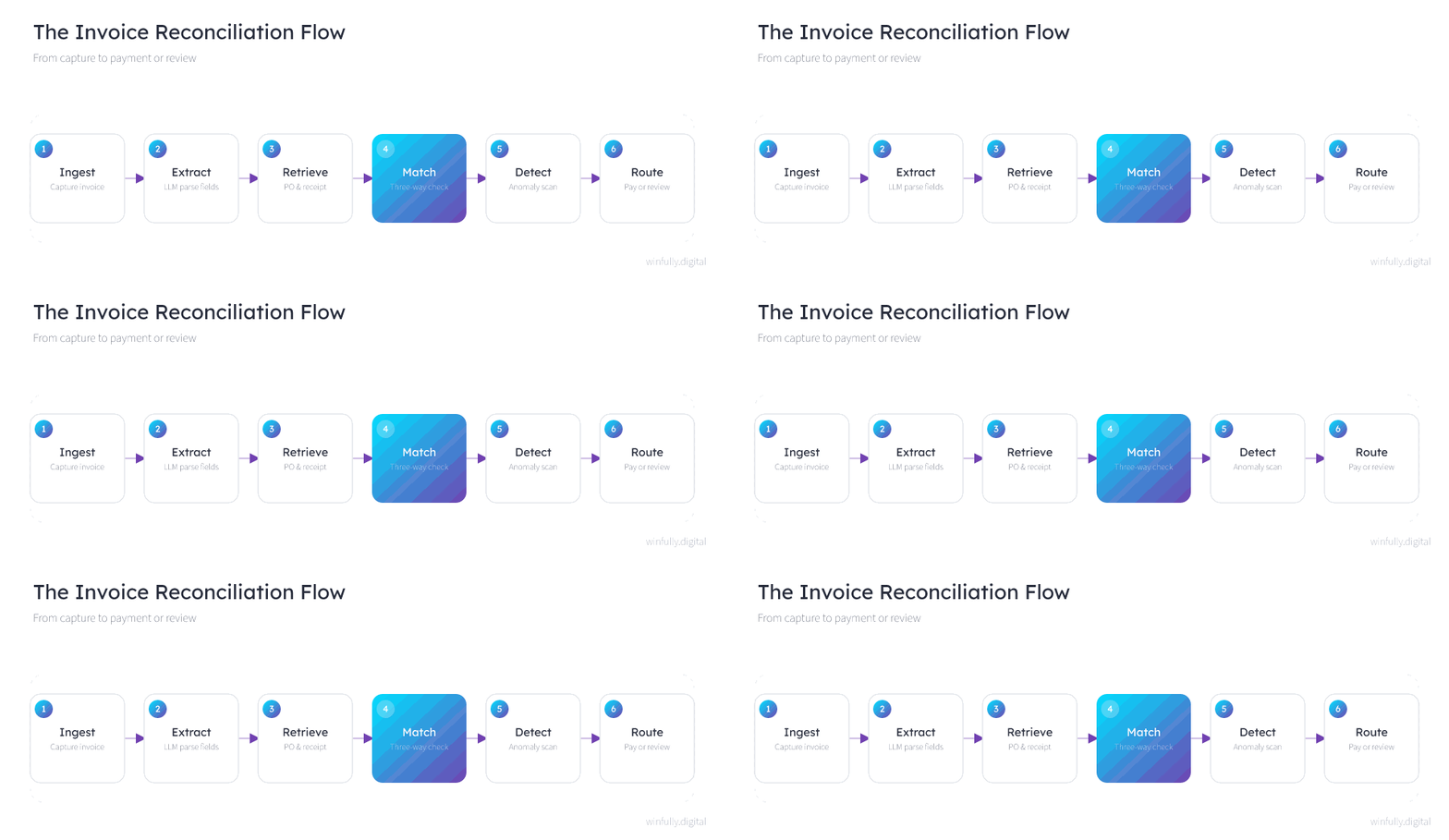
Seeing how a single invoice travels through these steps makes the operational payoff concrete, as the animation below illustrates.
Business Impact
Faster Invoice Processing
Automated reconciliation reduces invoice processing cycles from days to minutes, ensuring vendors are paid on time.
Reduced Workload
Finance teams spend significantly less time manually checking invoices, allowing AP staff to focus on strategic financial tasks.
Improved Vendor Relationships
Timely and accurate payments strengthen supplier relationships and reduce disputes.
Real-Time Financial Visibility
Automated reconciliation provides immediate insights into outstanding liabilities and upcoming payment obligations.
Key Industry Impact
- 95% Through Processing: Most invoices can be validated and approved automatically without human intervention.
- 50% Reduction in AP Operational Costs: Automation significantly reduces the need for manual reconciliation work.
- 2–3% Spend Savings: Organizations can capture early payment discounts by accelerating invoice approvals.
- Real-Time Cash Flow Visibility: Automated reconciliation enables more accurate forecasting of accounts payable liabilities.
Conclusion
Invoice volumes keep growing and getting more complicated, and traditional AP workflows can't keep up. For any organization processing thousands of invoices a month, manual reconciliation means delays, higher costs, and blind spots in financial visibility.
Pairing LangChain's integrations with LangGraph's multi-agent orchestration lets you build reconciliation systems that handle document parsing, financial validation, anomaly detection, and exceptions automatically. Invoice processing goes from a manual administrative task to something closer to a live financial workflow.
You get faster approvals, less overhead, better vendor relationships, and real-time insight into what you owe and when. As more finance teams bring AI into their operations, agentic AP systems are going to be central to clearing reconciliation bottlenecks and running a tighter financial operation.