
Beyond the Credit Score: Automating Credit Underwriting with LangChain Agents and Real-Time Data Fusion
Multi-agent AI orchestrated with LangGraph fuses real-time financial signals to underwrite thin-file borrowers faster and more accurately than credit scores.
A technical and strategic primer for fintech executives, risk officers, and lending technology leaders
By WinFully On Technologies | FinTech & Banking Practice
"Your borrower has never missed a rent payment in four years, earns $7,400 a month across three gig platforms, and maintains a healthy savings buffer, yet your scoring model just declined them. The problem is not the borrower. It is the model."
This plays out millions of times a year across lending institutions. Credit scoring was built for a W-2 world, and it no longer matches how people actually earn. If you run risk, lead lending technology, or own a fintech product line, that mismatch isn't just a fairness question. It quietly costs you revenue.
Thin-file and credit-invisible borrowers in the United States number more than 45 million. Most aren't high-risk. They're under-measured. Closing that measurement gap is one of the biggest commercial openings in financial services right now.
The way to close it is finally production-ready. Multi-agent AI systems, coordinated through stateful workflow frameworks like LangGraph, pull real-time financial signals from open banking feeds, alternative data, and behavioral patterns, then turn them into explainable, regulator-ready decisions in minutes rather than days.
The Structural Problem with Static Credit Scoring
Traditional underwriting leans on a narrow, backward-looking data set. FICO, still the default at most lenders, was built when jobs were stable, income was predictable, and a bank account held one paycheck. Borrowers don't look like that anymore.
A borrower's real financial picture now lives in a dozen places: gig platform earnings dashboards, digital wallet histories, buy-now-pay-later accounts, subscription liabilities, peer-to-peer payment apps, and alternative savings products. Almost none of it shows up in a bureau pull.
That blind spot has three direct consequences:
- Missed lending revenue from creditworthy but data-thin applicants incorrectly declined or offered suboptimal terms
- Elevated default rates from approved borrowers whose real-time financial deterioration is invisible until delinquency
- Slow decisioning cycles, often 24 to 48 hours that introduce abandonment risk in digital lending channels where applicants expect near-instant responses
Tweaking around the edges won't fix this. Slightly wider data pulls and slightly retuned scorecards leave the core problem in place. The fix is to treat the underwriting decision as a coordinated, multi-source intelligence operation, and that is what agentic AI makes possible.
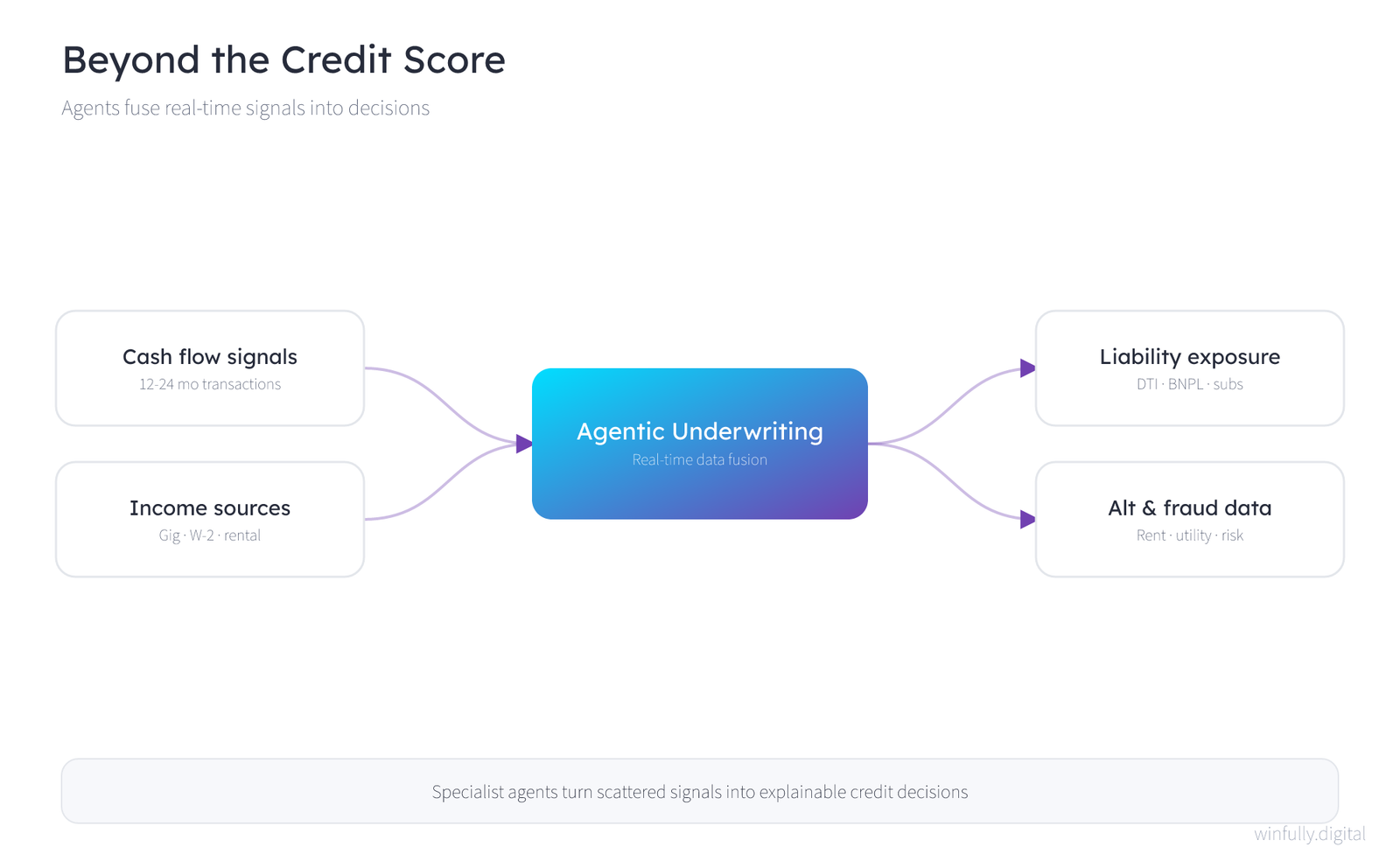
Introducing the Agentic Underwriting Architecture
An agentic underwriting system swaps the single monolithic score for a network of specialized agents. Each one is built to interrogate a specific slice of the data: cash flow, income classification, liability exposure, credit history, alternative signals, fraud patterns. Each writes its structured findings into a shared, stateful decision graph.
The layer that coordinates those agents runs on LangGraph, a framework built for stateful, conditional multi-agent workflows. It treats underwriting not as a straight-line pipeline but as a directed graph of decision nodes, with conditional branches that route each application based on the risk signals as they emerge.
Everything starts with a unified ingestion layer. It normalizes inputs from Open Banking APIs (Plaid, MX, Finicity), bureau pulls, bank transaction histories, and alternative sources like rent payment platforms, utility records, and gig income feeds. That normalized profile becomes the shared context every downstream agent works from.
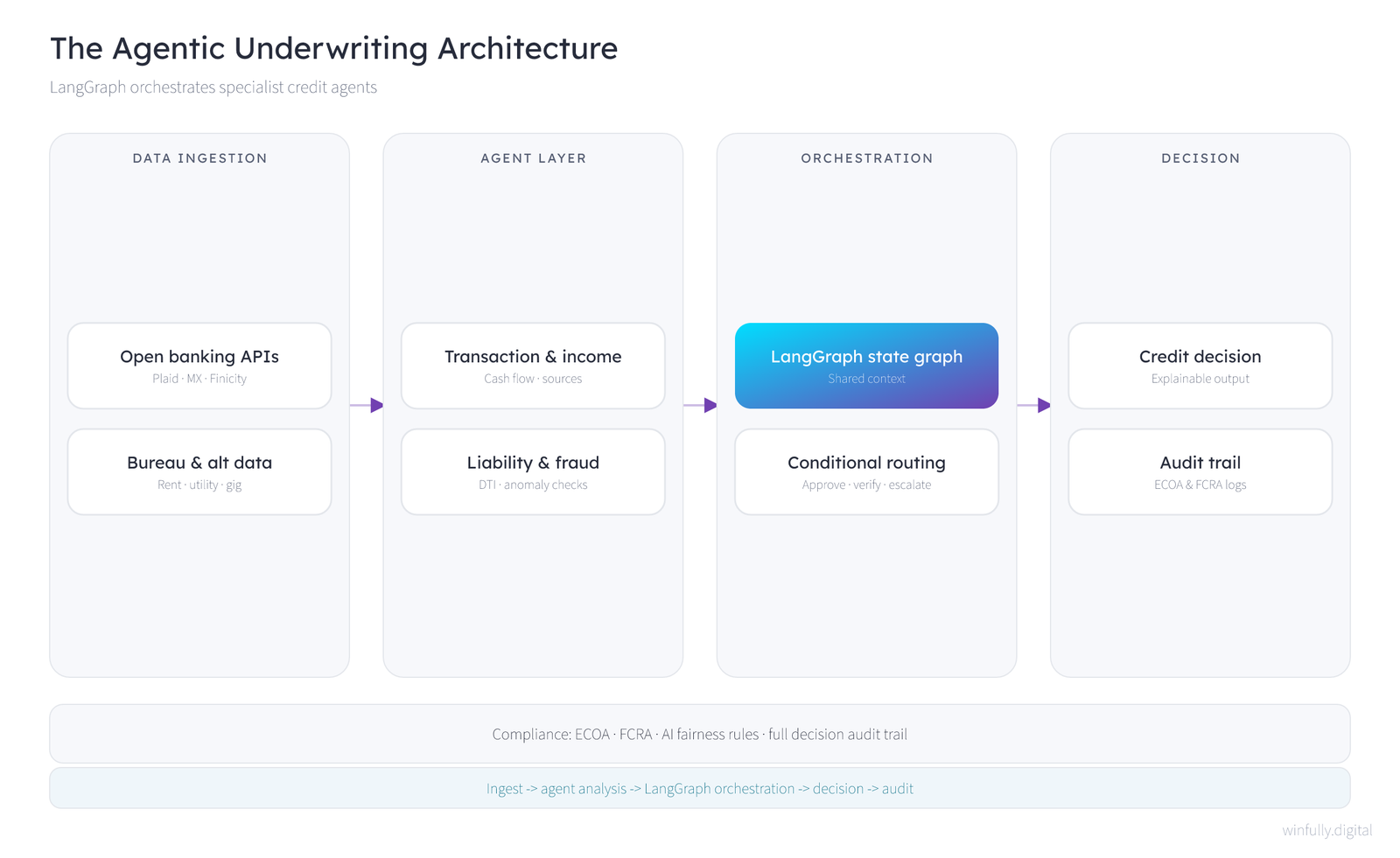
The Agent Layer: Specialized Intelligence at Every Dimension
Each LangChain agent is a domain specialist. The Transaction Analyst Agent reads 12 to 24 months of bank transactions to spot income volatility, spending discipline, and cash flow cycles. The Income Classifier Agent sorts earnings by source (W-2, freelance, gig, rental, investment) and weights each stream by how stable it is.
The Liability Assessor Agent works out debt-to-income in real time, reading not only reported credit obligations but the subscriptions, recurring transfers, and buy-now-pay-later commitments that conventional models never see. The Alternative Data Agent looks at rent and utility payment histories, which predict repayment well yet sit entirely outside bureau data.
The Fraud and Anomaly Detection Agent checks behavioral patterns against known fraud signatures, synthetic identity markers, rapid account cycling, and income-to-spending ratios that don't add up. It acts as a risk gate before any decision lands.
Here's the architectural payoff. Because every agent writes to a shared LangGraph state object, each one sees what the others have already concluded. The Liability Assessor can tighten its DTI thresholds the moment the Transaction Analyst flags income volatility. Rule-based systems simply can't reason across agents like that.
LangGraph: The Orchestration Engine That Changes Risk Decisioning
LangGraph's stateful graph is what turns a pile of individual agents into one coherent underwriting system. Four of its capabilities matter most for lending, and each is worth a closer look.
Persistent Workflow State
A stateless API chain forgets everything between calls. LangGraph keeps a live state object for the whole underwriting session, and every agent reads from and writes to it. Downstream agents reason about what came before them instead of working blind, which sharpens the risk profile most for the borrowers who are hardest to read.
Conditional Decision Branching
Applications take different paths depending on the risk signals as they arrive. A clean profile with stable income, solid payment history, and low liability-to-income goes straight to automated approval. A moderate-risk case kicks off a verification workflow, asking for more documents or a human review. A high-risk case gets escalated with the full agent reasoning attached.
Human-in-the-Loop Integration
On borderline cases, the analyst sees the whole picture: every signal the agents weighed, every threshold that tripped. It's not a black-box score to rubber-stamp. It's a structured briefing that lets a person decide faster and with more confidence. Analysts stop pushing data around and start applying judgment.
Regulatory Compliance by Design
Every agent action, data access, and decision node is logged automatically. When examiners come asking about ECOA, FCRA, or the newer AI fairness rules, the documentation trail is already there. No one has to reconstruct it by hand.
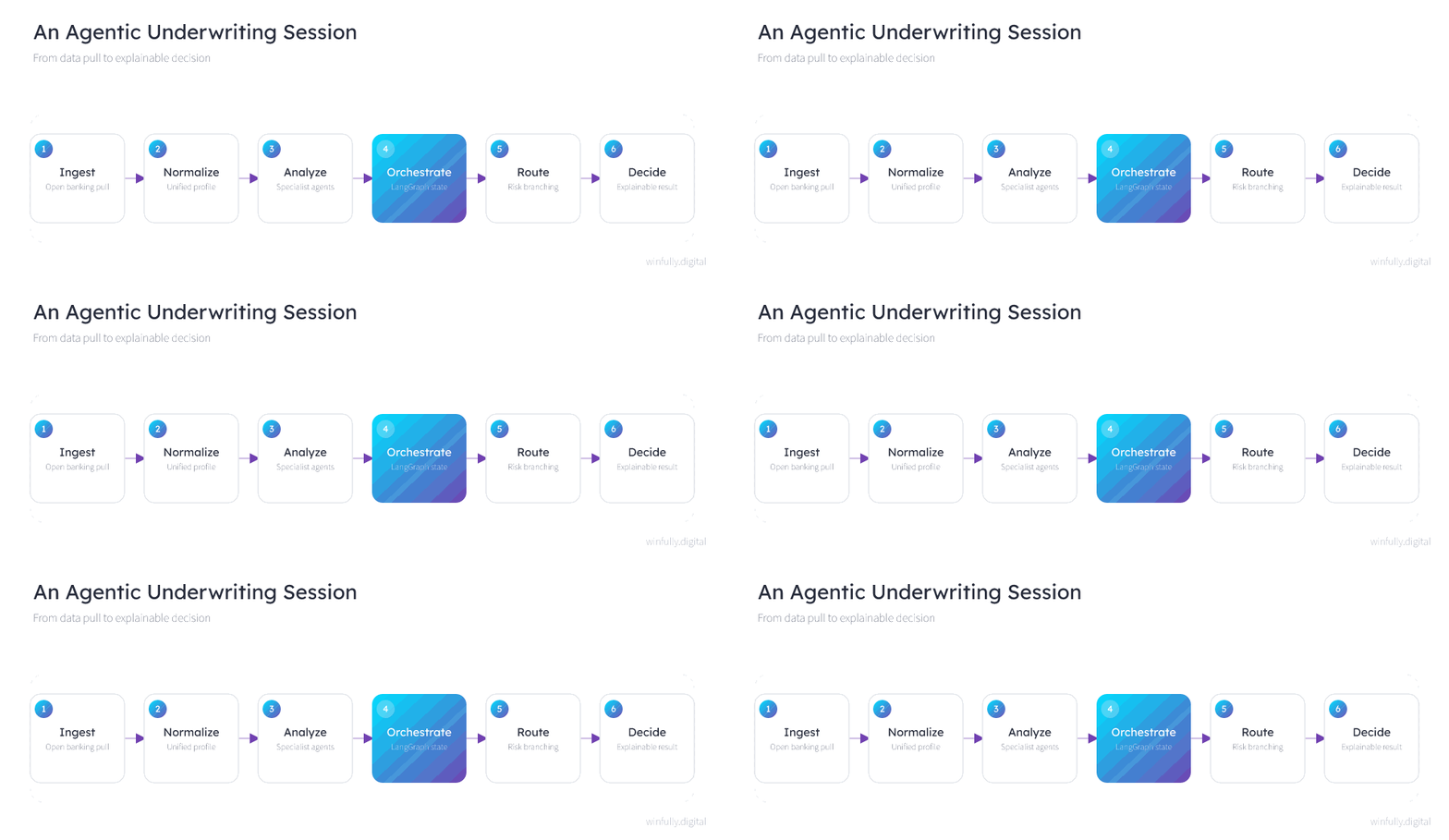
Before looking at the numbers, it helps to see how a single application moves through the system end to end, as the animation below traces.
Business Impact: The Measurable Case for Adoption
| Metric | Traditional Underwriting | AI-Agentic System | Improvement |
|---|---|---|---|
| Decision Time | 24 – 48 hours | 5 – 15 minutes | 60–80% faster |
| Operational Cost | Baseline | Reduced | 30–50% savings |
| Loan Approvals | Baseline | Expanded | +20–35% approvals |
| Default Detection | Baseline | Improved | 25–40% accuracy |
These aren't back-of-the-envelope guesses. The pieces here (Open Banking API integration, LangChain agent frameworks, LangGraph orchestration) are already running in production elsewhere. So the real question isn't whether the architecture works. It's how fast your institution can stand it up.
The pressure is genuine. Digital-native lenders and fintech challengers already use real-time financial data to approve the same borrowers traditional institutions turn away. In digital lending, every point of conversion you gain shows up directly as revenue and market share.
Implementation Pathway for Lending Institutions
Roll it out in three phases. Each one keeps integration risk contained while delivering something measurable.
- Phase 1: Data Foundation (Weeks 1–8): Stand up the Open Banking API integrations, normalize schemas across bureau and alternative sources, and ship the unified profile builder. Get the data layer right first, because everything the agents do depends on it.
- Phase 2: Agent Deployment (Weeks 9–16): Put the Transaction Analyst, Income Classifier, and Liability Assessor agents against live application volume. Score in parallel with your existing models to check performance and tune the agents before they carry weight.
- Phase 3: Orchestration and Compliance (Weeks 17–24): Turn on LangGraph orchestration with conditional branching, human-in-the-loop review, and the full audit trail. Move to production volumes with monitoring dashboards in place.
The Strategic Imperative
Underwriting is one of the highest-stakes decisions a lender makes, and today it runs on partial information, static models, and cycle times measured in days. The distance between what your current system knows about a borrower and what an agentic system could know is now a competitive gap you can actually measure.
The stack to close it (LangChain, LangGraph, Open Banking APIs, explainable ML risk models) is available today, integrates cleanly, and fits inside a normal enterprise implementation timeline. Move now and you build a lasting underwriting edge over the institutions still waiting.
WinFully On Technologies builds agentic AI and FinTech systems end to end, from architecture and agent development through compliance consulting and cloud deployment. Our FinTech practice helps banks, credit unions, and digital lenders modernize underwriting, fraud detection, and risk decisioning. Reach us at contactus@winfully.digital or visit winfully.digital.