
How RPA Reduced Claims Processing Time
A healthcare insurer cut claims processing time by 60% and halved error rates using governed bots that extract, validate, and route claims end to end.
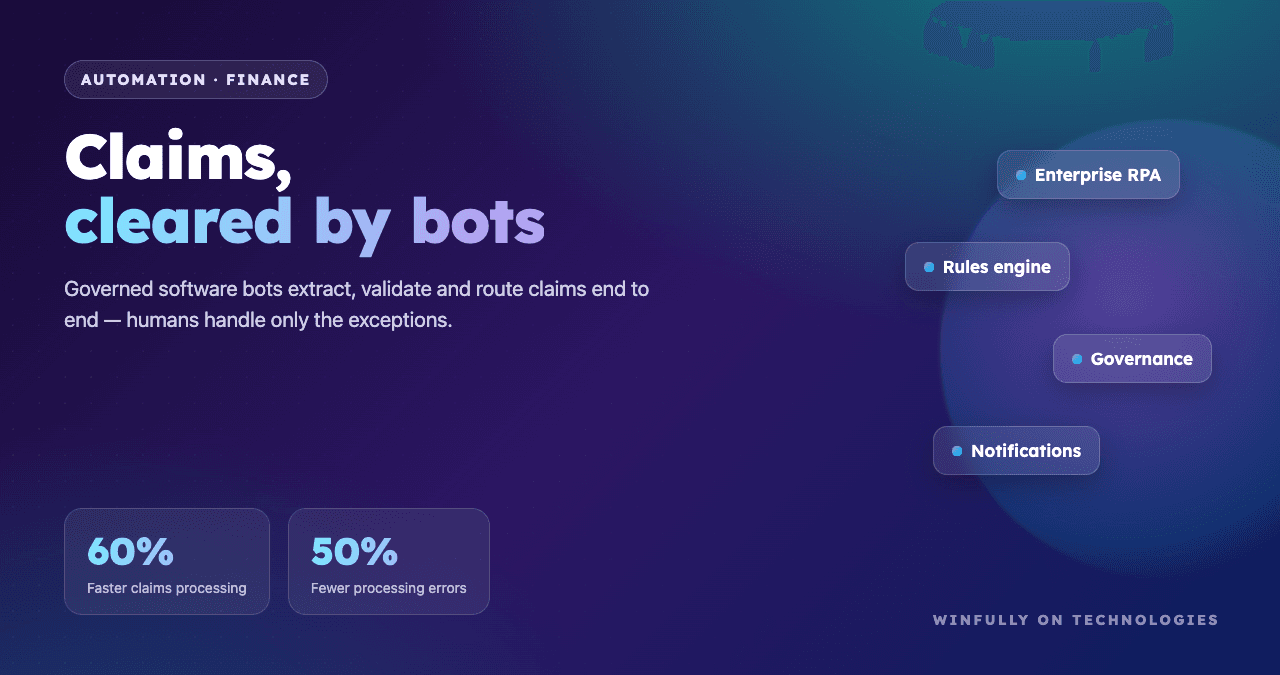
Results at a glance
The situation
A healthcare insurance provider's claims department ran on slow, labor-intensive manual review that couldn't keep up with daily volume. Every hand-keyed claim was prone to error, and inconsistent adjudication created rework and compliance exposure. Approval delays frustrated customers, and bottlenecks piled up across intake, validation, and status updates. Leadership needed more capacity without adding headcount at the same rate.
Automate the repetitive, rules-driven stages of claims adjudication while keeping human judgment for complex exceptions. Every automated decision had to stay auditable and provably compliant with policy and regulatory rules. The aim was faster cycle times, fewer errors, and happier customers.
How we delivered
Assess and design the automation blueprint
We mapped the claims lifecycle end to end, identified high-volume rules-driven steps suited to automation, and designed a phased rollout on an enterprise RPA platform to limit disruption to live operations.
Automate data processing and validation
Bots extract information from incoming claims forms and cross-reference each field against predefined rules and regulations, flagging incomplete or non-conforming submissions before they enter the queue.
Automate database status management
Bots navigate the company's claims database to update statuses, advance approved claims, and keep records synchronized in real time so every stakeholder sees a single source of truth.
Route exceptions to human reviewers
Escalation logic detects complex or ambiguous cases and directs them to the appropriate department for manual review, ensuring specialists focus only on claims that genuinely need judgment.
Automate customer communications
Notification workflows issue approval, denial, and status updates to customers and respond to routine queries, closing the loop without manual follow-up from staff.
Establish governance and compliance controls
We stood up a governance structure that enforces rule adherence, logs every bot action for audit, and reviews changes so automation stays compliant as policies evolve.
The technical solution
A block-level view of the system we designed and delivered — data and control flowing across each stage.
What the users see
A wireframe of the experience we shipped — laid out for the people who use it every day.
Modernize the core without the big-bang risk
A 'sidecar' approach wraps your legacy core with APIs and stands up new cloud-native services alongside it — so you migrate progressively, not all at once.
Automation that supports your people
Intelligent routing and GenAI self-service resolve the routine and hand off complex cases to agents with full context — cutting handle time, keeping the human touch.
Outcomes delivered
- Claims processing time dropped by 60%, sharply shortening the wait between submission and adjudication.
- The error rate fell by 50% as automated validation replaced error-prone manual keying.
- Daily claim volume and processing capacity increased significantly without adding headcount.
- Operating costs fell as fewer manual processors were needed and staff moved to higher-value work.
- Customer satisfaction improved substantially thanks to faster approvals and proactive, consistent communication.
Technology stack
The platforms, frameworks, and standards behind the solution.
Automation
Validation
Data & Integration
Customer Engagement
Governance
Want results like these?
Tell us the outcome you're after. We'll scope a short, fixed-fee discovery and a plan to get there.
Ready to start your digital transformation?
Let's talk about your roadmap, your compliance needs, and where technology can move your business forward.