
Achieving TEFCA-Ready Interoperability: How LLMs Bridge Legacy HL7 v2 and FHIR R4 in Adult Care
How LLMs transform legacy HL7 v2 messaging into FHIR R4, helping adult care facilities reach TEFCA-ready interoperability without disruption.
Introduction: The Interoperability Imperative in Adult Care
Residents in adult care and skilled nursing facilities (SNFs) rarely stay put. They move between hospitals, rehab centers, specialty providers, and home health services, and every one of those moves generates data that has to follow them: admission records, discharge summaries, medication updates, lab results, and care plans. When that information stalls between systems, the fallout is concrete. Treatments get delayed, medications get mixed up, tests get repeated, and residents land back in the hospital.
The pressure to fix this has grown fast. TEFCA, the Trusted Exchange Framework and Common Agreement, has matured quickly since its formal launch in December 2023. As of early 2026, more than 12,000 organizations are live on it, accounting for over 72,000 unique connections to clinicians, hospitals, post-acute care facilities, and public health authorities, with more than 474 million documents shared since go-live. Eleven Qualified Health Information Networks (QHINs) have now been designated, more than double the initial five, among them Oracle Health, eHealth Exchange, Epic Nexus, and Kno2. Federal agencies including the Social Security Administration, VA, CMS, CDC, and NIH are onboarding as well.
Here's the catch. Plenty of adult care and long-term care facilities are still running HL7 v2 interfaces that were built decades ago. Those systems were designed for point-to-point message exchange, not the API-driven, network-based world TEFCA assumes. The research is consistent: information gaps during hospital-to-SNF transitions drive adverse events, and medication discrepancies affect up to 60 percent of patients during handoffs. So the distance between legacy infrastructure and TEFCA readiness is both a patient safety problem and a business one, and it needs a bridge rather than a rip-and-replace.
The HL7 v2 Challenge: Why Legacy Systems Fall Short
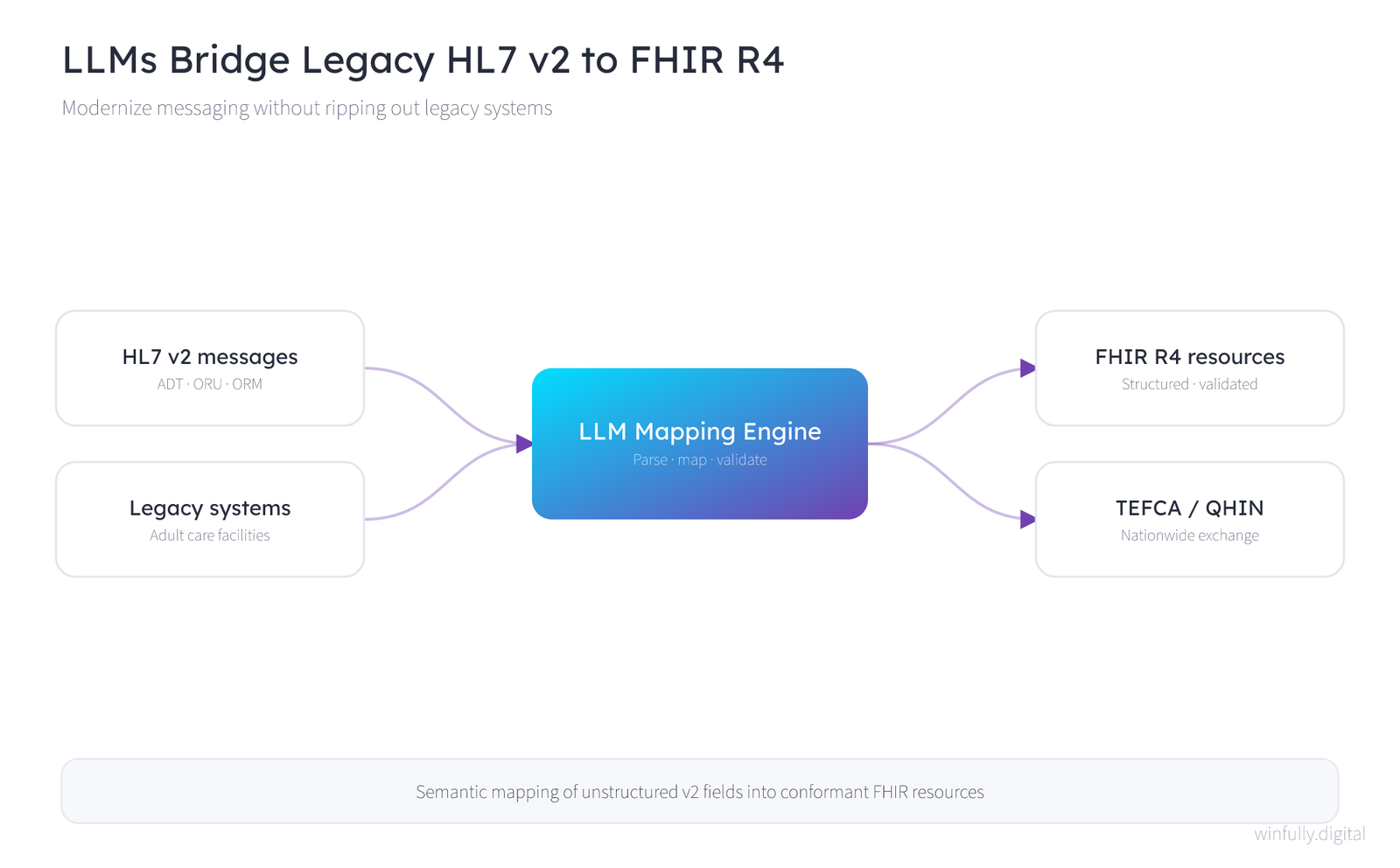
HL7 v2 is still the most widely deployed messaging standard in healthcare. It runs the ADT (Admission, Discharge, Transfer) notifications, lab result reporting, medication orders, and billing workflows in thousands of facilities, and for decades it has moved that data dependably.
The trouble is that HL7 v2 was built to be flexible, and that same flexibility is now the problem. Messages are pipe-delimited and loosely structured, and no two vendors implement them quite the same way. Fields get populated inconsistently, customized locally, or left semantically ambiguous. The standard has no native support for RESTful APIs, which makes real-time, two-way exchange hard to pull off at scale.
You feel these limits most acutely at the worst possible moments: a hospital-to-SNF transfer, an emergency admission, a medication reconciliation. When the structure is inconsistent and the meaning is unclear, information arrives incomplete, care decisions slip, and compliance gaps widen as TEFCA adoption picks up nationwide.
FHIR R4 and TEFCA: The Modern Interoperability Framework
Fast Healthcare Interoperability Resources (FHIR R4), developed by HL7 International, is the modern standard for secure, API-based data exchange. It shares patient information in a structured, consistent, real-time way through RESTful APIs and standardized resource models (Patient, Observation, Encounter, MedicationRequest), with coding support from SNOMED CT, ICD-10, and LOINC.
TEFCA sits on top of FHIR. It stitches QHINs into a "network of networks" so health information can move securely and consistently across the country. The Sequoia Project's FHIR Roadmap for TEFCA Exchange lays out four stages: Stage 1 enabled FHIR content support at launch; Stage 2 added QHIN-facilitated FHIR API exchange; Stage 3 pilots QHIN-to-QHIN FHIR exchange (running in 2025–2026); and Stage 4 will bring full end-to-end FHIR exchange between every participant and subparticipant.
For a facility, getting TEFCA-ready comes down to a checklist: align with FHIR R4 and US Core profiles, use standardized clinical terminology, secure your transport with identity verification, keep audit logging and consent management in place, and be able to answer authorized data queries from other networks.
What does that buy you day to day? During an admission, discharge, or emergency transfer, a resident's medications, diagnoses, allergies, recent labs, and care plans move securely with no delay and no manual reconciliation. The phone calls, faxes, and chart reviews that eat staff time on every transition largely go away. You can also take part in query-based exchange, pulling a patient's history from any QHIN-connected system in the country, which matters a great deal for an SNF admitting a resident from a hospital three states over. The end result is stronger compliance and safer care right at the bedside.
How LLMs Bridge HL7 v2 and FHIR R4: The Technical Architecture
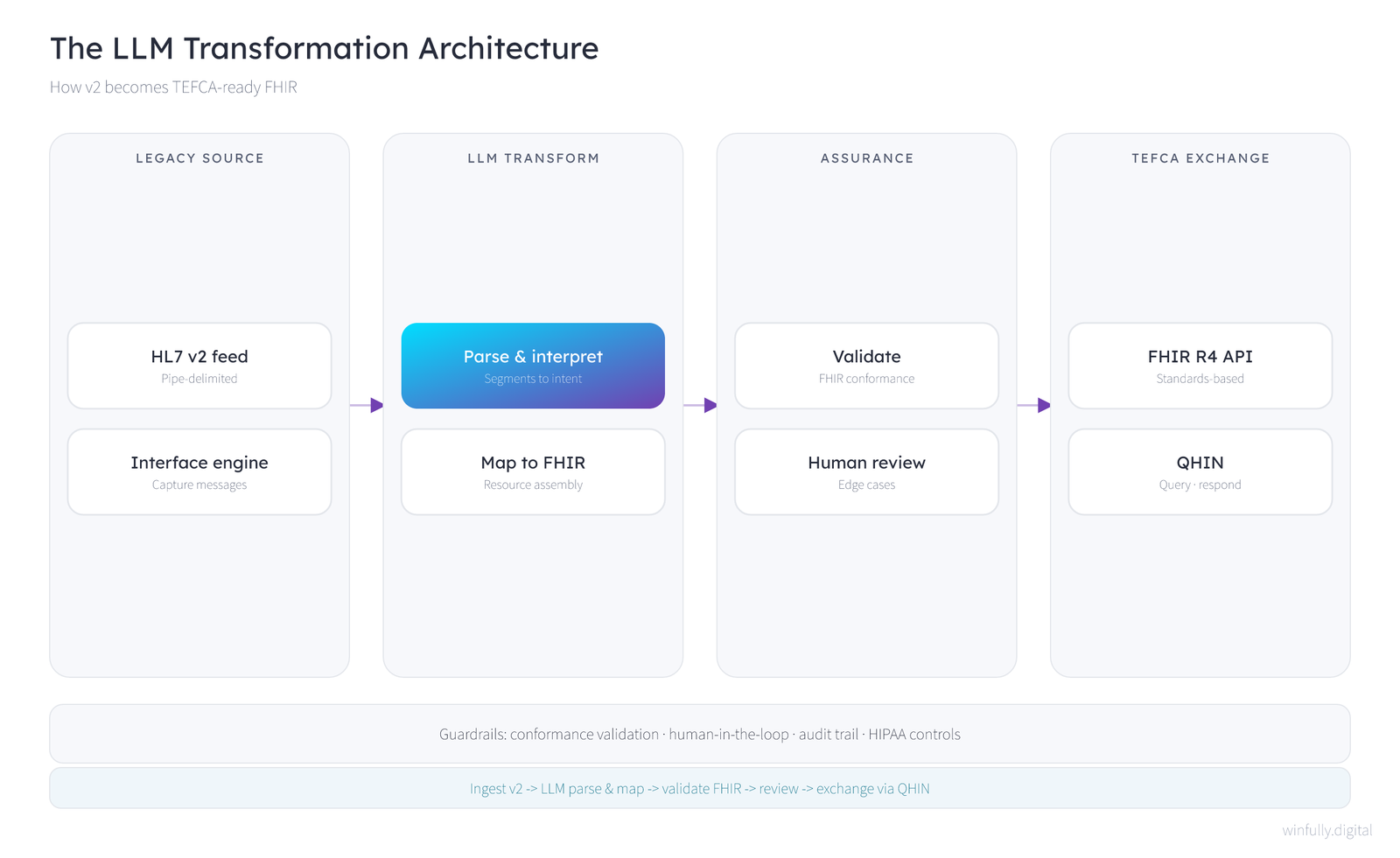
Most facilities can't just swap out their legacy systems. HL7 v2 workflows are wired into daily operations. What a Large Language Model offers is a semantic transformation layer that sits between old and new, modernizing exchange without tearing out the infrastructure underneath it.
Stage 1 | Intelligent Message Parsing
The LLM takes in raw HL7 v2 messages and breaks the pipe-delimited segments (PID, PV1, OBX, DG1, RXA, IN1, and the rest) into structured components. A rule-based parser trips over anything it wasn't explicitly coded for. The LLM reads the intent behind each segment, so vendor-specific quirks, fields in the wrong place, and old local customizations don't stop it cold.
Stage 2 | Semantic Interpretation
Adult care documentation is full of free-text notes, abbreviations (PRN, BID, NPO), homegrown codes, and formatting that changes from field to field. The LLM reads that unstructured material and pulls the clinical meaning out of it. A 2025 arXiv study put numbers on this: LLM-driven FHIR transformation with GPT-4o hit 94 percent accuracy on real-world clinical data from the MIMIC-IV database, and resource identification reached a perfect F1-score in early benchmarks.
Stage 3 | Terminology Normalization
Next, the LLM maps each extracted concept to a standard vocabulary: SNOMED CT for conditions and procedures, ICD-10 for diagnoses, LOINC for lab observations, RxNorm for medications. This step is what makes TEFCA exchange work. When a diagnosis crosses from one QHIN to another, it has to mean the same thing on both ends, no matter which system it came from.
Stage 4 | FHIR R4 Resource Generation
The normalized data then gets assembled into well-formed FHIR R4 resources: Patient, Encounter, Condition, Observation, MedicationRequest, DiagnosticReport. Each one carries the right references to the others, conforms to US Core profiles, and uses the correct coding systems. Lab results link back to the right Observation resources, medications carry proper dosage instructions, and encounter records hold their timing and relationships together.
Stage 5 | Validation and Quality Assurance
Nothing reaches the network until it clears a validation layer. This AI-driven check flags missing required fields, ambiguous entries, coding mismatches, and anything that looks like a PHI compliance problem. It cross-checks every generated FHIR resource against US Core profiles and TEFCA technical framework requirements before transmission. That quality gate does real work: it raises accuracy, cuts down on rejections from receiving systems, and gives you the governance and audit trail TEFCA expects. On a QHIN network, the data you send drives someone else's care decision, so getting it right before it leaves matters.
The system also learns. A feedback loop captures physician overrides, correction patterns, and how downstream systems respond, then folds that back into the mapping. Over time false positives drop and the semantic interpretation gets sharper with each pass.
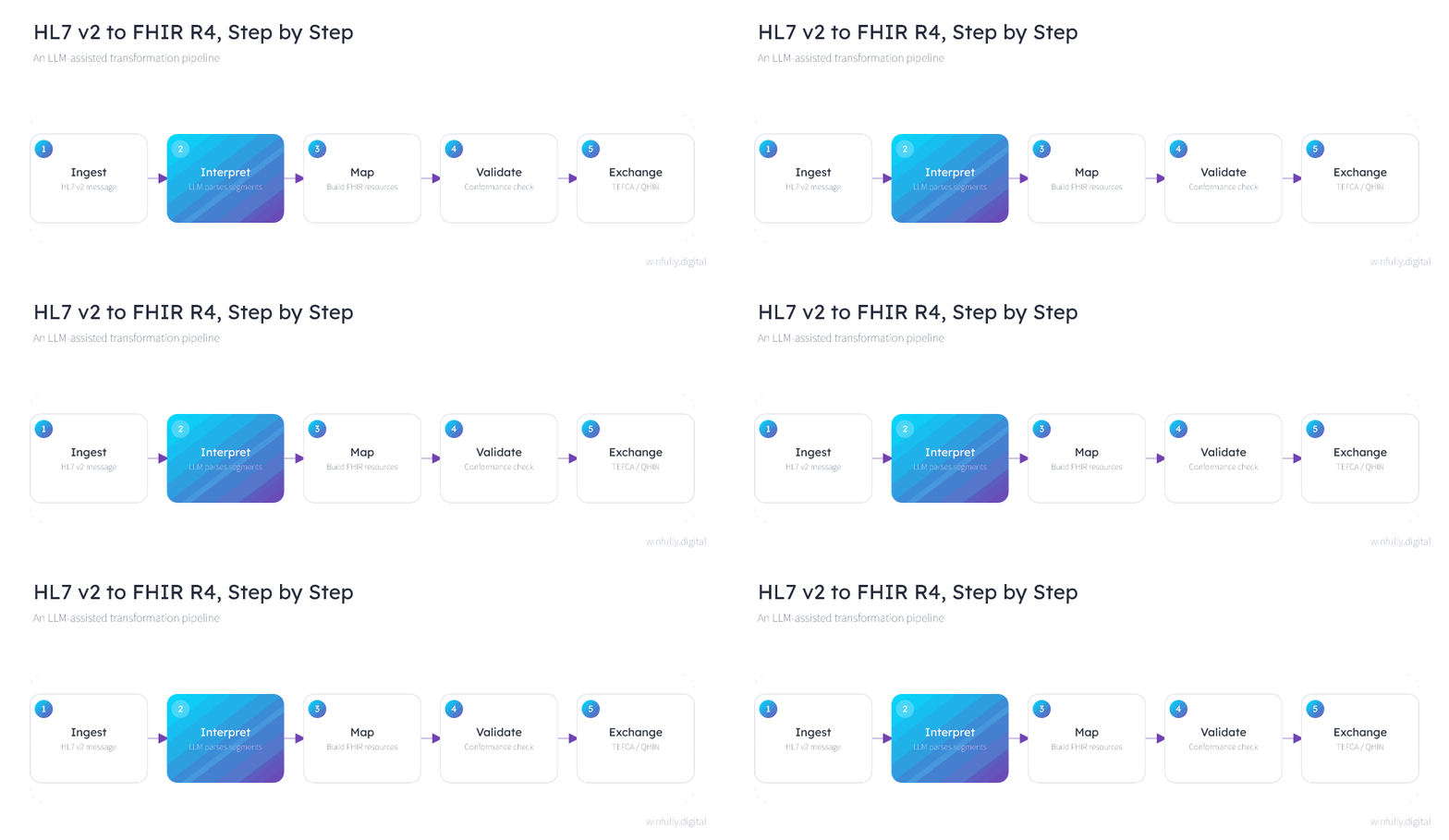
The animation below traces the HL7 v2 to FHIR R4 transformation, step by step:
Benefits and Risks: The Business Case for Upgrading
Operational Efficiency: LLM-assisted transformation takes manual reconciliation out of admissions, discharges, and transfers. Real-time FHIR API access means staff pull patient data on the spot instead of re-keying it, and coordination with hospitals, specialists, and payers gets simpler. Facilities that standardize their interoperability can cut administrative workload by up to 30 percent.
Cost Reduction: Maintaining a pile of custom HL7 v2 interfaces is expensive. Modern interoperability trims that IT overhead, cuts manual errors, and speeds up billing and claims. Over time facilities save 15 to 25 percent on administrative expenses while their compliance posture improves.
Regulatory Risk of Inaction: Staying on HL7 v2 alone carries a growing cost. You get limited access to TEFCA networks, more scrutiny as CMS and ONC widen their interoperability mandates, and a harder time meeting value-based care reporting. And every data delay during a transition is a patient safety risk that can turn into a compliance penalty.
HL7 v2 vs. FHIR R4: Key Technical Comparison
| Feature | HL7 v2 | FHIR R4 |
|---|---|---|
| Architecture | Point-to-point, message-based | RESTful API-based |
| Data Structure | Pipe-delimited, loosely structured | JSON/XML, standardized resources |
| Semantic Consistency | Variable across implementations | Standardized (SNOMED, ICD-10, LOINC) |
| Real-Time Access | Batch/polling, limited | Native API support, event-driven |
| Vendor Variability | High customization per vendor | Standardized implementation guides |
| TEFCA Alignment | Indirect, requires bridging | Fully compatible, core framework |
| Scalability | Limited to point-to-point | Network-of-networks architecture |
| Security Model | Transport-level | OAuth 2.0, SMART on FHIR |
Segment-Specific Applications
Providers (Hospitals, Health Systems): Clean ADT notifications, real-time lab result exchange, and discharge summaries shared with SNFs and post-acute facilities over TEFCA-connected QHINs. Fewer readmissions, better handoffs.
Payers and Health Plans: Automated eligibility verification, claims attachment exchange, and prior authorization workflows built on standardized FHIR data, all supporting the payment and healthcare operations exchange purposes now live on TEFCA.
Long-Term Care and Skilled Nursing: Automated medication reconciliation, ADT event processing, care plan synchronization, and MDS/OASIS documentation support, so you can join TEFCA without replacing your EHR.
Public Health and Government: Real-time reporting to CDC, SSA disability benefits determination (now onboarding to TEFCA via eHealth Exchange), and immunization registry integration. Every one of these depends on FHIR-based structured data.
Why WinFully on Technologies
Getting a facility TEFCA-ready takes expertise that spans four areas at once: legacy HL7 v2 systems, FHIR R4 implementation, clinical terminology standards, and AI-powered transformation. WinFully on Technologies (winfully.digital) brings 18+ years of healthcare IT work to that mix, with a focus on FHIR-based integrations, HL7 data exchange, DICOM imaging interoperability, and compliance frameworks like HIPAA, HITECH, and SOC-2.
The approach pairs standards-based interoperability architecture with AI-driven semantic intelligence, which is what lets adult care facilities connect legacy infrastructure to modern exchange networks without stopping operations to do it.
Conclusion: Bridging Legacy to the Future of Connected Healthcare
Adult care and skilled nursing facilities look after some of the most vulnerable people in the system. With TEFCA now past 12,000 participating organizations and federal agencies joining in, HL7 v2 messaging on its own no longer clears the bar for safe, efficient, compliant exchange.
TEFCA readiness needs three things: structured FHIR-based data, consistent meaning across systems, and solid governance controls. LLMs turn out to be a practical, proven bridge to all three, converting legacy HL7 v2 messages into interoperable FHIR R4 resources without upsetting operations. At 94 percent accuracy on real-world clinical data, the approach is ready for production, not just the lab.
Pairing AI-driven semantic intelligence with standards-based frameworks lets a facility tighten care coordination, take the risk out of transitions, and firm up its compliance footing. The ones that make this investment now aren't only meeting today's rules. They're getting ready for the full end-to-end FHIR exchange that TEFCA's Stage 4 roadmap promises, the point at which real-time data sharing across every participant in the national network simply becomes how care is done.
Ready to Achieve TEFCA-Ready Interoperability?
WinFully on Technologies helps healthcare organizations design and build HL7 v2 to FHIR R4 transformation, TEFCA-aligned interoperability infrastructure, and compliant digital solutions across the provider, payer, long-term care, and public health segments.
Contact us at contactus@winfully.digital | Visit winfully.digital