
RAG-Powered Clinical Decision Support for Primary Care Physicians
How Retrieval-Augmented Generation unites real-time patient data with evidence-based guidelines to ease physician burnout and sharpen primary care.
Introduction: The Hidden Cost of Information Overload in Primary Care
Primary care physicians (PCPs) sit at the front line of care, juggling acute, chronic, and preventive needs across large, complicated patient panels. The irony is that the tools meant to help them, Electronic Health Records (EHR), Practice Management Systems (PMS), Health Information Exchanges (HIE), and Patient Portals, have turned into one of their heaviest burdens.
Look at how a PCP's day actually splits. They spend roughly 4.5 hours in clinic and over an hour after hours on the EHR every day. A 30-minute appointment carries about 36 minutes of EHR work per visit once after-hours documentation is counted. EHR-related burnout runs at a pooled prevalence of 40.4 percent, and physicians who log more EHR time outside work are 2.4 times more likely to burn out. Nearly 69 percent of PCPs say most of the clerical EHR work doesn't need a trained physician at all.
Add it up and physicians spend about 2 hours documenting for every hour of direct patient care, which stretches the average week to 57.8 hours with only 27 of those spent face-to-face with patients. When burnout drives someone out, replacing them can cost an organization up to one million dollars once you factor in recruitment, lost revenue, onboarding, and the ramp-up before the replacement is fully productive.
This isn't only a workflow annoyance. It's a patient-safety, financial, and retention problem at once, and it needs a data-driven fix.
What Is RAG and How Does It Transform Clinical Decision Support?
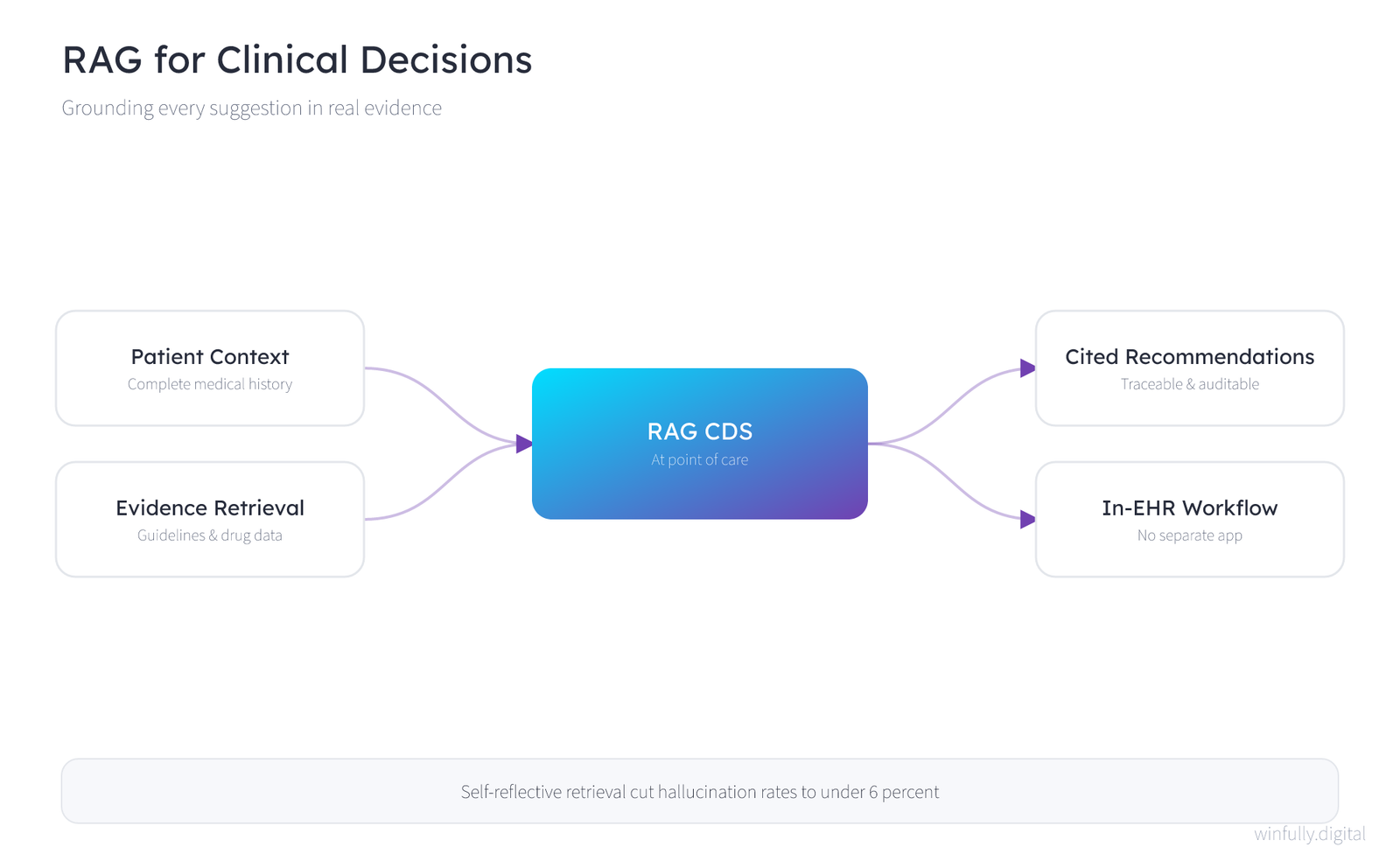
Retrieval-Augmented Generation (RAG) is a two-stage AI architecture that keeps knowledge retrieval separate from response synthesis. A standalone large language model (LLM) answers from static training data alone. A RAG system searches external sources at inference time first, then puts the LLM to work as a reasoning engine over what it found, producing answers that are grounded in context and cited to their sources.
That design maps neatly onto the problems PCPs face. Ask it about a patient's condition and it first retrieves what's relevant from FHIR-compliant EHR records, trusted clinical guideline repositories, drug interaction databases, and payer formulary systems. The LLM then turns that into concise, evidence-grounded recommendations, each with source citations you can trace and audit.
The research backs this up. A 2025 MDPI study tested twelve RAG variants against 250 clinical vignettes and found that hybrid retrieval pipelines, combining dense retrieval (DPR), sparse retrieval (BM25), and cross-encoder reranking, hit precision above 0.68 and nDCG@10 above 0.67. More notably, self-reflective RAG architectures cut hallucination rates to just 5.8 percent using an iterative "retrieve-evaluate-refine" loop. MedRAG, presented at ACM Web Conference 2025, showed how knowledge graph-enhanced RAG reasons more accurately about diseases that look alike, by pairing a four-tier hierarchical diagnostic knowledge graph with similar EHR cases on the fly.
A Frontiers in Medicine (2025) study pushed it further with an Agentic Graph RAG framework for hepatology built on a state-driven "retrieve-evaluate-refine" loop, where agents generated, validated, and refined their own graph search strategies. It's a clear example of how agentic capabilities raise RAG's clinical reliability.
For primary care, RAG is not a generic chatbot. It's a clinical-grade decision support layer, and every recommendation it makes is anchored in verifiable patient data, trusted evidence, and real-time retrieval.
Technical Architecture: The RAG Pipeline for Primary Care
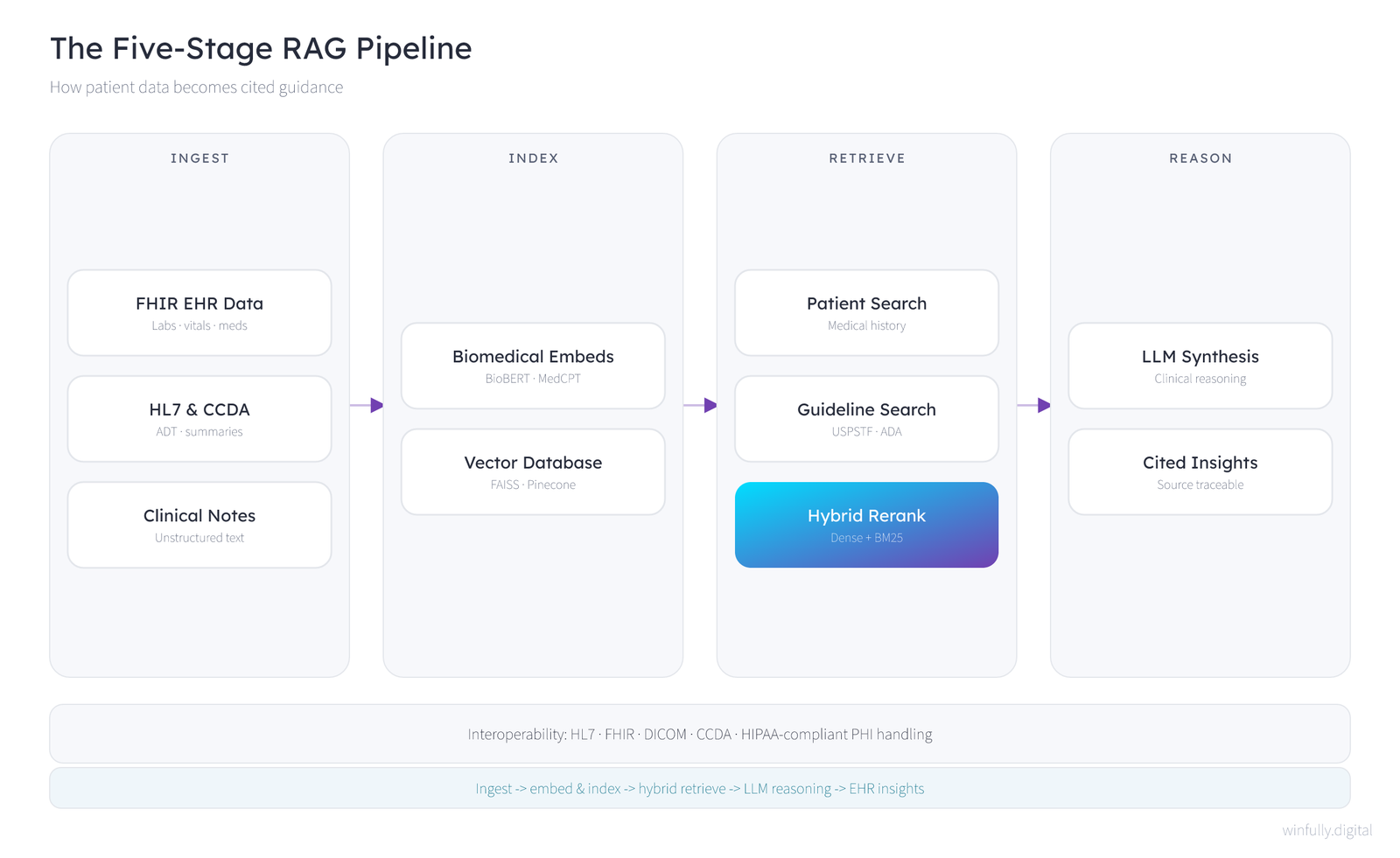
Here's how RAG-powered decision support runs end to end inside a primary care workflow, stage by stage:
Stage 1 | Real-Time Patient Data Ingestion
The system connects to FHIR-compliant EHR platforms over standard RESTful APIs and pulls in both structured data (lab results, vitals, medication lists, allergies, diagnoses, ICD-10/SNOMED CT codes) and unstructured data (clinical notes, imaging reports, discharge summaries). HL7 ADT feeds and CCDA documents get parsed, normalized, and split into meaningful chunks ready for embedding. PHI stays protected throughout under HIPAA-compliant handling.
Stage 2 | Vector Embedding and Indexing
Those data chunks and the clinical knowledge documents become dense vectors, produced by biomedical embedding models like BioBERT, PubMedBERT, MedCPT, or gte-large. Specialized medical embeddings clearly beat general-purpose models on clinical retrieval, and the research bears that out. The vectors live in high-performance databases (FAISS with 8-bit product quantization, Pinecone, or Weaviate), which return semantic matches across millions of documents in under a second.
Stage 3 | Dual-Path Hybrid Retrieval
A physician's query kicks off two retrieval paths at once. One runs a patient-specific semantic search across the full medical history, conditions, prior treatments, lab trends, risk factors, and social determinants. The other reaches into external knowledge bases: clinical practice guidelines (USPSTF, AHA, ADA, specialty societies), drug interaction databases (DrugBank, RxNorm), payer formulary requirements, and preventive care protocols. A hybrid fusion step, dense retrieval plus sparse BM25 plus cross-encoder reranking, scores and filters the passages for clinical relevance. It's the same setup that posted the highest precision in recent benchmarks.
Stage 4 | LLM-Powered Clinical Reasoning
The assembled context, patient data alongside evidence-based guidelines, goes to a large language model configured with medical system prompts, biomedical ontology alignment (SNOMED CT, ICD-10), and safety guardrails. From there the LLM reasons through the case in steps: spotting gaps in preventive care, flagging values outside reference ranges, catching potential drug-drug or drug-condition contraindications, weighing risk stratification, and ranking its recommendations. Every recommendation cites the source documents behind it.
Stage 5 | Workflow Integration and Continuous Learning
The insights land right inside the physician's EHR dashboard, part of the workflow rather than a separate app to open. They're concise, ordered by clinical urgency, and backed by the evidence. Physician decisions, overrides, and patient outcomes then flow back into the system as a learning loop, sharpening retrieval relevance, cutting alert fatigue, and tuning the recommendations to how the practice actually works.
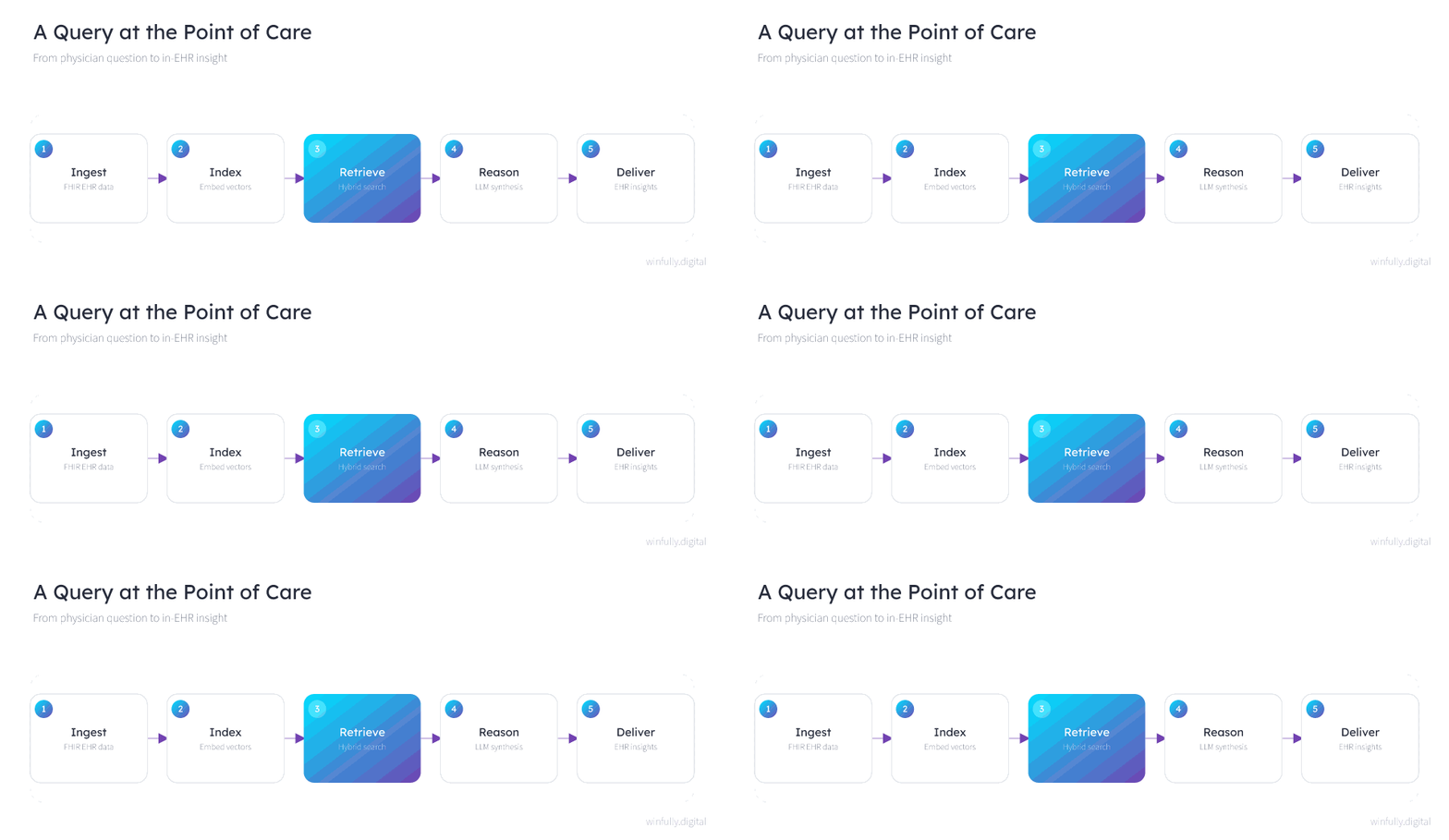
The diagram below traces a physician query at the point of care, from data ingestion to an in-EHR insight:
Clinical Impact: How RAG Transforms the PCP Workflow
Real-Time Complete Patient Context: Instead of clicking through a dozen EHR tabs, the physician gets the patient's full history condensed into one structured summary. Chart review time falls sharply, and even 5 to 10 minutes saved per patient adds up to hours a week across a full panel.
Evidence-Based, Personalized Recommendations: Because retrieval runs on two paths, every recommendation weighs both the patient's own profile (comorbidities, active medications, allergies, demographics) and the current guidelines. What the system suggests for a diabetic patient with hypertension won't be what it suggests for a young patient with no comorbidities, which is exactly how you avoid contraindications and bad drug interactions.
Reduced Cognitive Burden and Burnout: Think of RAG as a research assistant that reads the whole dataset and hands back only what's actionable. Take away the mental grind of cross-referencing guidelines, formularies, and history, and physicians report less fatigue, more confidence in their decisions, and less charting after hours. With after-hours EHR work carrying 2.4x the burnout risk, that's a direct win for retention.
More Time for Patient Care: Less time searching and documenting means more time with the patient, more room for clinical reasoning, and stronger relationships, all of which lift care quality, satisfaction, and value-based performance.
Healthcare Interoperability: The Data Foundation for RAG
RAG is only as good as the data it can reach. That means healthcare interoperability, EHR, PMS, LIS, RIS, HIE, and RPM systems talking to each other through standards like HL7, FHIR, DICOM, and CCDA, has to be in place first.
Break the data exchange and you break retrieval. The system loses access to real-time patient context, and its recommendations drift toward generic. So the interoperability layer isn't a nice-to-have you bolt on later. It's the thing you build before RAG.
WinFully on Technologies (winfully.digital) builds exactly that layer. With 18+ years in healthcare data exchange, FHIR-based integrations, and compliance frameworks (HIPAA, HITECH, SOC-2), the team sets up the interoperable foundation that makes RAG-powered clinical AI both possible and trustworthy.
Segment-Specific Applications of RAG in Healthcare
Primary care feels the benefit first, but RAG-based decision support reaches across the rest of the healthcare ecosystem too:
Providers (Hospitals, Specialty Clinics, Ambulatory Care): Automated diagnostic reasoning, discharge planning, documentation coding (ICD-10, CPT), prior authorization support, and post-visit follow-up. Less admin work in every care setting, plus better coding accuracy and a smoother revenue cycle.
Payers and Health Plans: Claims adjudication support, utilization management, medical policy compliance, member engagement, and fraud detection, with RAG grounding each decision in plan-specific formularies, coverage guidelines, and CMS requirements. Medical necessity reviews and benefit verification get automated through evidence-based retrieval.
Life Science and Pharma: Clinical trial patient matching, adverse event surveillance (pharmacovigilance), drug interaction analysis, real-world evidence generation, and regulatory documentation, with RAG tying together research databases, FAERS reports, and FHIR-compliant records to speed drug development and safety monitoring.
Home Health and Post-Acute Care: Automated care plan generation, medication reconciliation, RPM alert triage, follow-up coordination, and OASIS documentation, carrying RAG's value out of the hospital and into community-based care while lowering readmission risk.
Measurable ROI: Financial and Operational Impact
| Metric | Expected Impact |
|---|---|
| Chart review and data retrieval time | 40-60% reduction |
| Clinical documentation workload | 30-40% reduction |
| Diagnostic variability across providers | 15-25% reduction |
| Preventive care guideline adherence | 20-30% improvement |
| Physician turnover and recruitment cost | Significant reduction (avg. $1M per replacement avoided) |
| Value-based care performance metrics | Measurable improvement in quality scores |
| After-hours EHR documentation time | 25-35% reduction |
Conclusion: From Information Overload to Intelligent Decision Support
Primary care is at a turning point. Data volumes keep climbing, administrative demands keep growing, and burnout stays stubbornly high. RAG answers all three at once, combining real-time retrieval from trusted sources with strong language-model reasoning and a feedback loop that corrects itself. It's practical, it scales, and it's been validated in clinical settings.
Grounding every recommendation in FHIR-based records, verified guidelines, and domain-specific knowledge bases moves decision support past generic automation into something closer to evidence-based, context-aware clinical intelligence. It lightens the cognitive load, firms up diagnostic confidence, personalizes care, and looks after the physician too.
The strategic payoff follows: lower burnout risk, fewer errors, better quality metrics, stronger value-based performance, and primary care operations that can actually be sustained.
When there's more information than any one person can hold, RAG isn't just a nicer piece of software. It's a shift toward healthcare that's smarter, safer, and more human.
Ready to Build Your RAG-Powered Healthcare Solution?
WinFully on Technologies helps healthcare organizations design and build FHIR-based interoperability infrastructure, AI-powered clinical decision support, and compliant digital solutions across the provider, payer, and life science segments.
Contact us at contactus@winfully.digital | Visit winfully.digital