
The January 2027 Prior Authorization API Deadline Is Closer Than It Looks — Your Realistic CMS-0057-F Roadmap
The CMS-0057-F Prior Authorization API deadline is January 1, 2027. What the rule requires and a realistic 16-week roadmap for payers and providers.
If you work at a health plan or a provider organization, you've probably had CMS-0057-F sitting on a compliance checklist somewhere since early 2024. Back then, January 2027 felt like a lifetime away. It isn't anymore. As of this writing, you have a little over sixteen weeks of real engineering time left in 2026 — and if your Prior Authorization API isn't in a test environment yet, you're no longer early.
We work with mid-size payers and provider organizations every week, and the pattern is remarkably consistent: everyone knows the rule exists, most have read a summary, and very few have an actual implementation underway. This post is for that majority. No scare tactics — just what the rule requires, why the technical lift is bigger than the summaries suggest, and a realistic path to get there from where you are today.
What CMS-0057-F actually requires
The CMS Interoperability and Prior Authorization Final Rule was published in January 2024, and it splits its demands into two waves.
The first wave already hit. Since January 1, 2026, impacted payers — Medicare Advantage plans, Medicaid and CHIP fee-for-service programs, Medicaid and CHIP managed care plans, and Qualified Health Plan issuers on the federally facilitated exchanges — have been required to meet the operational provisions: prior authorization decisions within 72 hours for expedited requests and seven calendar days for standard requests, specific denial reasons communicated to providers, and public reporting of prior authorization metrics. If you're a payer reading this, you're presumably living that reality already.
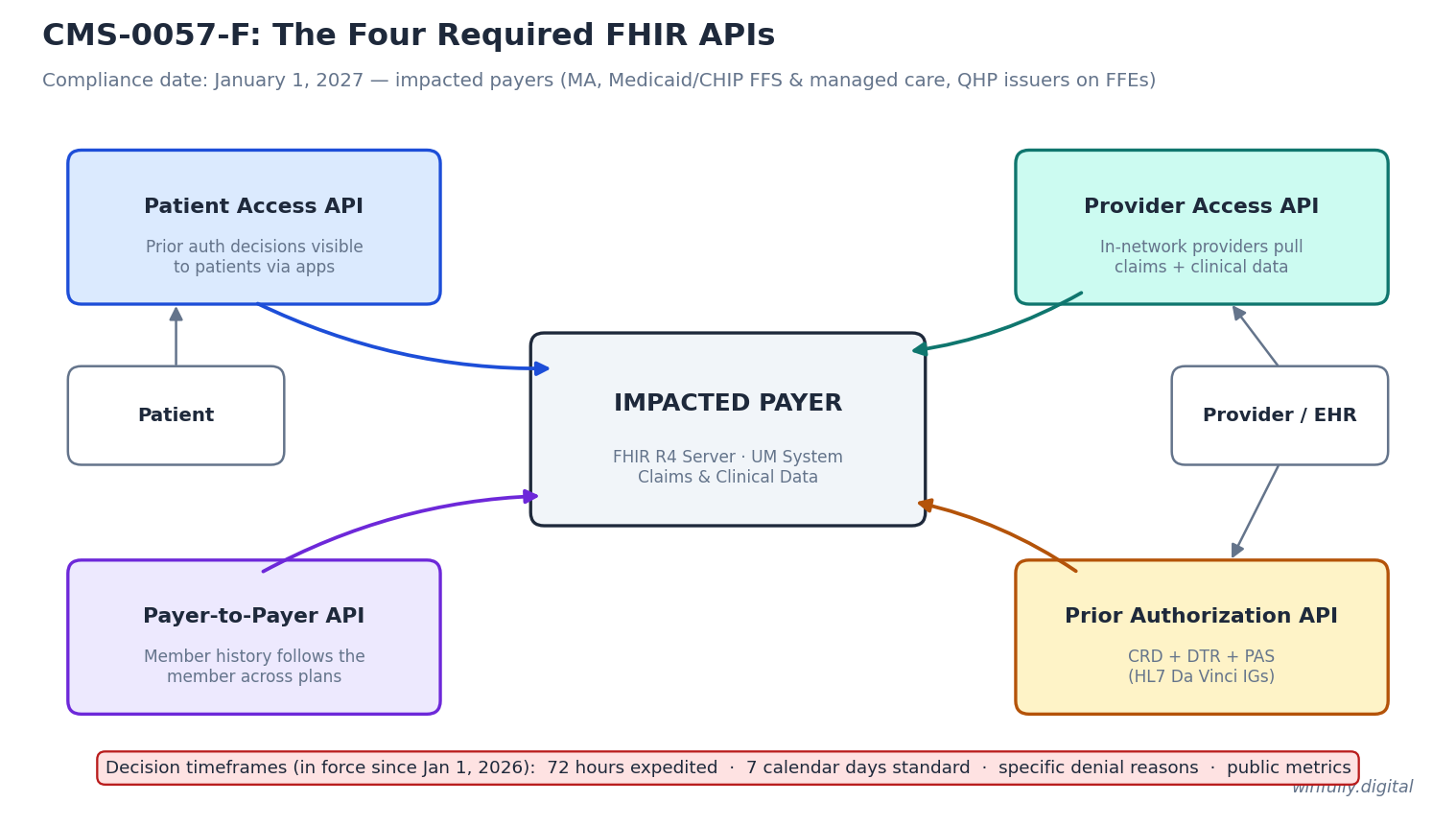
The second wave is the one that matters now. By January 1, 2027, impacted payers must have four FHIR-based APIs live:
The Prior Authorization API — the headline item. It must let providers query whether prior authorization is required for a given item or service, identify the documentation requirements, and submit the request and receive the decision electronically. In practice this means implementing the HL7 Da Vinci implementation guides: Coverage Requirements Discovery (CRD), Documentation Templates and Rules (DTR), and Prior Authorization Support (PAS).
An enhanced Patient Access API — extending what the 2020 rule required so patients can see prior authorization decisions and related information through the apps they already use.
The Provider Access API — giving in-network providers access to patient data the payer holds, including claims and clinical data, so care decisions aren't made blind.
The Payer-to-Payer API — so when a member switches plans, their new payer can pull their history rather than starting from zero.
Providers aren't off the hook either. MIPS-eligible clinicians and hospitals now face an "electronic prior authorization" measure, which means your EHR workflows need to actually use these APIs, not just admire them from a distance.
Why this is harder than the compliance summaries make it sound
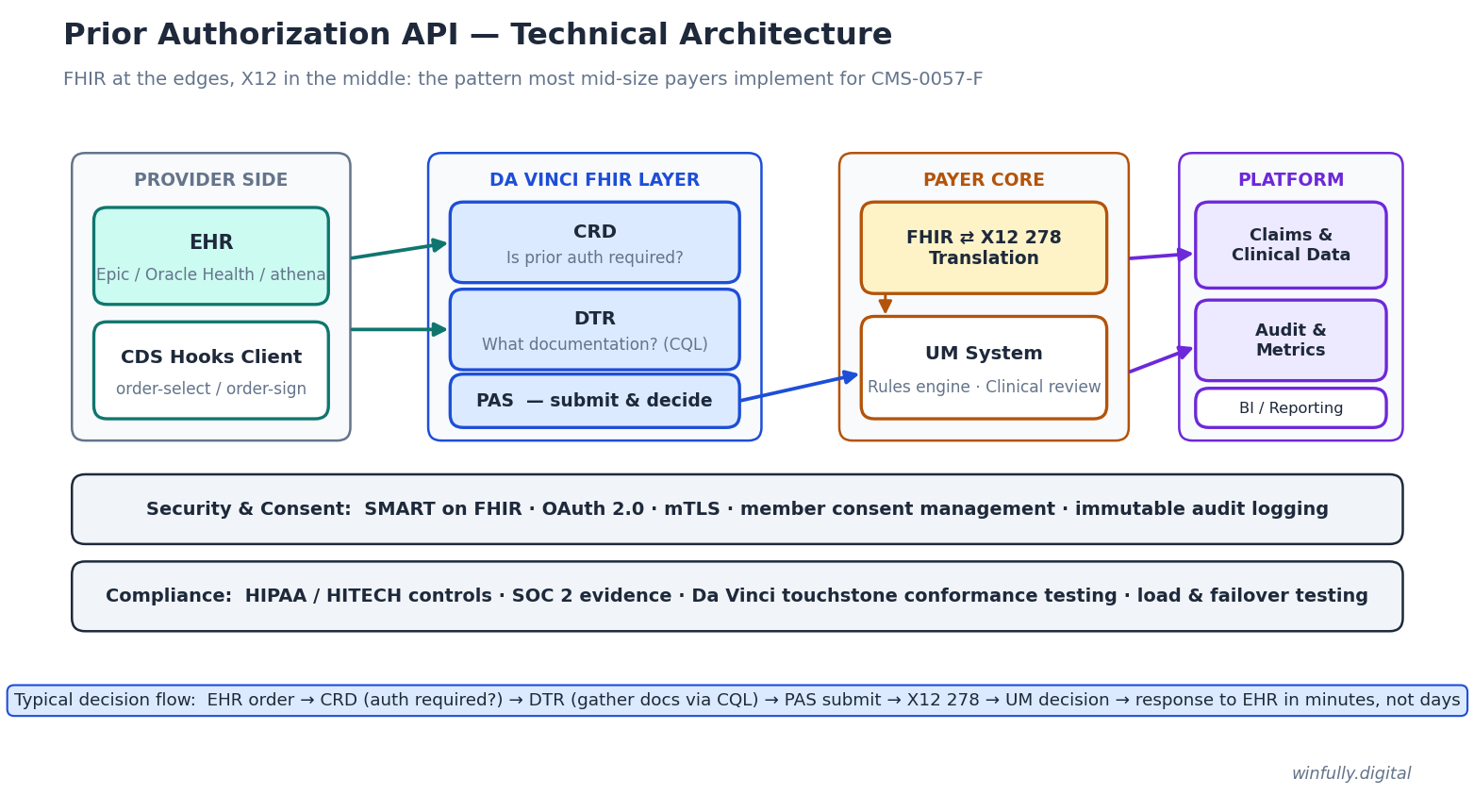
Here's the part the two-page vendor one-pagers gloss over: the Prior Authorization API isn't one API. It's a coordinated dance between three Da Vinci implementation guides, your utilization management system, your clinical rules engine, and — for most payers — a legacy X12 278 pipeline that isn't going anywhere, because HIPAA transaction standards still apply. Most real-world architectures end up running FHIR at the edges and translating to X12 in the middle, which means mapping, reconciliation, and a whole category of edge cases nobody budgeted for.
Then there's the data problem. CRD and DTR only work if your coverage rules and documentation requirements exist in a machine-readable form. At a lot of mid-size plans, those rules live in PDFs, portal content, and the heads of two senior UM nurses. Digitizing that knowledge is routinely the longest pole in the tent — longer than the API build itself.
And there's the integration problem on the provider side. An API nobody calls doesn't reduce burden or satisfy the spirit of the rule. Provider organizations need their EHR — Epic, Oracle Health, athenahealth, eClinicalWorks, whatever you run — configured to fire CRD hooks at the right moments in the ordering workflow, render DTR questionnaires, and submit through PAS. That's workflow engineering, not just interface engineering.
The large national payers have had teams on this since 2024. The organizations we worry about — and the ones we mostly serve — are the mid-size plans and provider groups under a hundred million in revenue, who don't have a standing FHIR team and can't afford a failed first attempt.
A realistic sixteen-week-to-live roadmap
You can still make January 2027 without heroics, but the sequencing matters. Here's the roadmap we use with clients, compressed to its essentials.
Weeks 1–3: Assessment and gap analysis. Inventory your current state honestly: where prior auth rules live, what your UM system can expose, what FHIR maturity your existing vendors actually have (ask for their Da Vinci PAS test results, not their brochure). Decide build-vs-buy per component — most mid-size organizations buy a FHIR server and CRD/DTR tooling and build the integration and rules layers.
Weeks 4–8: Foundation. Stand up the FHIR infrastructure, implement identity and consent (SMART on FHIR, OAuth 2.0), and start the unglamorous work of digitizing coverage rules into CQL and DTR questionnaires. Run this rules-digitization track in parallel with the engineering track from day one — it's the schedule risk.
Weeks 9–13: Integration and translation. Wire the PAS flow into your UM system, build or configure the FHIR-to-X12 278 translation layer, and connect the Provider Access and Payer-to-Payer APIs to your data stores. This is where the edge cases surface: partial approvals, pended requests, requests needing peer review. Design for them explicitly.
Weeks 14–16: Testing and hardening. Da Vinci Touchstone testing, security review, load testing, and — critically — end-to-end tests with at least one real provider partner ordering real (test) services through their actual EHR workflow.
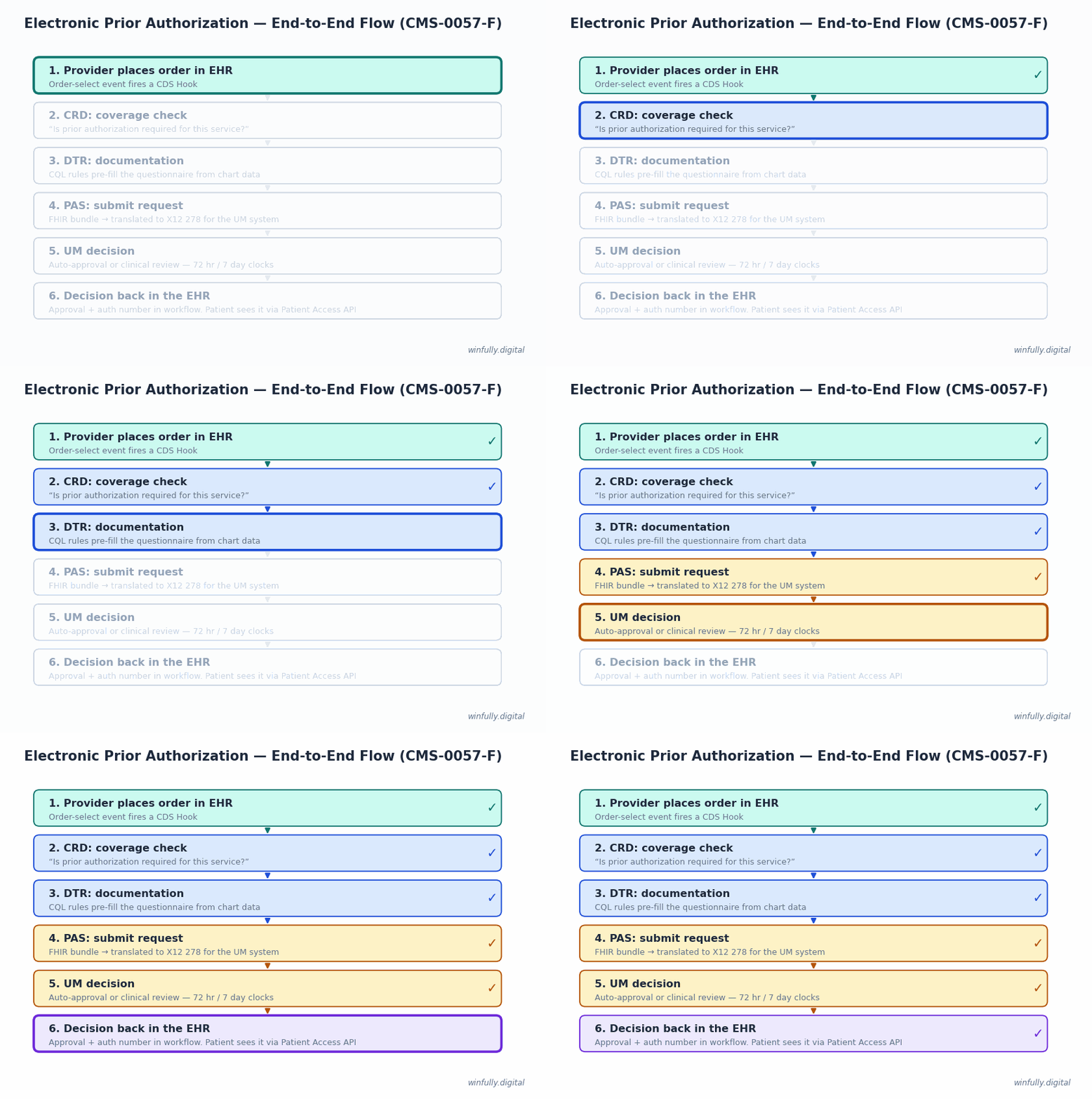
The diagram below traces the end-to-end electronic prior authorization flow we typically implement, from the order-select CDS Hook through to the decision landing back in the provider's EHR.
The cost of waiting
Every month of delay from here doesn't just compress the schedule — it changes what's possible. Integration partners' calendars fill up. EHR configuration queues at provider organizations stretch to months. And CMS has signaled through the first wave's enforcement posture that "we're working on it" is not a compliance strategy. Beyond the regulatory exposure, there's a quieter cost: plans that get this right early are already using the same FHIR infrastructure to reduce call center volume and speed up care decisions. The compliance project, done well, pays for itself in operations.
Where Winfully fits
At Winfully on Technologies, healthcare interoperability is one of the core things we do — FHIR implementations, Da Vinci guide conformance, EHR integration, and the HIPAA/HITECH and SOC 2 compliance work that has to travel alongside all of it. We specialize in exactly the organizations this rule stresses most: mid-size payers and provider groups that need enterprise-grade engineering without an enterprise-size standing team.
If you're staring at January 2027 and aren't sure whether your current plan gets you there, let's find out together. We offer a free 30-minute consultation — bring your current state, and we'll walk through your gap analysis and give you an honest read on your timeline, whether or not you ever work with us. No slide deck, no hard sell.
Book your free 30-minute consultation →
Winfully on Technologies is an IT consulting and implementation firm specializing in healthcare, fintech, and supply chain solutions for small to mid-size organizations. Learn more at winfully.digital.