
Building an Agentic AI Care Coordinator for Home Health Using LangGraph
How agentic AI built with LangGraph automates home health care coordination, cutting administrative burden up to 40% while improving clinical outcomes.
Introduction: The Administrative Bottleneck in Home Health
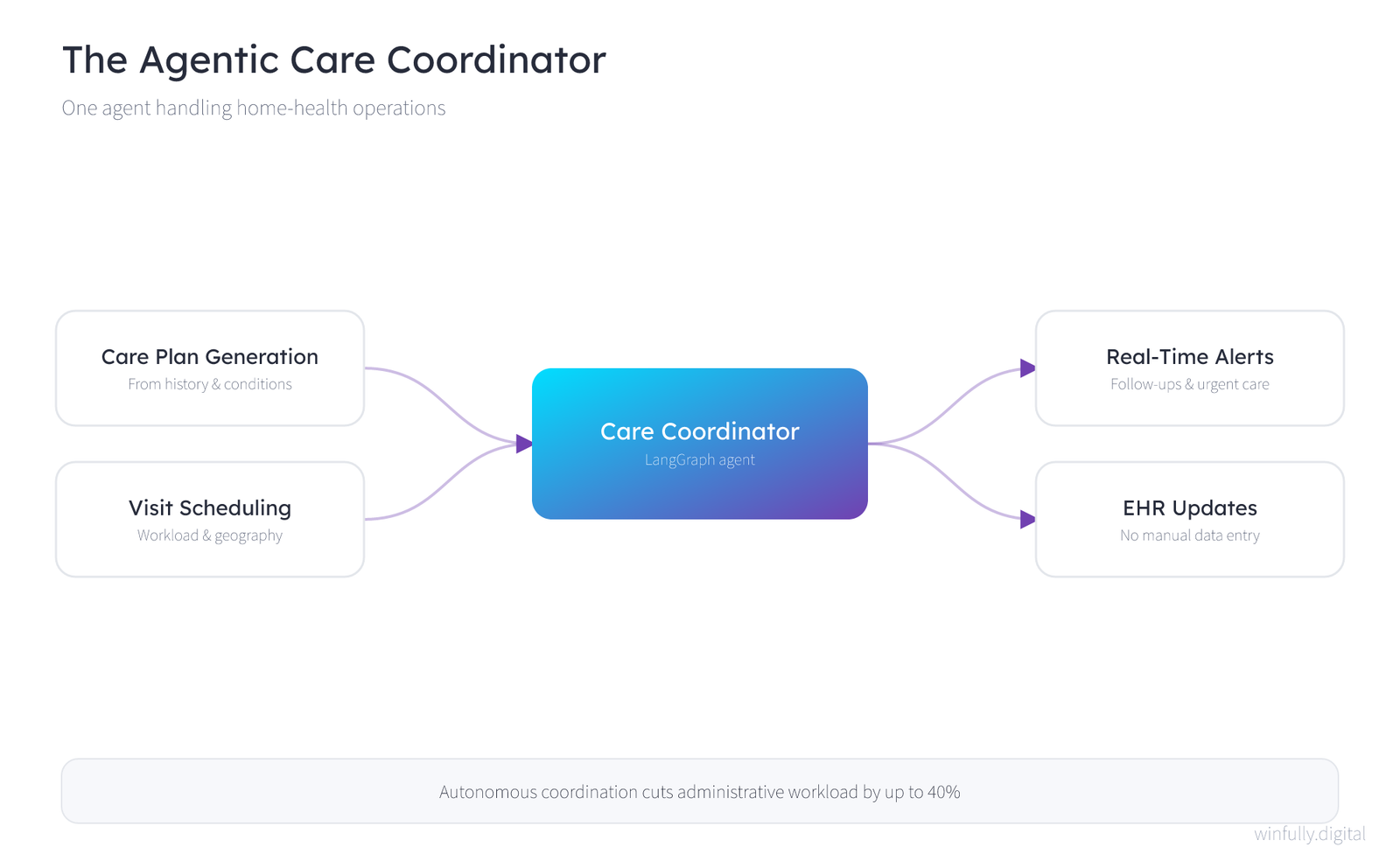
Home health agencies deliver care where people actually want it: at home. But every visit sits on top of a mountain of paperwork, from care plan creation and nurse scheduling to clinical documentation, progress tracking, and regulatory compliance. That work eats up to 40% of staff time, pulling clinicians away from the reason they took the job, which is caring for patients.
The industry has reached a turning point. Deloitte's 2026 US Health Care Outlook Survey found that over 80% of healthcare executives expect both agentic AI and generative AI to deliver moderate-to-significant value across clinical, business, and back-office functions. Microsoft research published in the New England Journal of Medicine found that 60% of healthcare leaders believe agentic AI will meaningfully improve the provider-patient experience. The debate has shifted from whether to adopt AI to how to do it well and responsibly.
That's where agentic AI built on LangGraph comes in, giving home health agencies an autonomous care coordination system that does far more than the software tools they're used to.
What Is Agentic AI and Why Does It Matter for Home Health?
Agentic AI is a real break from the passive, prompt-driven tools most teams know. Generative AI produces content, like a clinical summary or a documentation draft. Agentic AI goes further: it plans, reasons, takes action, and runs whole workflows across multiple systems without someone steering every step.
In home health, that gap changes everything. Ask a traditional tool "What is this patient's blood pressure trend?" and it hands you a summary. An agentic system watches the trend on its own, checks pharmacy records, catches a missed medication refill, nudges the patient with a reminder, and books a telehealth check-in with the nurse. All of it happens without a prompt.
For an agency, that means agentic AI can build patient-specific care plans from medical history and current conditions, schedule and optimize nursing visits around workload and geography, fire off real-time alerts for follow-ups or urgent interventions, and keep electronic health records (EHR) and documentation current without anyone typing it in by hand.
61% of healthcare organizations are already building or have secured budgets for agentic AI initiatives (Deloitte, 2026)
Why LangGraph? The Framework Behind Intelligent Care Workflows
LangGraph is a graph-based orchestration framework in the LangChain ecosystem, built for stateful, multi-step agent workflows. Where a linear automation chain runs step after step, LangGraph lays out tasks as nodes in a directed graph. Each node is a decision point, an action, or a data source, and the edges between them set the conditional paths execution can take.
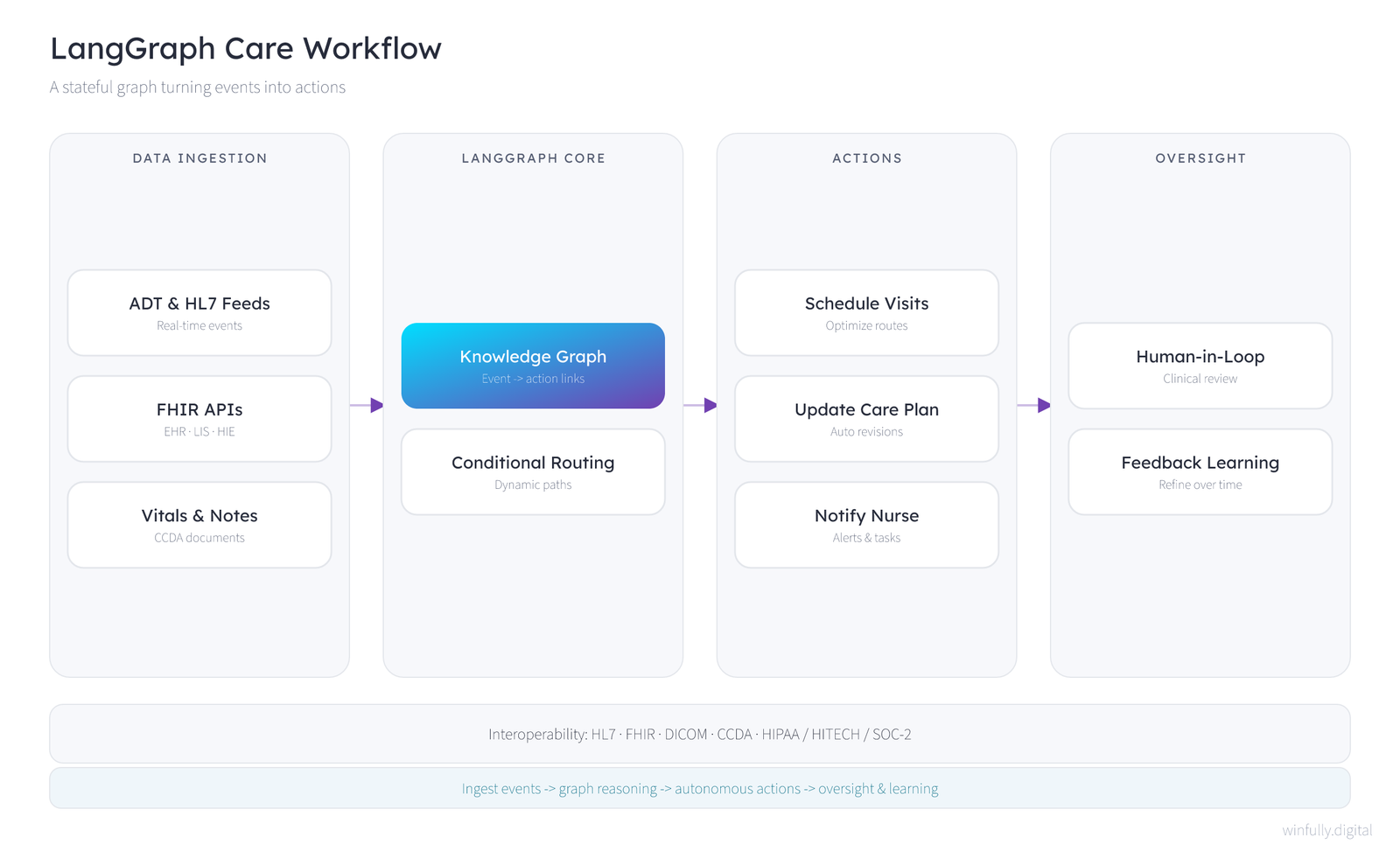
That fits healthcare well, because clinical work is rarely a straight line. Take a patient's Admit-Discharge-Transfer (ADT) event. It doesn't move through one tidy sequence. It sets off a chain of connected actions: updating the care plan, notifying the assigned nurse, scheduling a follow-up, reconciling medications, and sometimes flagging the physician about abnormal labs. Every one of those depends on context from a different system.
Key LangGraph Capabilities for Healthcare
Graph-Based Reasoning: Ties patient events (ADT, vitals, lab results) to the right clinical actions through structured knowledge graphs, holding context steady across a multi-step process.
FHIR & HL7 Integration: Reads standardized healthcare data through FHIR APIs and connects EHR, LIS, RIS, and HIE systems so data moves between them in real time.
Persistent State Management: Keeps a patient's context intact across sessions, so coordination holds together even as their condition shifts over days or weeks.
Conditional Routing: Adjusts the workflow to what's actually happening. A routine follow-up becomes an urgent intervention the moment new labs point to deterioration.
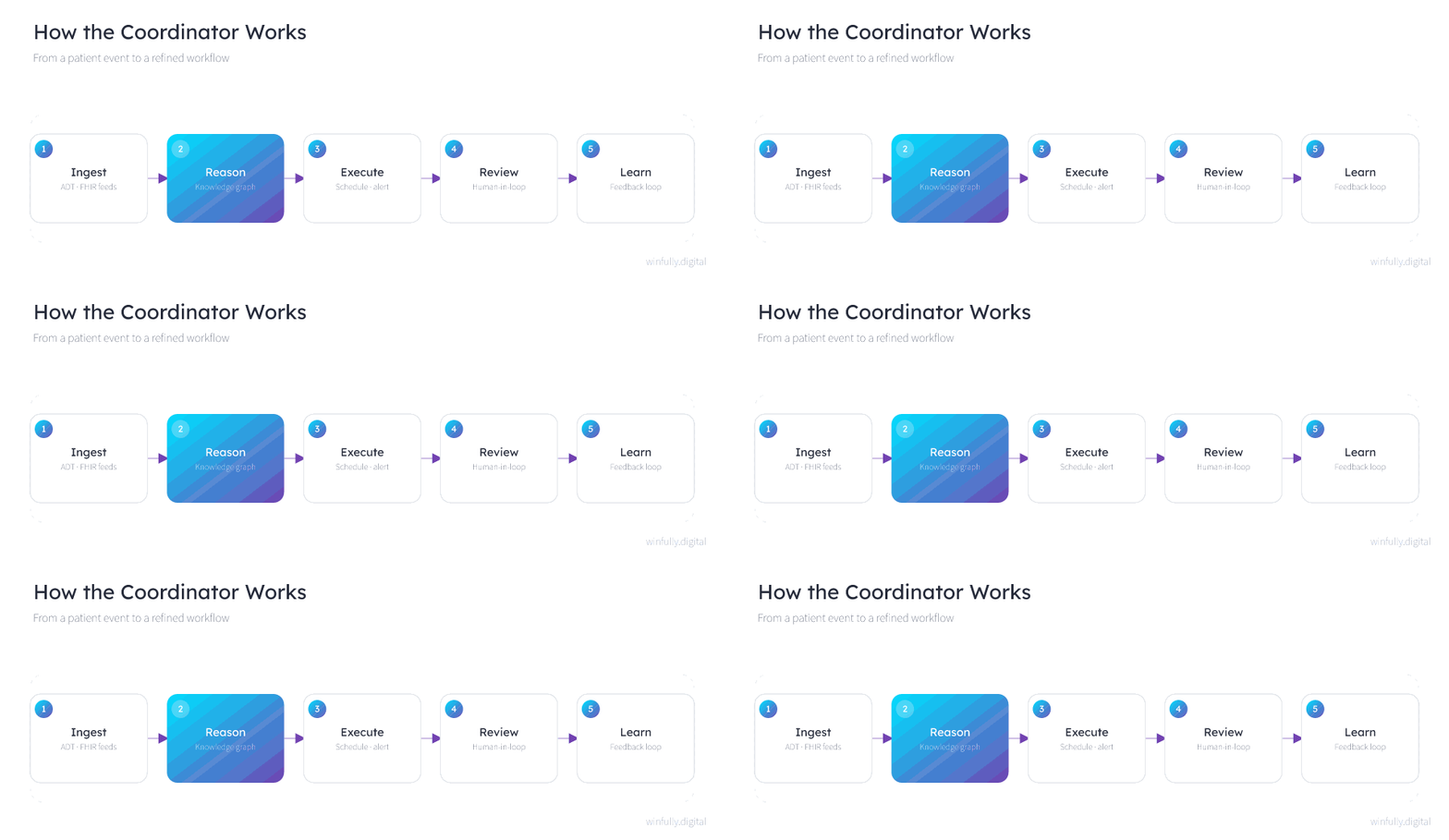
The diagram below traces how the coordinator works, from a patient event through to a continuously refined workflow:
How the Agentic Care Coordinator Works: A Step-by-Step Workflow
Step 1 | Real-Time Data Ingestion: ADT events, clinical notes, vitals, and prior visit data come in as they happen through FHIR-compliant APIs. The system plugs into existing EHR platforms and data exchange networks, reading structured data from HL7 feeds and CCDA documents.
Step 2 | Graph-Based Clinical Reasoning: LangGraph builds a live knowledge graph that connects each event to the clinical and administrative actions it should set off. A hospital discharge, for instance, automatically kicks off follow-up scheduling, medication reconciliation, care plan updates, and home safety assessment coordination.
Step 3 | Autonomous Action Execution: The agent handles routine work on its own: booking visits, alerting nurses, updating care plans, and drafting clinical documentation. When a decision carries real weight, a human-in-the-loop checkpoint puts a clinician in the loop.
Step 4 | Continuous Learning and Feedback: Completed tasks and nurse confirmations flow back into the graph and sharpen the next round of decisions. Over time the system spots bottlenecks, tightens scheduling patterns, and adapts protocols to how patients actually respond.
Measurable Impact: ROI and Performance Metrics
An agentic care coordinator pays off in numbers you can track across operations, clinical quality, and finances. Deloitte's data shows that 98% of surveyed healthcare executives expect at least 10% cost savings from agentic AI within two to three years, and 37% expect savings above 20%.
30-40% Reduction in Administrative Workload: Automating care plan generation, scheduling, and documentation cuts manual data entry sharply, which frees nurses to see more patients.
20-30% Improvement in Scheduling Accuracy: Smarter scheduling cuts missed, delayed, and duplicate visits while balancing each nurse's workload against travel time.
10-15% Reduction in Hospital Readmissions: Continuous monitoring and proactive alerts catch problems early, so interventions land in time to prevent complications and avoidable readmissions.
15-25% Operational Cost Savings: Leaner workflows trim overtime, and the added visit capacity grows revenue without a matching jump in headcount.
Healthcare Interoperability: The Foundation for Agentic Intelligence
Agentic AI is only as good as the data underneath it. Interoperability, connecting separate systems through standards like HL7, FHIR, DICOM, and CCDA, is the foundation that lets agents reach patient data, make sense of it, and act on it across the care continuum.
For a home health agency, that means pulling EHR platforms, practice management (PM) systems, laboratory information systems (LIS), radiology information systems (RIS), and health information exchanges (HIE) into one data layer. Without that plumbing, even the smartest agent stalls. It has no real-time context to make a clinical call.
WinFully on Technologies (winfully.digital) works right at this intersection of healthcare interoperability and AI. With hands-on experience in FHIR-based integrations, health data exchange, and compliance frameworks like HIPAA, HITECH, and SOC-2, the team helps providers, payers, and life science organizations build the data foundation agentic AI depends on.
Beyond Home Health: Agentic AI Across Healthcare Segments
Home health has the most to gain from agentic coordination, but the same framework carries across the rest of healthcare:
Healthcare Providers (Hospitals, Clinics, Specialty Care): Prior authorization, discharge planning, post-visit follow-ups, and documentation coding, all run by agents that talk to EHR, scheduling, and billing systems.
Health Plans and Payers: Claims processing, utilization management, and member engagement workflows. Gartner predicts that all surveyed payer organizations plan to deploy agentic AI by 2028.
Life Science and Pharma: Trial recruitment, adverse event monitoring, drug interaction analysis, and regulatory documentation, handled by agents working across research databases and FHIR-compliant records.
Conclusion: From Reactive to Proactive Care Delivery
For home health agencies, agentic AI on LangGraph is more than a better tool. It changes how care gets coordinated, delivered, and improved. Pair autonomous agents with graph-based clinical reasoning and FHIR-compliant interoperability, and an agency moves from chasing tasks to orchestrating care ahead of need.
The numbers back it up: administrative burden falls by up to 40%, timely interventions lift clinical outcomes, scheduling accuracy climbs 20-30%, and agencies grow patient capacity without adding staff at the same rate. If you're mapping out a digital transformation roadmap, this isn't a someday item anymore.
Healthcare is heading toward a split where automation absorbs the routine complexity and clinicians spend their time on the patients who need them. The agencies that invest in the right interoperability and AI now are the ones who will set the standard everyone else follows.
Ready to Build Your Agentic AI Healthcare Solution?
WinFully on Technologies helps healthcare organizations design and build interoperability infrastructure, AI-powered workflows, and compliant digital solutions.
Contact us at contactus@winfully.digital | Visit winfully.digital