
Ambient Listening Meets Multi-Agent AI: Eliminating Clinical Documentation Burden in Small Provider Practices
How ambient AI and multi-agent systems automate clinical documentation, easing physician burnout so small practices can refocus on patient care.
Physicians are spending too much of their day on paperwork instead of patients. On average, a doctor puts in roughly one hour of documentation for every five hours of patient care. That trade-off hurts both sides of the exam room and drags down the quality of care overall. Small and new practices feel it most: enterprise documentation tools are out of reach, so they stay on manual charting. The result is predictable — burnout, more late-night work, and fewer patients seen. Ambient AI paired with multi-agent systems is where that pattern starts to break.
The goal is straightforward: give physicians their time back instead of asking them to work around the clock. Ambient AI handles the charting, coding, and auditing in the background while the doctor is with the patient. It takes on the documentation load so clinicians can spend that recovered time on care.
Ambient AI and Documentation Crisis
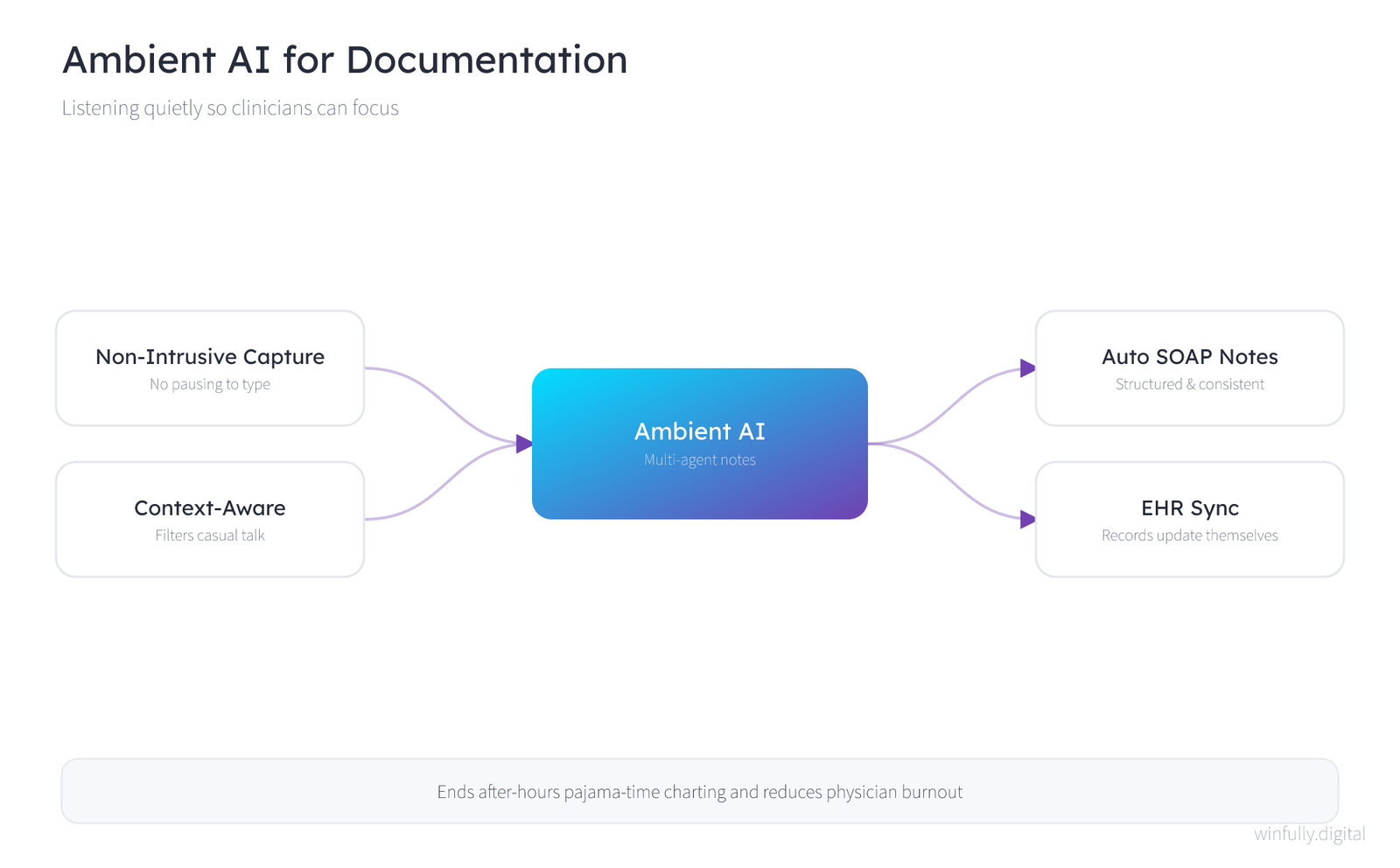
Ambient AI runs quietly in the background, listening to and interpreting a real conversation without getting in the way. Rather than the doctor typing into the EHR, the system listens to the exchange between physician and patient and updates the record on its own, keeping the documentation structured. Traditional EHRs make the clinician the data-entry clerk; ambient AI acts more like an assistant that listens, understands, drafts the note, and hands it back.
The documentation crisis is worth sizing up honestly. Hours of after-work charting lead to burnout, which in turn erodes patient compliance and, in some practices, drives staff turnover. The practical fix is ambient AI that is affordable, scales with the practice, and drops into the existing clinical workflow without a heavy lift.
How does Ambient AI work?
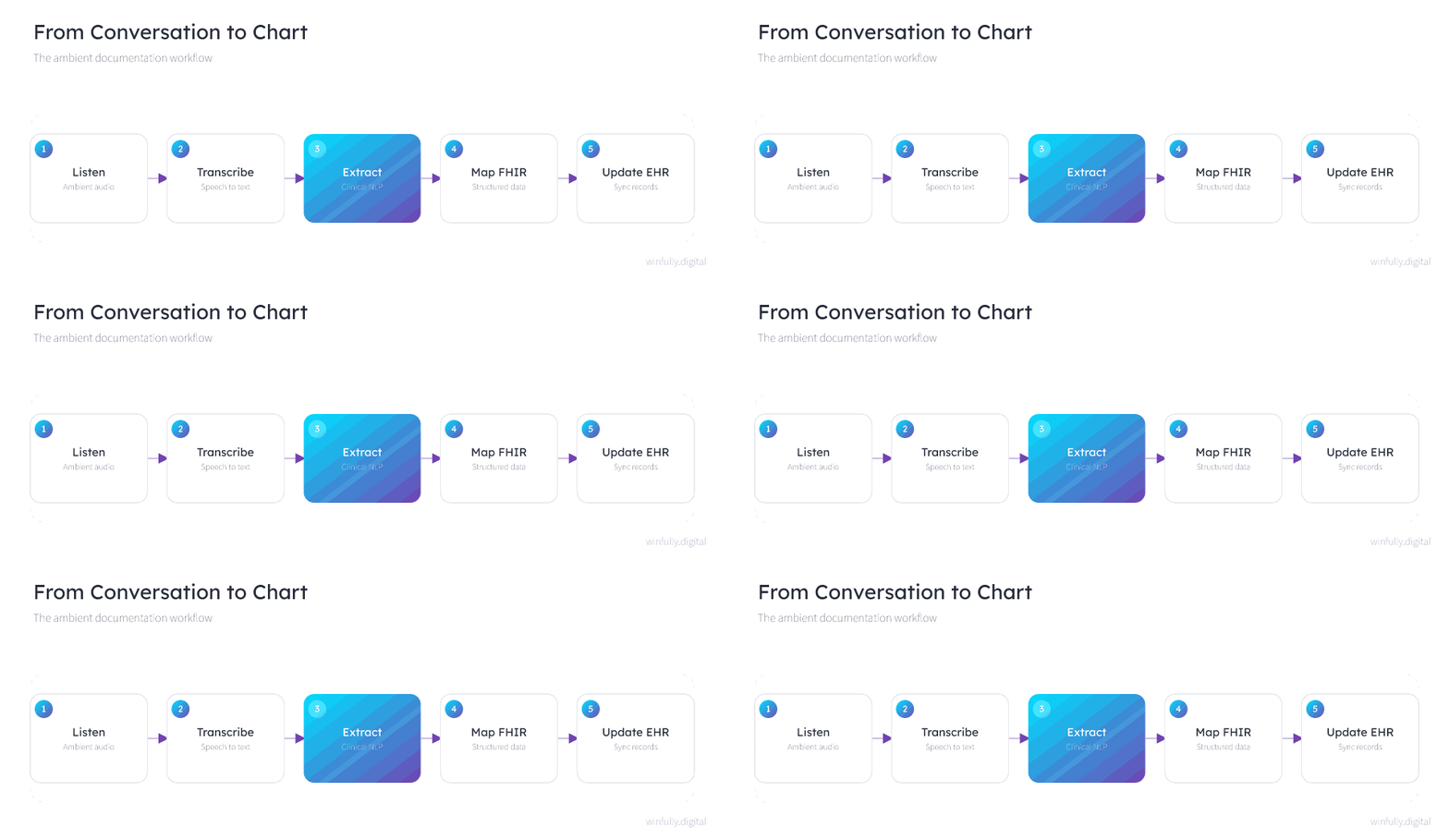
Ambient AI listens to the visit and turns it into a structured clinical note. It works in a few steps. A microphone captures the conversation, and speech is converted to text — the transcription step. The AI then reads that transcript, pulls out the medical details that matter, and drafts the note. Finally, the note is written to the Electronic Health Record (EHR). No manual typing, a lot of time saved for the physician, and a knock-on benefit for patient compliance.
Inside the multi-agent ambient AI system (LangGraph Architecture)
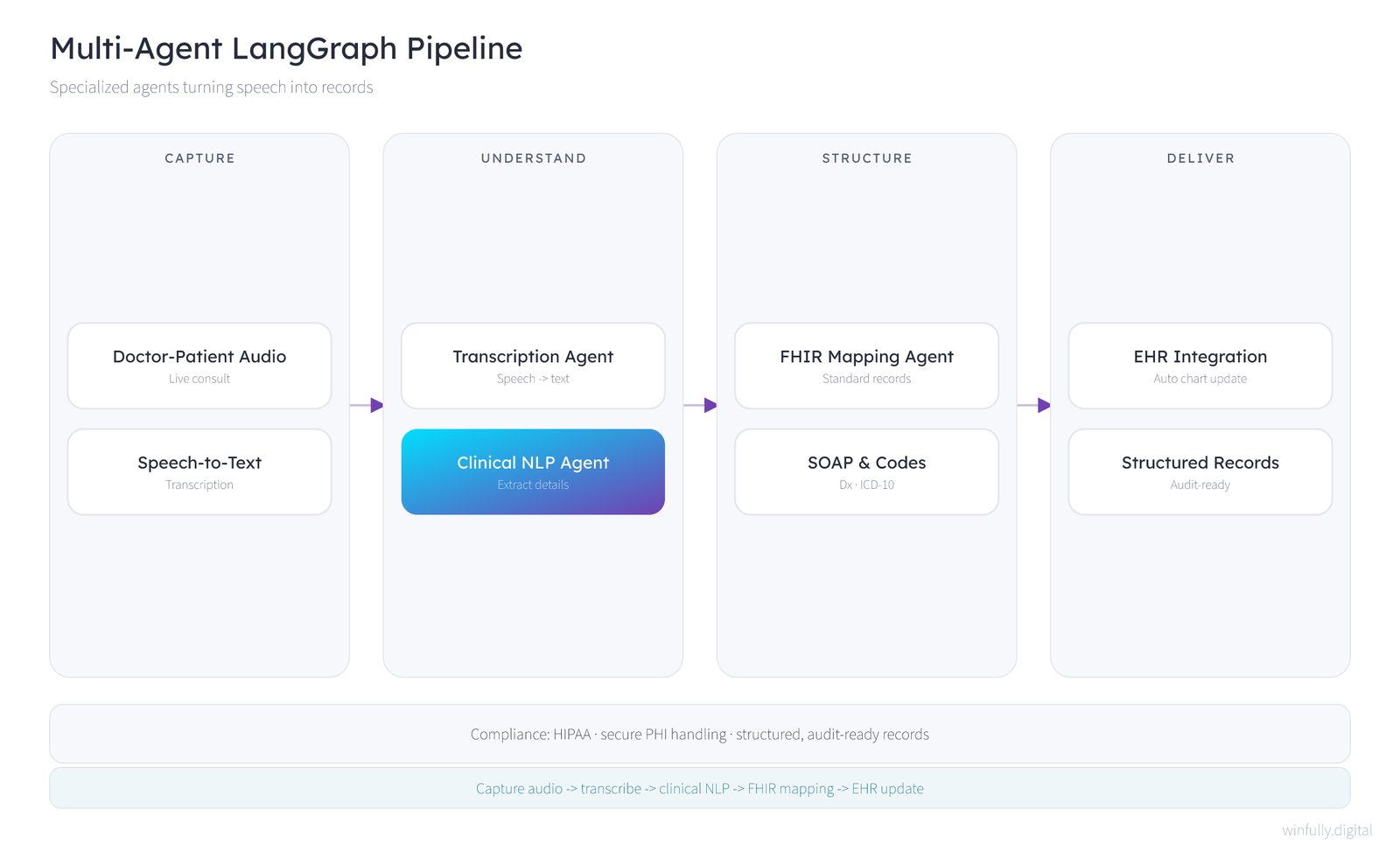
For the system to stay reliable, the work is orchestrated with LangGraph, which organizes several AI agents into a step-by-step workflow. Rather than one large model trying to do everything, each agent owns one task. That keeps the system accurate, easier to scale, and easier to control in the messy reality of a clinical setting.
The agents pass work down the line. First, a transcription agent captures the doctor–patient conversation and converts the speech into usable text. A Clinical NLP agent then reads that text and extracts the medical detail — SOAP notes, diagnosis codes — so the system understands the clinical context correctly. From there, a FHIR Mapping agent turns the unstructured output into standardized, healthcare-ready records that clinical systems can accept. Last, an EHR Integration agent pushes those records into the practice's EHR, updating the patient's chart as needed.
Splitting the work this way makes the whole pipeline more accurate and dependable, keeps data moving cleanly from one stage to the next, and takes the manual documentation load off the provider.
Features of Ambient AI
Non-Intrusive
The system stays in the background and never interrupts the visit. Doctors don't have to stop and type mid-conversation, so the exchange flows naturally and their attention stays on the patient rather than the screen.
Context-Aware
The AI can tell clinically relevant information from small talk. It drops the chatter and keeps the medical detail. "How are your kids?" gets ignored; "Pain in the knee for 3 days" gets recorded as clinical data.
Auto-Structuring
Captured information lands in a proper medical format automatically. The system produces SOAP notes — Subjective (what the patient reports), Objective (clinical observations), Assessment (diagnosis or condition), and Plan (treatment or next steps) — so the documentation stays accurate and consistent visit to visit.
The diagram below traces the ambient documentation workflow from conversation to chart:
Impact of Ambient AI Technology
Improved Efficiency and Time Savings
With the notes generated automatically, doctors spend far less time on manual documentation — which means more patients seen and schedules that hold together.
Better Patient Care
When the charting is handled, the doctor's attention goes back where it belongs. Visits become real conversations, patient concerns get heard, and both care and compliance improve.
Reduction in Physician Burnout
The after-hours charting known as "pajama time" largely goes away. That eases the stress that comes with it and gives providers back some work-life balance.
Compliance and Data Security
Accurate, structured records and careful handling of patient data help practices meet their regulatory obligations, including standards like HIPAA.
Transform Clinical Documentation with Ambient AI
Clinical documentation is no longer just an operational chore. It shapes provider efficiency, patient care, and compliance all at once. Ambient AI, paired with multi-agent systems, automates the paperwork, tightens accuracy, and gives doctors more room to focus on patients.
At WinFully on Technologies, we design and build ambient AI tailored to your practice — from LangGraph-based multi-agent systems to EHR integration and HIPAA-compliant workflows.
Cut the documentation workload, improve patient care, and stay compliant without adding complexity. Talk to WinFully on Technologies to build your AI-powered clinical workflow.