
LangChain & FHIR: Building a Conversational Patient Intake Agent for Paediatric Clinics
How conversational AI agents built with LangChain and FHIR streamline pediatric patient intake, cutting admin burden and improving data accuracy.
Few workflows in outpatient care are as tangled as pediatric intake. An adult visit rarely needs more than the presenting symptoms and a quick history. A child's visit does: family medical history, a full immunization record, allergies, birth history, growth patterns, and age-specific developmental milestones. And most of that comes from a parent or caregiver, not the patient. These are people who may never have heard the clinical name for a vaccine or a milestone. Some are working from memory. Others are reading off a dog-eared vaccination card or a stack of records collected from three different providers.
Paper forms and static digital questionnaires were never built for that. Parents skip fields they don't understand. A vaccine date gets typed in wrong. A developmental concern goes unmentioned because the question never made sense to the person reading it. Then front-desk staff have to chase down the gaps, key the answers into the EHR, and reconcile whatever doesn't line up. The result is a slower workflow, thinner documentation, and more admin work than anyone signed up for.
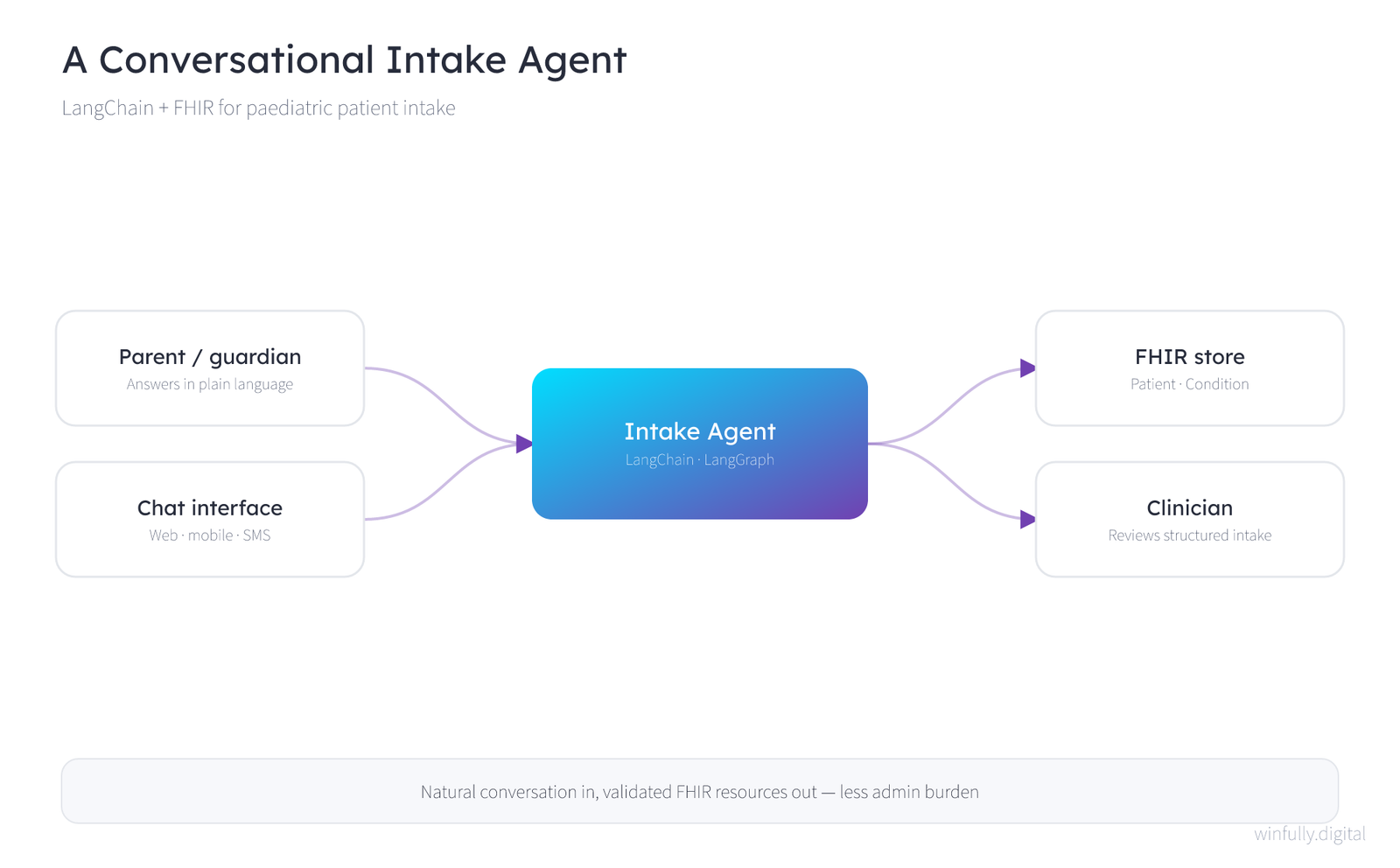
A conversational intake agent shifts the burden. Built on LangChain, the FHIR interoperability standards from HL7, and agentic AI design, it walks a parent through intake one plain-language question at a time, adapting as it goes.
Common Challenges
Uncertainty About Vaccination Record
Parents rarely recall exact vaccine names, schedules, or dates from memory, so immunization records come in incomplete or slightly off.
Missed Developmental Milestones
A subtle speech, motor, or behavioral concern gets missed when the question wasn't phrased in a way the caregiver understood.
Incomplete Family Medical History
Hereditary conditions such as asthma, diabetes, or heart disease go undisclosed, often because the parent didn't know to mention them or simply forgot.
Manual Data Re-Entry
Staff retype paper and portal answers into the EHR by hand, which adds workload and invites transcription errors.
FHIR in Pediatric Intake
FHIR (Fast Healthcare Interoperability Resources), developed by HL7, is the data standard that keeps clinical information structured and exchangeable between systems. In an intake workflow, it does the translation work: a parent's spoken answer becomes standardized clinical data rather than a free-text note. Demographics, immunizations, growth metrics, developmental observations, and family history each map to a defined FHIR resource.
That structure is what lets intake data flow straight into EHR systems, decision support tools, and population health platforms without rekeying. It also opens the door to real-time validation. Vaccine entries, for example, can be checked against the recommended schedules from the Centers for Disease Control and Prevention, which sharpens accuracy and supports preventive-care compliance.
Agentic Workflow
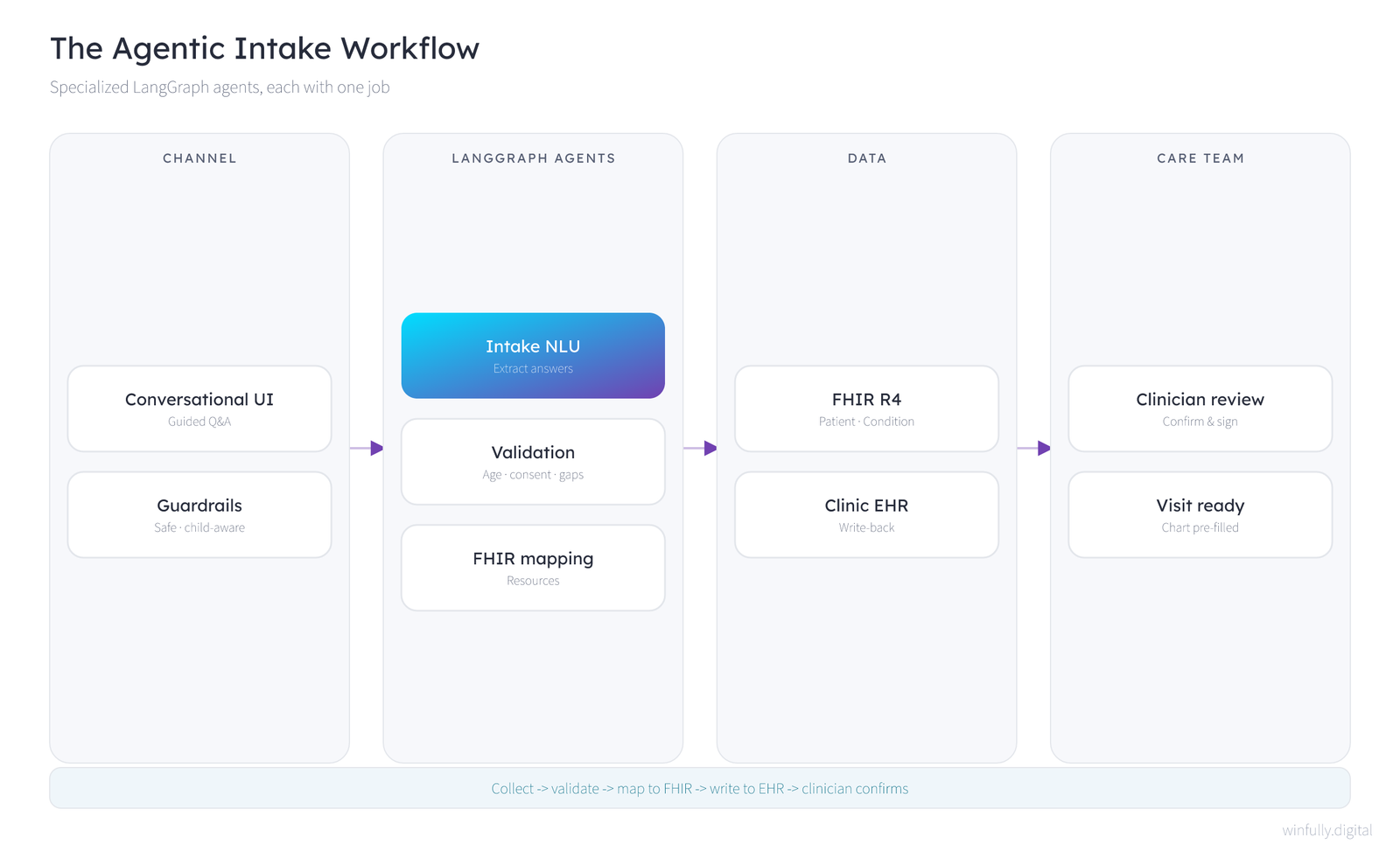
Intelligent Reasoning and Data Collection
As answers come in, the agent reads them in clinical terms and reshapes the conversation around the child's age, history, and what the parent has already said.
Clarification of Data
A vague answer like "I think last year" triggers a follow-up question rather than a blank field, so the record ends up specific.
Missing Information Request
When vaccine dates, allergy details, or developmental data are missing, the agent asks for them before it moves on.
Gap Detection
Timing gaps and irregular vaccine intervals that fall outside recommended guidelines get caught early, before they become documentation errors.
Risk Indicators
High-risk hereditary conditions or concerning developmental patterns are surfaced for the provider to review, so nothing waits until the visit to be noticed.
Standardized Clinical Data
Validated answers are assembled into FHIR bundles that follow HL7 specifications.
Seamless EHR Submission
The structured data then moves securely into the clinic's EHR. No retyping, less admin load, and a record you can trust.
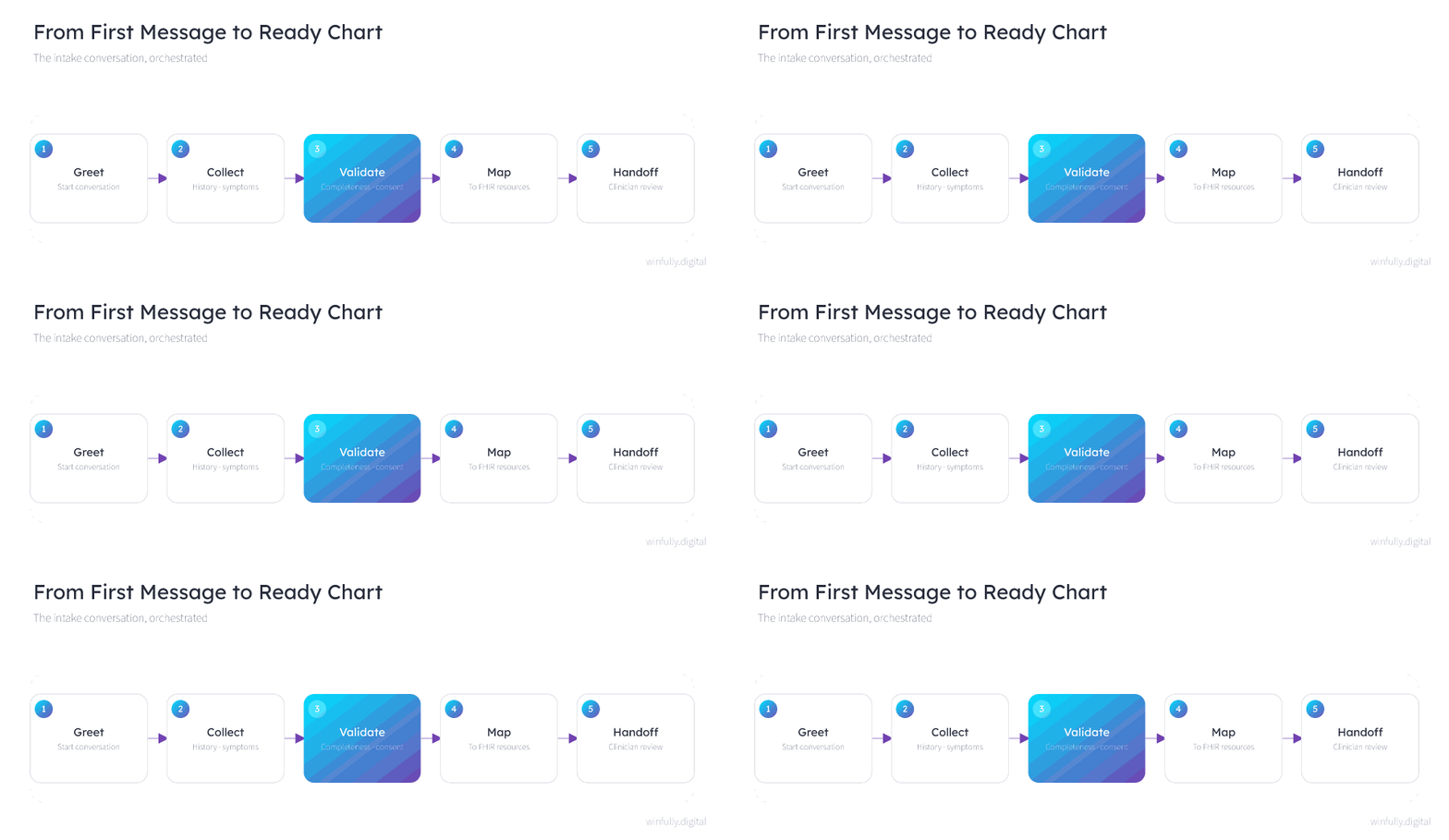
The animation below follows the intake conversation from first message to a ready chart:
Benefits for Paediatric Clinics
Reduced Administrative Burden
Automated capture and direct EHR integration take repetitive manual entry off the front desk, so staff can spend their time on patient coordination instead of paperwork.
Higher Data Completeness and Accuracy
Conversational prompts plus real-time validation produce a fuller, more structured, more reliable record.
Improved Vaccine Schedule Compliance
Checking entries against recommended immunization guidelines catches gaps early and keeps preventive care on track.
Friendly and Stress-Free Intake Experience
Plain-language questions make intake feel manageable, even for a caregiver with no medical background.
Faster Check-In and Reduced Wait Times
Clean, structured data moves through the workflow faster, which keeps the clinic running smoothly.
LangGraph and Real-World Impact
LangGraph is a graph-based AI framework that lays out data, actions, and decision logic as connected nodes and edges. That structure is what lets an intake agent reason across a child's demographics, immunization records, growth metrics, and family history rather than treating each answer in isolation. Connect those points and the system can validate responses, catch inconsistencies, flag high-risk conditions, and produce recommendations in real time. The same pattern shows up outside healthcare too, in finance for risk assessment, in supply chain optimization, and in compliance monitoring, wherever multi-step reasoning sharpens a decision.
The numbers hold up in practice. Deployments have shown efficiency gains of 30–50%, mostly by cutting manual data entry. Short-term, the savings come from fewer labor hours and fewer transcription errors, on the order of 10–20% of operational costs. Longer-term, you get better compliance, stronger preventive care, and annual savings of $50k–$150k per department depending on clinic size. The flow itself is straightforward: ingest patient data, map it onto the graph for reasoning, flag gaps or risks, generate structured FHIR output, and populate the EHR automatically. Fewer errors, safer patients, and clinical staff who get to spend their day on care instead of paperwork.
Conclusion
Pediatric records are about as sensitive as data gets, so security and compliance are not optional. Encrypt everything in transit and at rest. Use role-based access control so only authorized people can view or change records. Keep audit logs of AI-generated entries, and put a human review step in place to catch anything that looks off.
Compliance aside, pairing LangChain with FHIR gives clinics a genuinely better workflow. These agents don't replace staff. They hand physicians a complete, validated, structured picture of the patient before the visit even starts.
Put the pieces together (AI-driven conversation, standards-based interoperability, and automated handoff to the EHR) and pediatric clinics can run safer, faster, and more patient-centered care.