
Interoperability: Cross System Data Exchange in Healthcare
A guide to healthcare data interoperability, covering standards like HL7, FHIR, and DICOM, RESTful APIs, and best practices for secure data exchange.
This article explains why interoperability matters in healthcare IT and how to put it into practice without the process falling apart. It also draws on WinFully Information Systems' work building healthcare applications. If you run or support a healthcare organization, it's worth a read.
Moving patient data between systems, quickly and securely, is no longer a nice-to-have. It's the job. Over 18 years in healthcare IT, I've watched cross-system data transfer break in more ways than I can count, and this post covers what actually holds up. That means the standards you'll deal with most (HL7, FHIR, and DICOM), the protocols that carry the data (RESTful APIs and Secure FTP among them), and the practices that keep data intact, secure, and compliant.
I wrote this for healthcare and IT professionals who want to sharpen their data-transfer approach and get more out of their systems. By the end, you'll have a clearer picture of how to build data-transfer systems that scale and adapt as healthcare IT keeps shifting.
What Does Interoperability Mean?
After 18 years building software in healthcare IT, here's how I define interoperability: hardware and software (applications, databases, and other systems) working together as if they were one.
In healthcare, that matters more than in most fields. Interoperability is the ability of health information systems, devices, and applications to connect, both inside a single organization and across its walls. It covers the secure exchange and use of patient data and related information: admission and discharge records, transfer notifications, lab and exam results, even fully detailed claims. When that data flows freely and reliably, care gets more efficient and more effective. When it doesn't, everything slows down.
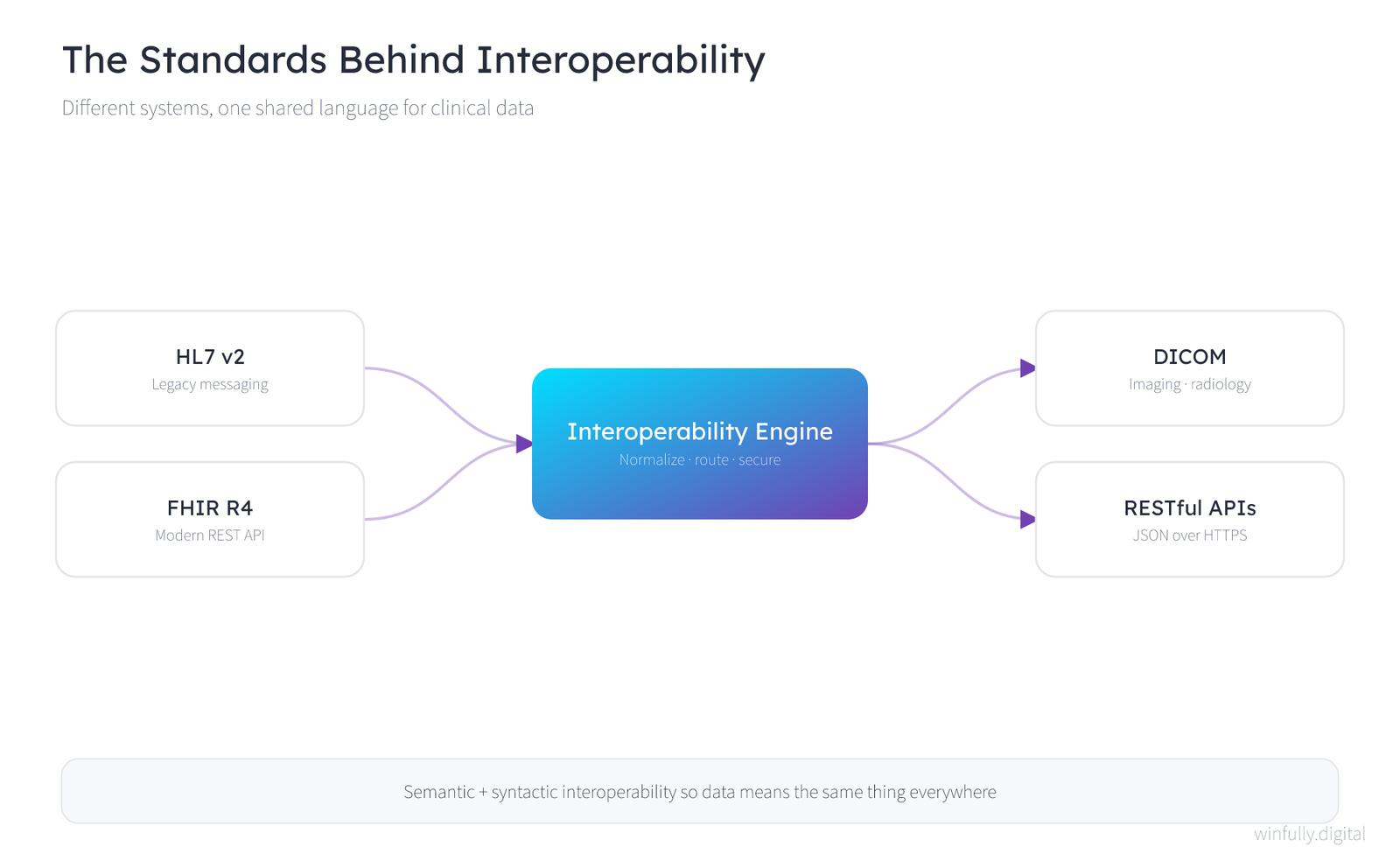
Cross-System Data Exchange: The Backbone of Modern Healthcare IT
Healthcare IT lives or dies on one thing: moving patient data between systems reliably and efficiently. Get it right and operations run smoother and care improves. Get it wrong and the standard of care suffers.
The hard part is the sheer number of standards and protocols that govern how that data moves.
Understanding the Standards: HL7, FHIR, and DICOM
HL7, FHIR, and DICOM do most of the heavy lifting in cross-system data transfer. Each one solves a different problem and fits different use cases, so I'll walk through them with examples.
-
HL7 (Health Level 7)
- HL7 refers to a set of international standards for the exchange of clinical and administrative data in healthcare. It's designed to streamline the process so different systems can understand and interpret the data being exchanged.
- HL7 messages are encoded in a specific format, with fields and segments (each on a distinct line) separated by delimiters. An HL7 message including patient information, for example, would typically begin with an MSH (Message Header) segment and proceed to include PID (Patient Identification) and PV1 (Patient Visit) segments.
- Consider the following scenario: A patient visits a clinic. When a patient is registered, the clinic's system generates an HL7, ADT (Admission, Discharge, Transfer) message. This message contains information such as patient identification, visit information, and insurance information. When data is sent to a hospital information system, the system interprets it for further processing, such as appointment scheduling or updating medical records.
-
FHIR (Fast Healthcare Interoperability Resources)
- A more recent standard called FHIR was created by HL7 with interoperability and ease of use in mind. It works especially well with cloud communications, mobile devices, and the web.
- FHIR makes use of contemporary web technologies like XML, JSON, and RESTful APIs. It organizes data into basic units called "resources" that can be joined to create complex healthcare data representations. A 'Patient' resource in FHIR, for example, may include attributes like name, gender, and birthdate.
- Consider a telemedicine app that needs to retrieve a patient's medical history from a hospital's electronic health record (EHR) system. Using FHIR, the app can send a RESTful query to the EHR's FHIR server to retrieve the 'Patient' resource. This query would return structured data (such as JSON) containing the patient's medical history, which the app could then display.
-
DICOM (Digital Imaging and Communications in Medicine)
- DICOM is the international medical imaging standard. It is used to store, transmit, and retrieve medical images and information.
- DICOM facilitates the integrated management of images and patient data by fusing image data with patient information. A DICOM file normally includes the image data as well as a header that holds patient data, scan type, and other information.
- Say a radiologist performs an MRI. The scan is saved as a DICOM file that carries both the patient's information and the specifics of the study. Send that file to another provider, and their DICOM-compliant system can display the image alongside the patient details in one view. That bundling of image and patient data in a single file is exactly what makes DICOM so useful in practice.
Ensuring Secure and Efficient Data Transfer
Now the protocols that actually carry the data. Three matter most in healthcare IT: RESTful APIs, SOAP, and Secure FTP. Here's what each is good for and where it fits.
-
RESTful APIs
- RESTful APIs are a popular choice in healthcare data exchange, particularly with the advent of FHIR. They use standard HTTP methods and are known for their simplicity and statelessness.
- In a clinical application, to retrieve a patient's medical record, the app might make a GET request to the FHIR server using a RESTful API. The server responds with the requested data in a structured JSON format that the application can then process and display.
-
SOAP
- SOAP is a protocol used for exchanging structured information in web services. It is known for its high security and extensibility, making it suitable for complex enterprise-level healthcare applications.
- A SOAP message may be used in a hospital information system to transmit sensitive patient data to a billing system. This message would be encrypted and could contain detailed patient billing information in a structured XML format.
-
Secure FTP (File Transfer Protocol)
- Secure FTP is used for transferring large files or batches of data securely over the internet. It is essential for scenarios like transferring large medical imaging files or extensive patient records.
- A healthcare provider needs to send a large number of patient records to a central health information exchange (HIE). Secure FTP can be used to encrypt and safely transmit these files.
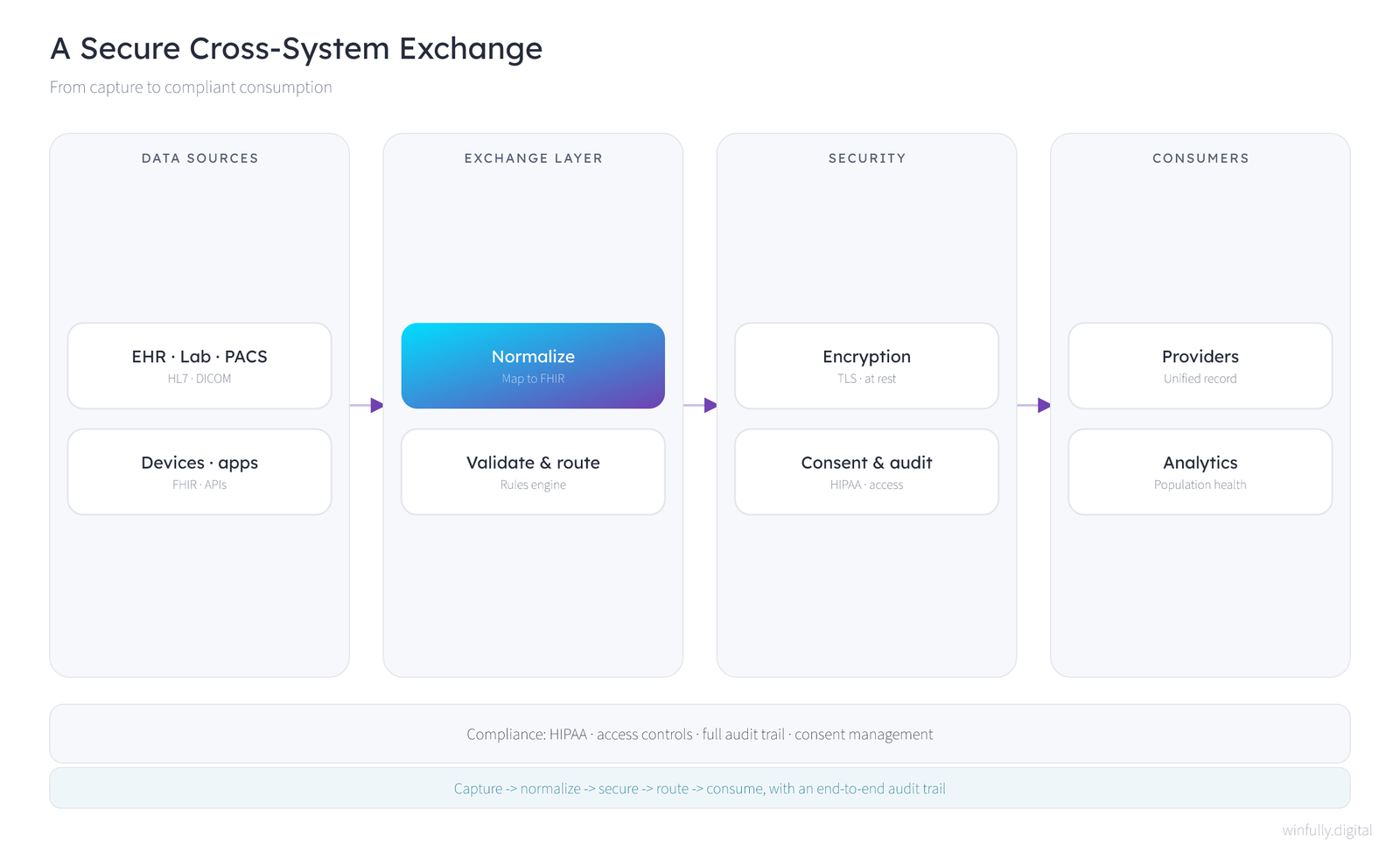
Curious About Optimizing Your Data Transfer System
Talk to us about how your organization can get more from its data-transfer systems, without giving up security, efficiency, or compliance.
Healthcare IT, and data transfer in particular, keeps changing. Part of the job is staying current, so your systems meet today's standards and are ready for what comes next.
Getting to streamlined, secure data exchange is ongoing work, but with the right expertise it's very doable.
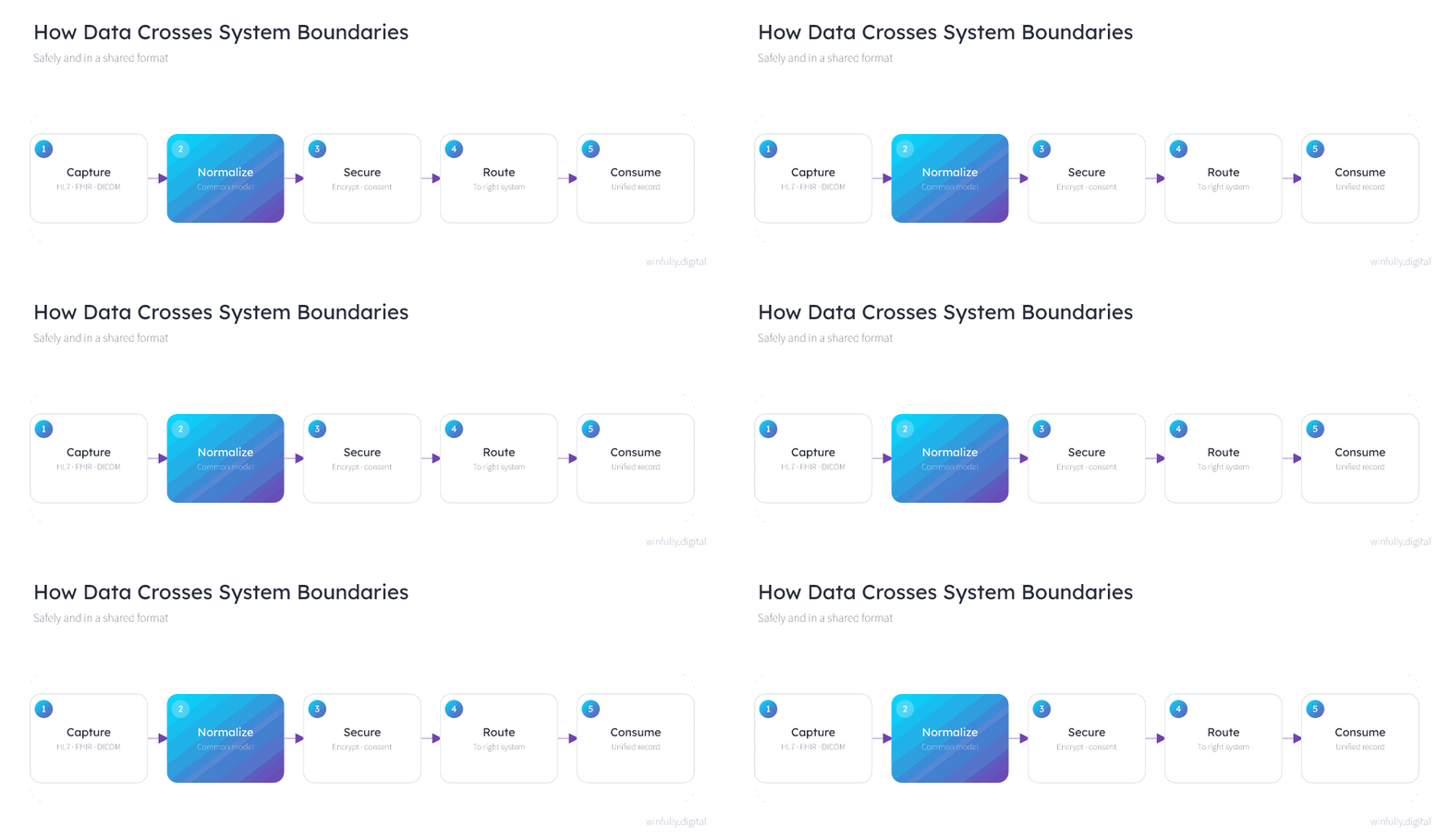
The animation below shows how data crosses system boundaries safely and in a shared format:
Interested in Expert Guidance?
If you want a hand improving your healthcare IT systems, especially the data-transfer side, get in touch. My team and I build solutions around your specific needs, not a generic template.