
Roadmap to Mastering HL7: A Step-by-Step Guide for HL7 Developers
A step-by-step roadmap to mastering HL7 standards, covering development, integration techniques, and real-world implementations for healthcare IT.
HL7 is one of the standards that keeps modern healthcare systems talking to each other. It sets the rules for how electronic health information gets exchanged, integrated, shared, and retrieved, and those rules underpin clinical practice along with the way health services are managed, delivered, and evaluated. In short, HL7 is where interoperability starts. Without it, providers would be stuck trying to share patient data across systems that don't understand one another, and the errors and delays would follow.
What is HL7?
HL7, short for Health Level Seven, is an international family of standards for moving data between the software applications different healthcare providers run. The goal is straightforward: let separate systems communicate well enough that critical patient information shows up when and where someone needs it. That kind of interoperability is what makes care safer and operations smoother. The standards span a lot of ground, patient records, billing, lab results, and more.
The Role of HL7 in Facilitating Healthcare Communication
HL7 is what lets systems that were never designed to work together trade patient information anyway. That connection cuts errors, smooths clinical workflows, and leads to better outcomes. Take a simple case: a patient sees a specialist, and HL7 lets that specialist pull the medical history from the primary care physician. With the full record in hand, the specialist can make a better call instead of working half-blind.
The Various Versions of HL7 and Their Relevance
HL7 comes in several versions, each with its own strengths. The two you'll run into most are 2.x and 3.
- Version 2.x is simple and everywhere. Its plain, text-based encoding is easy to implement, though it misses some of the more advanced capabilities of later versions.
- Version 3 is more flexible, built on an XML structure. The encoding is heavier, but it can represent more precise and complex data, and it adds security and confidentiality features that 2.x lacks.
Each has its place; the right choice depends on what the providers involved actually need and can support. Both are still developed and maintained by the HL7 organization.
The Basic Building Blocks of HL7
Introduction to HL7 Messages, Segments, and Fields
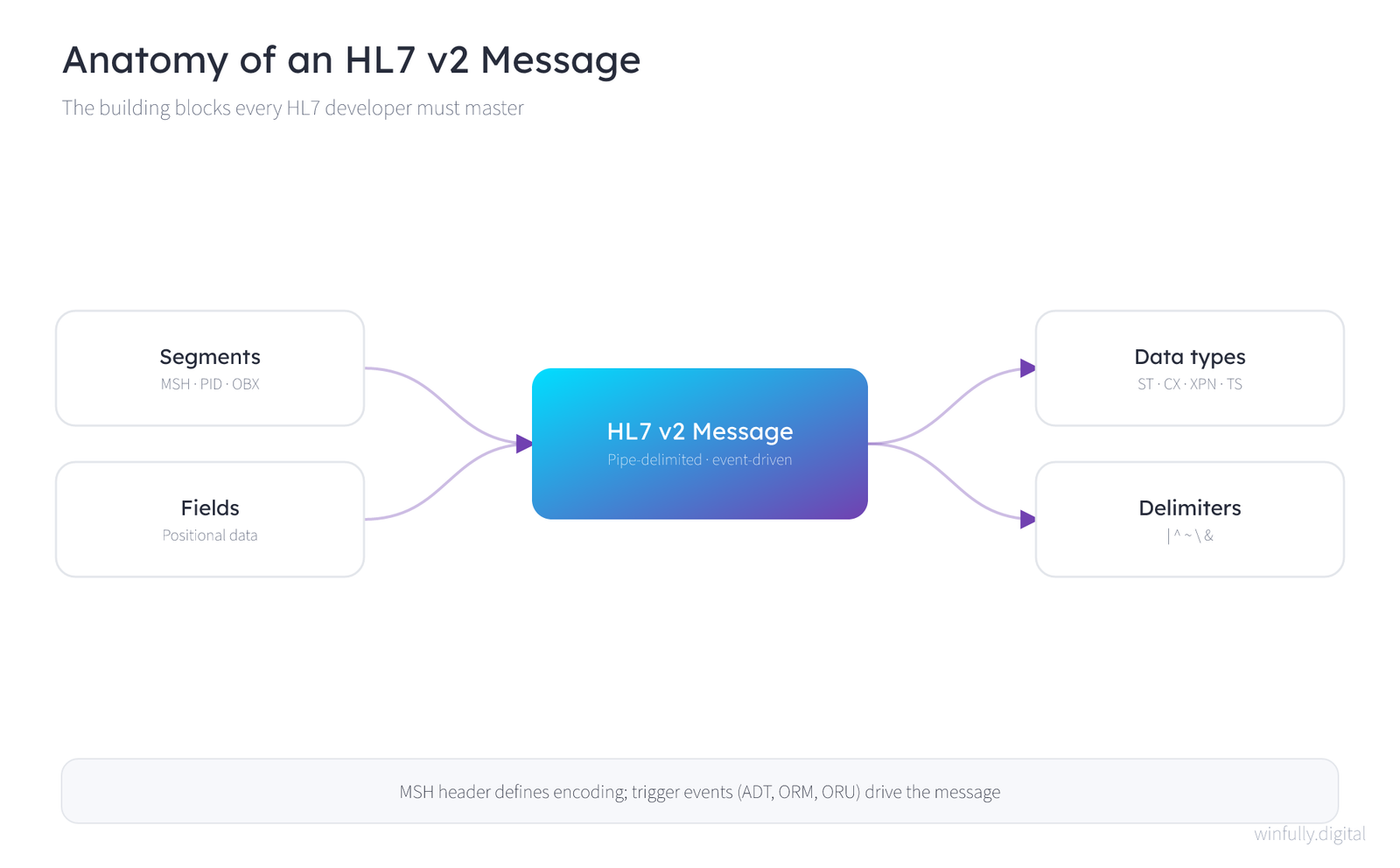
An HL7 message is the basic unit of communication in the protocol. Each message is built from segments, blocks of related information, and each segment breaks down further into fields, the individual pieces of data. A patient's name and date of birth, for instance, are separate fields inside the same segment. Get comfortable with how messages, segments, and fields fit together and you've got the foundation for everything else in HL7 development.
Understanding the HL7 Syntax and Encoding
HL7's syntax and encoding rules are what keep messages formatted and interpreted the same way on both ends. They govern how data is laid out and how different data types get encoded, right down to the delimiters: pipes separate fields, carets separate sub-components. Know these rules and you can build integrations that read and process HL7 messages accurately; miss them and you'll chase parsing bugs for days.
A Brief Overview of Common HL7 Message Types
HL7 defines many message types, each built for a particular clinical situation. ADT (Admit/Discharge/Transfer) messages carry admission, discharge, and transfer information. ORM (Order) messages handle orders for tests or procedures. ORU (Observation Result) messages return the results. Knowing what each type is for, and how it's structured, is fundamental to building anything useful in HL7.
Would you like to talk with our expert?
We will help you to understand your clinical data and prepare a plan for step-by-step exchange.
Getting Started with HL7 Development
Necessary Tools and Resources for HL7 Developers
A few tools make HL7 work far easier. Message validators check your messages against the standard. Interface engines move messages between systems. Testing platforms let you try things out in a controlled setting before they hit production. Beyond the tooling, HL7.org and the community forums are worth leaning on, they're where the latest standards, best practices, and a lot of hard-won experience live.
Setting Up Your Development Environment
Setting up an HL7-ready development environment comes down to picking the right tools. That might mean a dedicated HL7 interface engine with messaging support built in, or a general IDE like Visual Studio or Eclipse fitted out with the right libraries and plugins. What you choose depends on the project's needs and how your team likes to work.
HL7 Specifications and Documentation: Navigating Your Way
You can't build compliant HL7 applications without knowing the specifications, and there are a lot of them. They spell out the requirements, lay out the structure of each message type, define the syntax and encoding rules, and pin down what every code and identifier means. The documentation is dense and sprawling, and working through it takes patience, but there's no substitute for it once you're deep in a build.
Mapping Healthcare Requirements to HL7
Analyzing Healthcare Workflows for HL7 Integration
Designing a good HL7 solution starts with figuring out where it can actually help. That means understanding the clinical process in detail, intake, diagnosis, treatment, follow-up, and seeing where better data exchange would move the needle. Automating the flow of lab results from the testing facility into a patient's electronic health record, for example, shaves real time off diagnosis and treatment.
Identifying Key HL7 Messages for Specific Healthcare Scenarios
Picking the right message type for the job matters, and the clinical scenario drives that choice. Admissions call for ADT (Admit, Discharge, Transfer) messages, lab orders for ORM (Order) messages, billing for DFT (Detailed Financial Transaction) messages. The better you understand what each type does and how it's built, the stronger your solution will be.
Tips for Effective HL7 Message Mapping
Good mapping starts with a close look at both systems, source and target, and what each one can and can't do. You need to know how their data structures line up with HL7 segments and fields. Mapping tables help here: they give you a clean, documented record of how each data element on one side corresponds to the other, which keeps the translation accurate.
Building Robust HL7 Interfaces
The Anatomy of an HL7 Interface
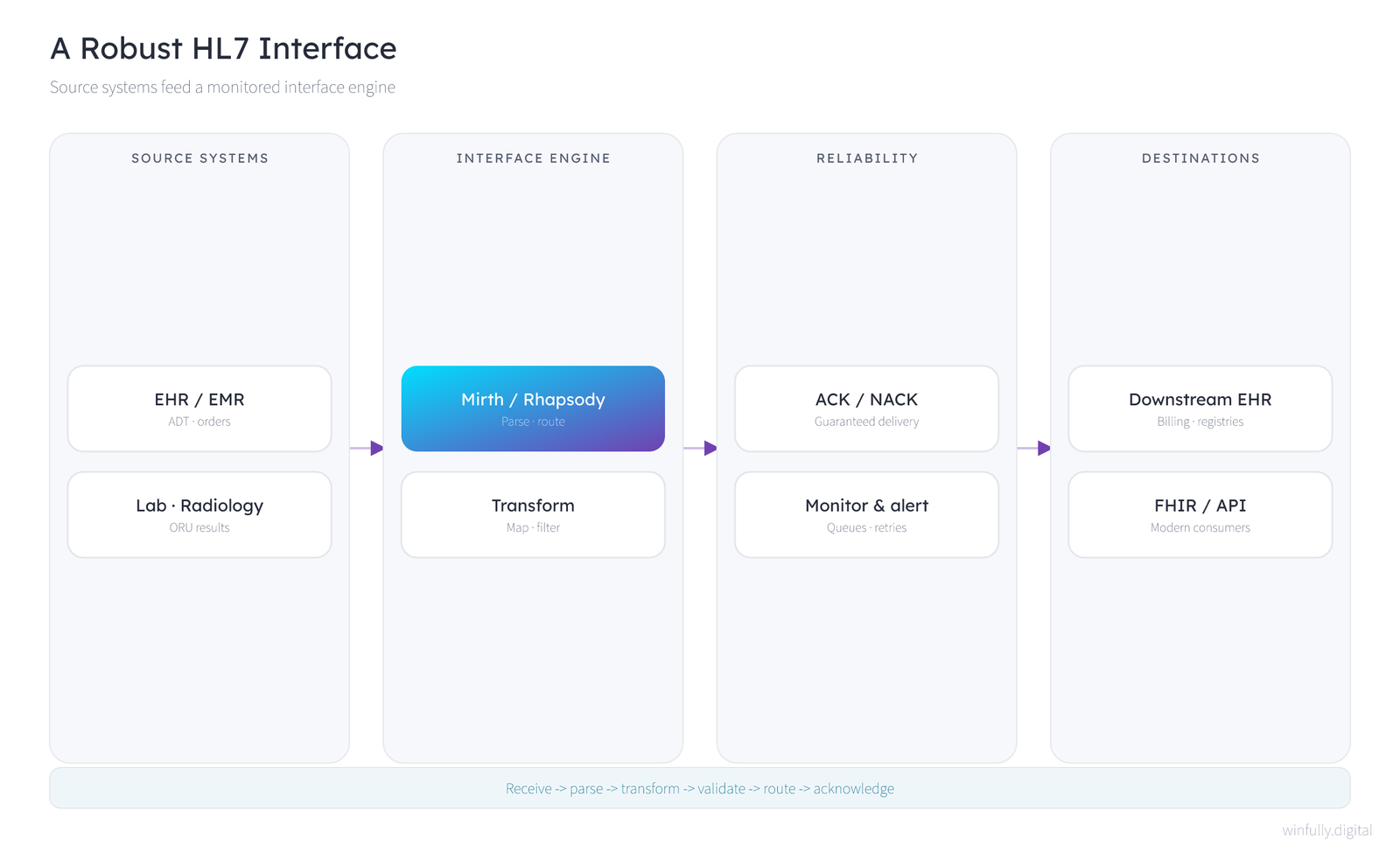
A well-built HL7 interface reliably gets messages from one system to another, but that's only part of the job. It also has to handle errors, track messages, and keep data secure. In practice that means recovering gracefully when the network drops, knowing exactly which messages went through, and protecting patient data in transit.
Best Practices in Designing HL7 Interfaces
A few habits separate solid HL7 interfaces from fragile ones: thorough logging so you can trace data flow and spot problems, validation that catches errors before they spread, and sticking to established standards so your interface plays well with everything else.
Common Pitfalls in HL7 Interface Design and How to Avoid Them
A handful of mistakes trip up HL7 interfaces again and again. Weak error handling loses or corrupts data. Thin testing lets bugs and compatibility issues slip through. Ignoring performance leaves you with slow transfers and a sluggish system. Watch for these early and design around them, and your interface will hold up far better.
Testing Your HL7 Solutions
Tools and Techniques for Testing HL7 Interfaces
Testing HL7 interfaces leans on message validators and simulators. The National Institute of Standards and Technology (NIST), for one, offers a toolkit built around message profiles, with Java APIs for things like automated message generation and validation. Another tool, Message Maker, produces a full set of test messages for any given profile. Tools like these are how you confirm an interface does what it should and stays compliant.
Strategies for Effective HL7 Message Testing
Lean on a few complementary approaches. Scenario-based testing builds cases from real-world situations to confirm the system handles everyday operations. Regression testing re-checks components after changes so nothing that used to work quietly breaks. Load testing pushes high message volumes through to see whether the system holds up. Together they surface the issues that matter before your users do.
Handling Errors and Troubleshooting Common Issues
Fixing problems fast comes down to good error handling and a methodical way of tracking issues down. Know the common HL7 errors and how to clear them. A single stuck message can back up an entire queue, so you want to be able to rule that message in or out quickly. Documenting your profiles and specs pays off here too: once the interface is live, those notes make it far easier to troubleshoot and adjust configuration. Reusing the assets you built earlier in the lifecycle lets you head off problems and avoid extra cost.
HL7 Integration Patterns and Practices
Dealing with Version Incompatibilities
Version mismatches are one of the trickier parts of HL7 work. Most messaging still runs on 2.3 and 2.3.1, but you need to know how the 2.x and 3.x versions differ to interface them correctly. Version-conversion tools help. IBM, for example, lets you configure an HL7 DFDL model to validate the version of HL7 in the messages you receive. This involves importing one of the HL7 DFDL libraries into your workspace and enabling version validation in your model. This ensures that you are processing messages that are using the expected version of HL7.
Managing Large Volumes of HL7 Messages
At high volumes, how you process and store messages decides whether the system stays fast and reliable. Google Cloud's Healthcare API, for instance, provides methods to store an HL7v2 message in the Cloud Healthcare API. When you use these methods, the system generates a response containing an HL7v2 acknowledgment (ACK) message when successful or a negative acknowledgment (NACK) message when there is an error. Another example is processing a batch of HL7 messages manually by removing the batch envelope, splitting the data into separate messages, and processing each message individually.
Ensuring Data Privacy and Security in HL7 Messaging
Adhering to data privacy and security standards like HIPAA is non-negotiable in HL7 messaging. Implementing encryption, access controls, and audit trails are fundamental practices. For example, CapMinds suggests implementing a strictly enforced password policy, including multi-factor authentication, so that data is safeguarded around the environment, as well as adopting advanced third-party technologies. Another solution is to use a Virtual Private Network (VPN) for a secure connection via open networks. This is the simplest and cheapest solution for sending Low-Level Protocol (LPP) data, used to transfer HL7 messages, via VPN.
HL7 Integration Technique
Leveraging HL7 with Modern Web Services
Connecting HL7 to modern web services and APIs opens up more flexible, scalable ways to move healthcare data. One U.S.-based healthcare communications company uses HL7 integration to pull inputs from across hospital systems: EHR, remote patient monitoring devices, laboratory, radiology, and more. This easily drives team communication via mobile devices like a smartphone, a pager, and others.
Integrating HL7 with Other Health Informatics Standards (e.g., FHIR, DICOM)
Pairing HL7 with standards like FHIR and DICOM covers a wider range of clinical needs than any one standard does alone. For instance, a study suggests integrating the currently implemented queue management solution (QMS) with the electronic medical records (EMR) solution, using Health Level Seven (HL7) protocols. As a pilot study, this research will include a simulation experiment in three of the busiest clinics, internal medicine, orthopedics, and ENT clinics.
Utilizing HL7 in Mobile and Cloud-Based Applications
Mobile and cloud technologies make HL7 applications more accessible and let data move and process in real time. For example, Google Cloud's Healthcare API provides methods to store an HL7v2 message in the Cloud Healthcare API. When you use these methods, the system generates a response containing an HL7v2 acknowledgment (ACK) message when successful or a negative acknowledgment (NACK) message when there is an error. Another example is processing a batch of HL7 messages manually by removing the batch envelope, splitting the data into separate messages, and processing each message individually.
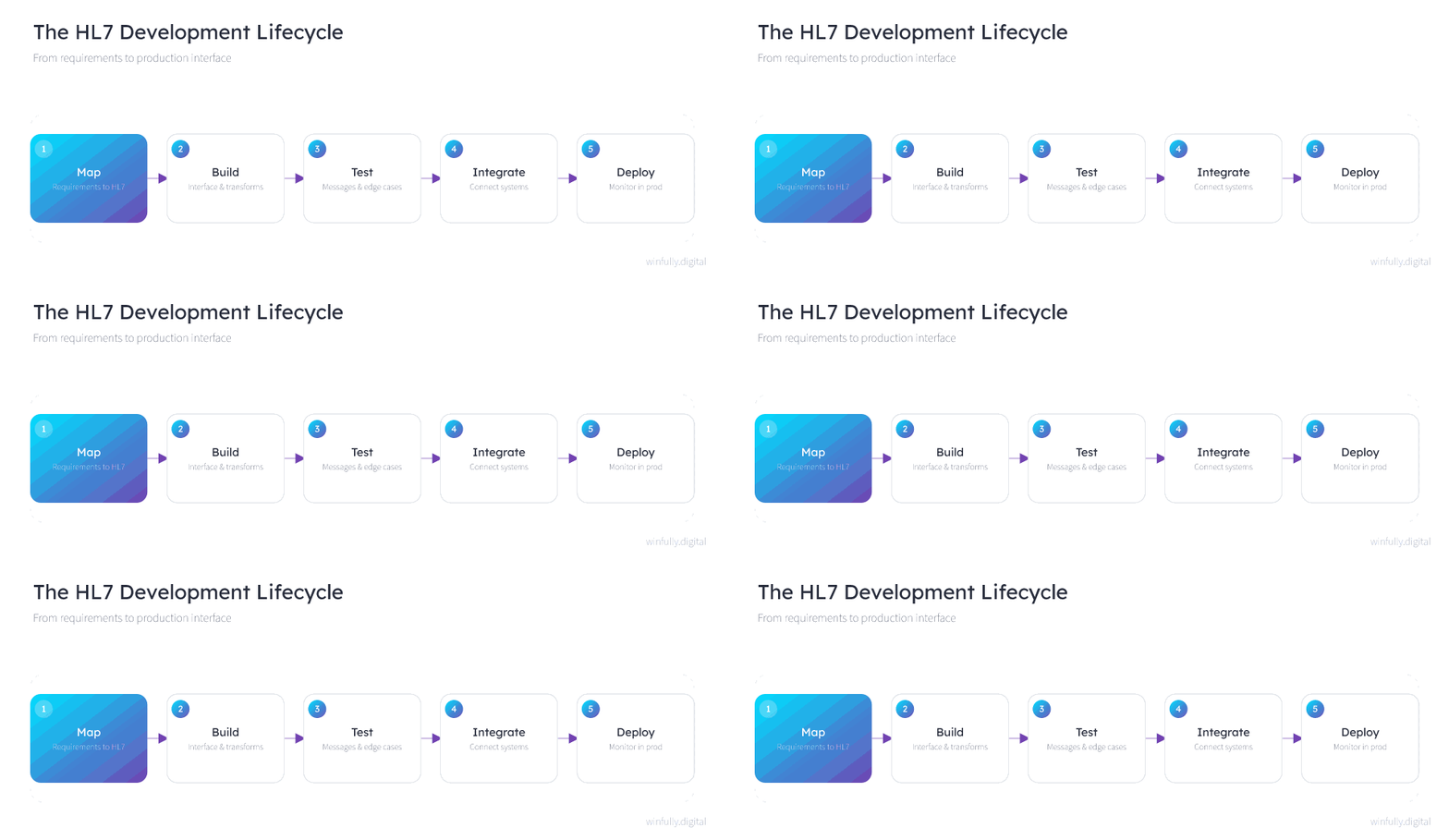
The animation below traces the HL7 development lifecycle from requirements through to a monitored production interface:
HL7 Deployment
Key Considerations During Deployment
Deploying HL7 solutions in a healthcare setting requires a deep understanding of the environment, including its technical infrastructure and clinical workflows. EHR systems, interface engines, and database management systems all factor into this. An experienced consultant can assess your current infrastructure, find the gaps, and recommend HL7-enabled systems that fit your existing workflows.
Monitoring and Maintaining HL7 Interfaces
The performance and reliability of HL7 interfaces hinge on continuous monitoring and maintenance. Tools like interface engines often come with built-in monitoring features that can track message flow, identify errors, and generate alerts. However, setting up these tools and interpreting their output requires expertise. This is where an HL7 consultant can provide immense value. They can set up custom alerts, create dashboards for easy monitoring, and even train your staff to handle day-to-day maintenance tasks.
Scaling HL7 Solutions to Meet Growing Needs
As healthcare organizations grow, so do their data and service offerings. HL7 solutions must be scalable to handle this growth. This might involve upgrading to more powerful servers, moving to cloud-based solutions, or even integrating with additional standards like FHIR or DICOM. An expert consultant can guide this scaling process, ensuring that the upgraded systems are not only capable of handling increased loads but also compliant with all relevant regulations and standards.
Case Studies: Successful HL7 Implementations
HL7 Implementation in a Healthcare Organization in UAE
A healthcare organization in the United Arab Emirates implemented an HL7-based solution to facilitate patient self-check-in. The solution integrated the queue management solution (QMS) and the electronic medical records (EMR) using HL7 protocols and Extensible Markup Language (XML).
- Clinical Workflow Before HL7 Implementation: Before the implementation of the HL7 solution, the patient identification process was routine-based. Patients would arrive at the outpatient department, wait in line to check in, and then wait again to be triaged.
- HL7 Implementation and Its Impact: The HL7-based solution allowed patients to self-check in using their Emirates national ID cards. This significantly reduced waiting times in the outpatient department by enabling early identification of patients.
- Solution: The solution was evaluated through a simulation experiment involving 517 valid appointments. The experiment compared the routine-based identification process with the patient self-check-in process.
- Result: The results showed that the HL7 solution reduced the patient's journey time by more than 14 minutes and the time to identify patients by 10 minutes. There was also a significant reduction in the waiting time to triage and the time to finish the triage process.
The HL7 solution proved to be efficient and innovative, providing a positive added value for the patient's whole journey. It demonstrated how HL7 standards can be used to improve clinical workflows and patient care in a hospital information system.
HL7 Implementation in Public Health Reporting
The United States has implemented an HL7-based solution, the Electronic Initial Case Report (eICR), to streamline public health reporting. The eICR is a standard for the electronic submission of initial public health case reports using HL7 Version 3 Clinical Document Architecture (CDA), Release 2 format.
- Clinical Workflow Before HL7 Implementation: Before the implementation of the HL7 solution, public health reporting was a manual and time-consuming process. Healthcare providers had to manually fill out case report forms for each reportable condition and send them to jurisdictional public health agencies.
- HL7 Implementation and Its Impact: The eICR allows healthcare providers to electronically communicate the specific data needed in initial public health case reports to jurisdictional public health agencies. This has significantly improved the timeliness and completeness of public health reporting, enhancing disease surveillance, outbreak management, and health policy decision-making.
For example, during an outbreak of a communicable disease, healthcare providers can quickly report new cases to public health agencies via the eICR. The agencies can then use this information to monitor the spread of the disease, identify hotspots, and implement control measures.
Moreover, the eICR improves bidirectional communication by delivering public health information in the context of a patient's condition and local disease trends. It also facilitates ad hoc communications between healthcare providers and public health agencies.
The HL7-based eICR solution has proven to be effective in streamlining public health reporting in the United States. It demonstrates how HL7 standards can be used to enhance public health practices and improve patient care.
HL7 Usage in Laboratory Information Systems (LIS)
In the context of Laboratory Information Systems (LIS), HL7 facilitates efficient test ordering, result reporting, and data analysis. Here's a clinical example:
Let's say a doctor orders a blood test for a patient. The order is sent from the hospital's Electronic Health Record (EHR) system to the LIS using HL7 messaging standards. The LIS receives the order, processes it, and then sends the necessary instructions to the lab equipment. Once the test is completed, the results are sent back through the LIS, which uses HL7 messages to update the EHR system. The doctor can then access the test results directly from the EHR system.
This HL7 integration allows for real-time, accurate data exchange, reducing the chance of errors and improving patient care. For instance, if lab test results are quickly integrated into a hospital's EHR system, then a list of patients with diabetes can be compiled. The provider can then determine which of these patients have uncontrolled blood sugar and schedule necessary follow-up appointments.
The through-line: HL7 integration is what lets different systems actually talk to each other, and that makes care both more efficient and safer.
Conclusion
Mastering HL7 takes work, but it pays off. As healthcare keeps modernizing, demand for developers who know these standards well keeps climbing. Learn the standards deeply, keep up with where they're heading, and keep sharpening your skills, and you'll have real influence over how healthcare IT gets built.
HL7 and healthcare IT keep changing. Stay curious and adaptable, and your work as an HL7 developer won't just be steady, it'll matter.