
Transforming AI with Retrieval-Augmented Generation (RAG)
How Retrieval-Augmented Generation pairs LLMs with external data to deliver accurate, context-rich AI, transforming healthcare, fintech, and more.
Introduction
AI and machine learning keep producing techniques that change how whole industries operate, and healthcare and FinTech are two of the clearest examples. Retrieval-Augmented Generation (RAG) is one of the more useful ones. It pairs a large language model (LLM) with external data sources so the model's answers stay accurate and grounded in real context. In 18-plus years as a solutions architect and cloud engineer, I've watched this pattern turn AI from a demo into something that carries real business value and opens up new ground for automation.
In this blog, we will explore:
- The core principles behind RAG
- How Agentic network creation amplifies the capabilities of RAG
- Key use cases in Healthcare and FinTech
- A high-level overview of architecture and implementation strategies
By the end you'll have a solid picture of how RAG solves real problems, particularly in the regulated, data-heavy environments where getting the answer right actually matters.
Understanding Retrieval-Augmented Generation
The Basics
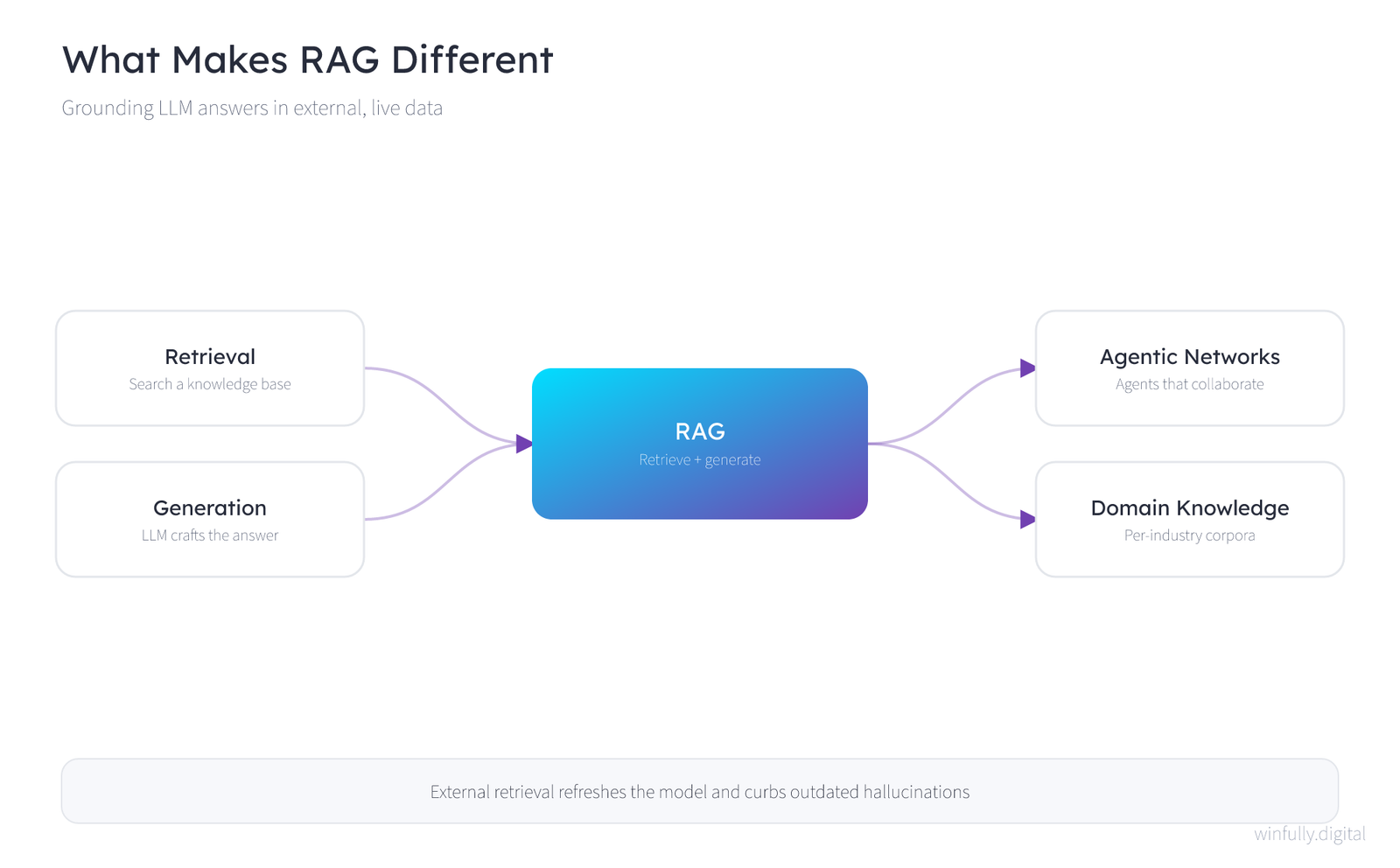
RAG uses a large language model, a GPT-style system, to generate text, with one important change. Rather than answering purely from what it memorized during training, the model first pulls in information from an external source. That grounding in current, context-specific data is what makes the output more reliable and more relevant to the question at hand.
The process runs in two stages:
- Retrieval: The model queries an external database, search index, or knowledge base to find the documents or data points that matter most for the question.
- Generation: The LLM reads what it retrieved and writes an accurate, natural-sounding answer around it.
That combination addresses two of the LLM's oldest weaknesses: making things up and working from stale information. In effect, RAG refreshes the model's knowledge at query time and shapes each answer to the specific question being asked.
AI, ML, and LLM Synergy
RAG lives where AI and ML meet. Retrieval leans on ML-driven ranking and vector similarity search; generation leans on the LLM. Put them together and you get:
- High Accuracy: Pulling in real-time or domain-specific knowledge cuts down on factual errors.
- Scalability: Retrieval can be sharded or replicated across nodes in the cloud, so responses stay fast even under heavy load.
- Customizability: Give each domain, Healthcare or FinTech, its own knowledge base, and the system gets genuinely specialized.
Agentic Network Creation: The Next Evolution
What is Agentic Network Creation?
In a RAG setting, agentic network creation means building AI agents that work together, share data, and make decisions with some autonomy. The agents "talk" to one another and form a network that can carry a complex task from start to finish, from pulling patient data in a hospital to running a loan approval in FinTech.
How It Enhances RAG
Instead of one LLM bolted to one database, agentic networks let several specialized models coordinate, each with its own retrieval pipeline:
- Healthcare Example: One agent retrieves past medical histories, another analyzes pathology reports, and a third turns the result into a patient-friendly summary.
- FinTech Example: For a loan, one agent pulls the applicant's credit report, another scores the risk, and a third assembles a personalized offer, all in real time.
You end up with an orchestrated workflow where specialized agents each do what they're good at, and the combined output is more accurate and better grounded.
RAG in Healthcare and FinTech
Healthcare: Precision and Personalization
Challenge: Clinicians wade through mountains of data, electronic health records, research journals, diagnostic images, and have to stay inside regulations like HIPAA the whole time.
RAG Solution:
- Precision Diagnosis: A RAG system can surface the latest research relevant to a patient's symptoms, so recommendations come backed by evidence.
- Patient Engagement: RAG-powered chatbots answer common questions instantly, grounded in that patient's own medical history.
- Agentic Networks: Several agents fetch lab results, check medication histories, and propose treatment plans in parallel, which lifts both care quality and clinical throughput.
FinTech: Automating Workflows and Reducing Risk
Challenge: Financial work means chewing through large datasets, historical trading data, fraud indicators, credit scores, under strict regulatory scrutiny.
RAG Solution:
- Risk Assessment: RAG pulls live market metrics, regulatory policy, and customer credit data together to build an accurate risk profile.
- Automated Support: Agentic networks handle customer queries, policy reviews, and compliance checks at once, taking manual work off the table.
- Fraud Detection: By retrieving from transaction logs and user history on the fly, a RAG system flags anomalies faster than rule-based methods can.
High-Level RAG Architecture
Data Ingestion Layer
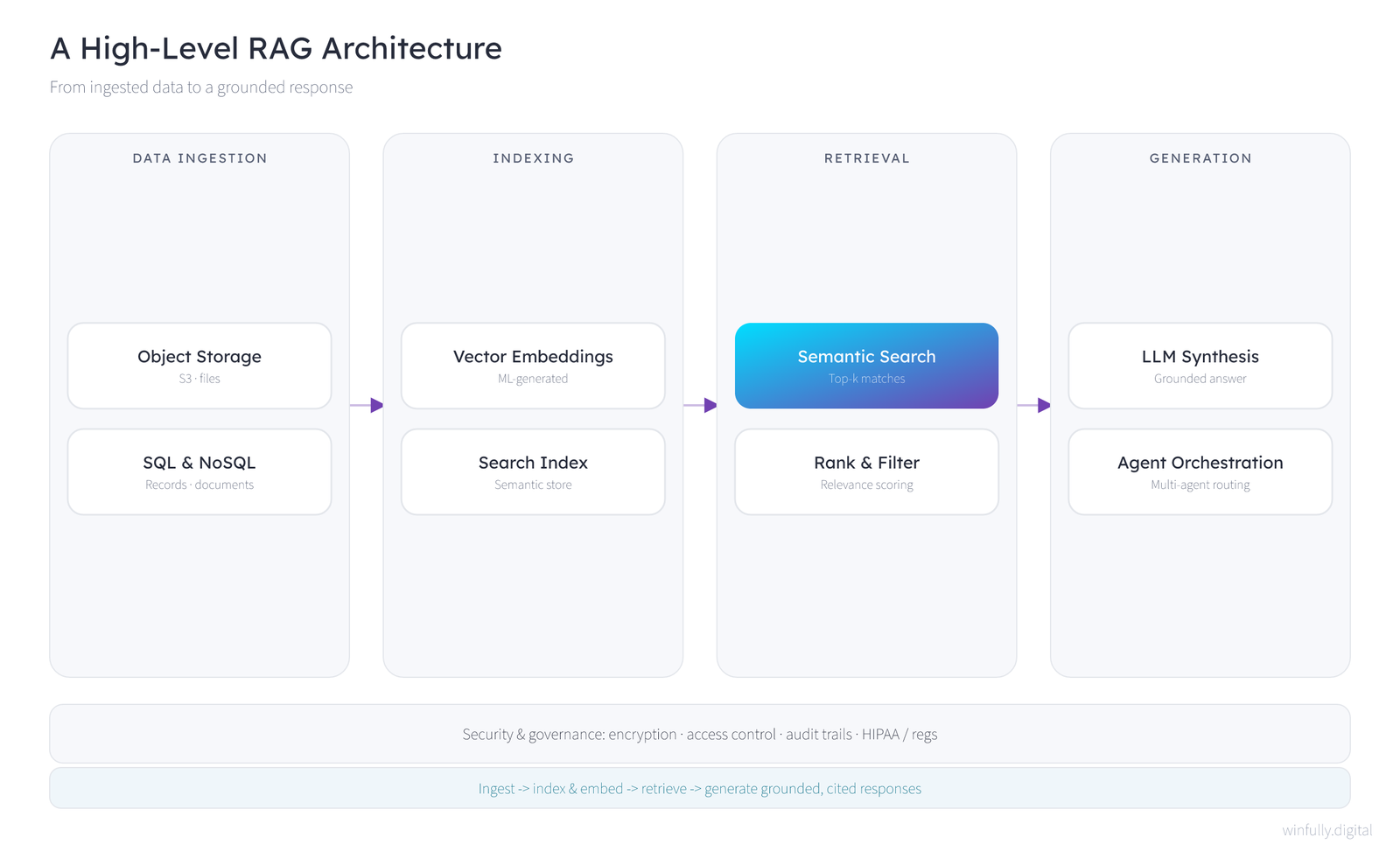
Everything you want the system to draw on, medical records, financial documents, scientific research, lands in scalable storage first. In the cloud, that usually looks like:
- Object Storage (e.g., Amazon S3) for unstructured files
- Relational Databases (e.g., MySQL) for structured data
- NoSQL Databases (e.g., MongoDB) for semi-structured data
Indexing and Embeddings
Next you index the data so retrieval is fast. Most RAG systems generate vector embeddings with ML models. Because those embeddings capture meaning rather than exact wording, the system can find related documents even when none of the keywords match.
Retrieval Pipeline
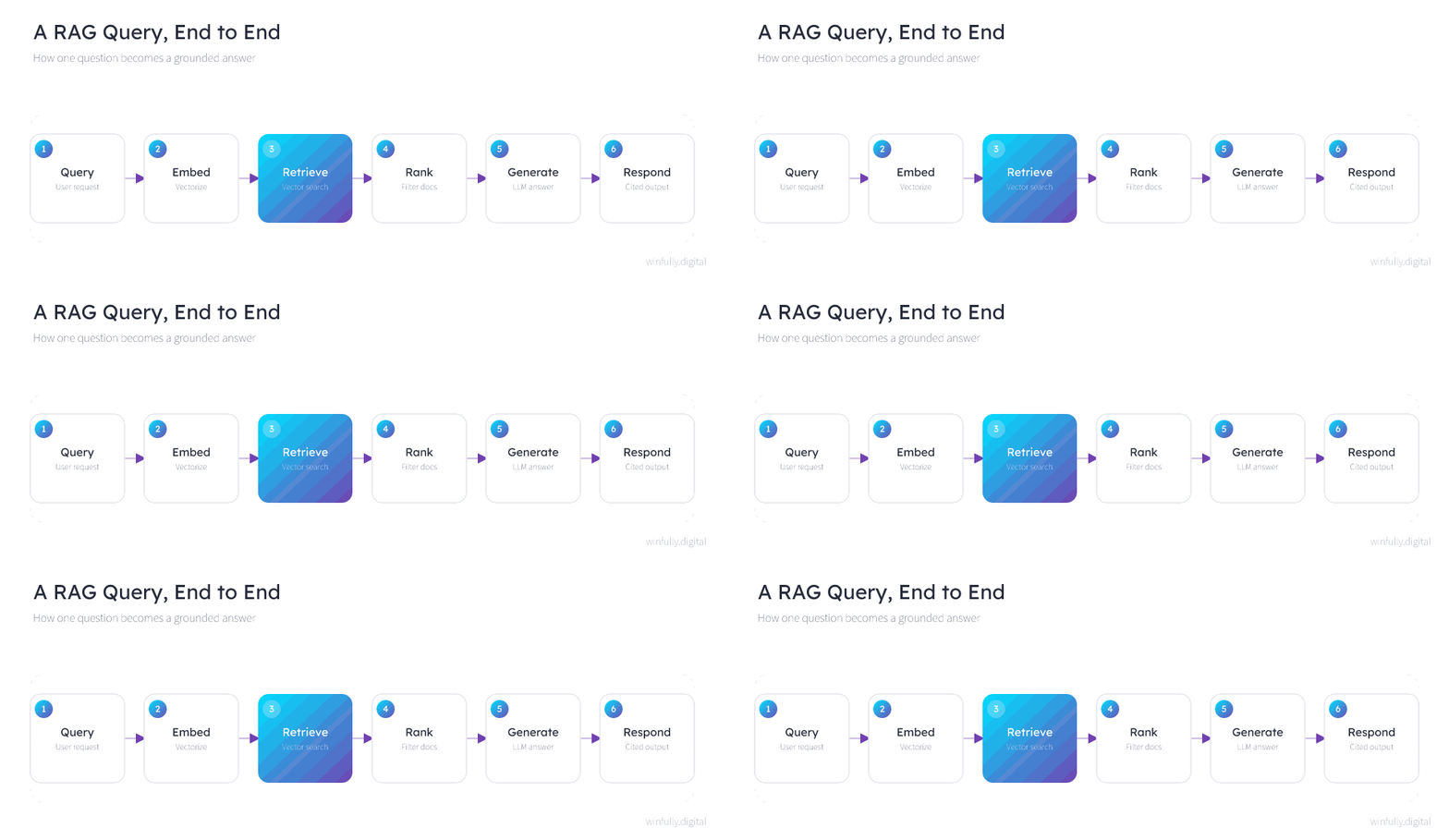
When a query comes in, say, someone asks for the best treatment for a rare condition, the system:
- Generates an Embedding of the query.
- Searches the vector store for the closest matching documents.
- Ranks and filters those documents by relevance and authority.
Generation Layer (LLM)
The LLM reads the retrieved documents and writes the response. Depending on the domain, it may also check regulatory guidelines or hit external APIs for live data, current financial regulations, for instance.
Agentic Network Coordination
In more advanced setups, several agents each own a specialized task. An orchestration layer routes the request to the right agents, merges what they return, and keeps the whole thing inside the compliance rules.
Security and Governance
In Healthcare and FinTech, privacy and governance aren't afterthoughts. Encryption in transit and at rest, access controls, and audit trails make up the security layer. Cloud teams wire these in with services like AWS KMS (Key Management Service), Azure Key Vault, or GCP's Secret Manager.
The diagram below traces a single RAG query end to end, from user request to a cited answer:
Implementation Strategies
- Pilot Projects: Start with a proof of concept. Roll RAG out in one hospital department or one FinTech product line, and measure relevance, latency, and user satisfaction before you scale.
- Cloud-Native Microservices: Split RAG into separate services, retrieval, embedding, generation, and so on. Scaling gets simpler, and traffic spikes stop taking the whole system down with them.
- Observability and Monitoring: Instrument everything with logging, monitoring, and tracing. When query times crawl or a retrieval fails, you want to find the bottleneck in minutes, not days.
- Continuous Model Updates: The retrieval and generation models both improve over time. Ship updates through CI/CD so your system always runs on current embeddings and LLM weights.
LLM Models to start with
Healthcare
- BioBERT/ClinicalBERT
- PubMedBERT
- BioGPT
- LLaMA
FinTech
- FinBERT
- BloombergGPT
- RoBERTa
Why Engage a Seasoned Solutions Architect and Cloud Engineer?
Eighteen years of designing and tuning cloud infrastructure for AI/ML teaches you where scalable RAG projects tend to break. Whether the goal is sharper diagnostics in Healthcare or automated workflows in FinTech, the cloud architecture underneath is what decides success, choosing the right storage, designing the retrieval and generation services, and locking down sensitive data.
Pro Tip: Don't skip domain-specific fine-tuning. Your LLMs and retrieval indices work best when they're tuned to the language, regulations, and data formats of your particular industry.
Embrace RAG for a Smarter Future
RAG is more than a buzzword. It combines AI, ML, and current LLM capabilities to produce answers that are accurate and aware of their context. Add agentic network creation on top, and businesses in Healthcare and FinTech can reach levels of efficiency, personalization, and intelligence that weren't practical before.
Getting there comes down to orchestrating the pieces well, ingestion, indexing, retrieval, generation, on a cloud-native foundation built for security and scale. Do that, and RAG can anchor your entire AI strategy. After nearly two decades doing this work, helping teams find their footing with technology like this is the part I enjoy most.
Ready to take your AI initiatives to the next level?
Let's talk about how a custom RAG build, with agentic network creation layered in, can change how your workflows run.
Reach out for a consultation or more detail, and let's build the future of Healthcare and FinTech together.