
FHIR and DICOM to Enable AI-Assisted Radiology Workflows
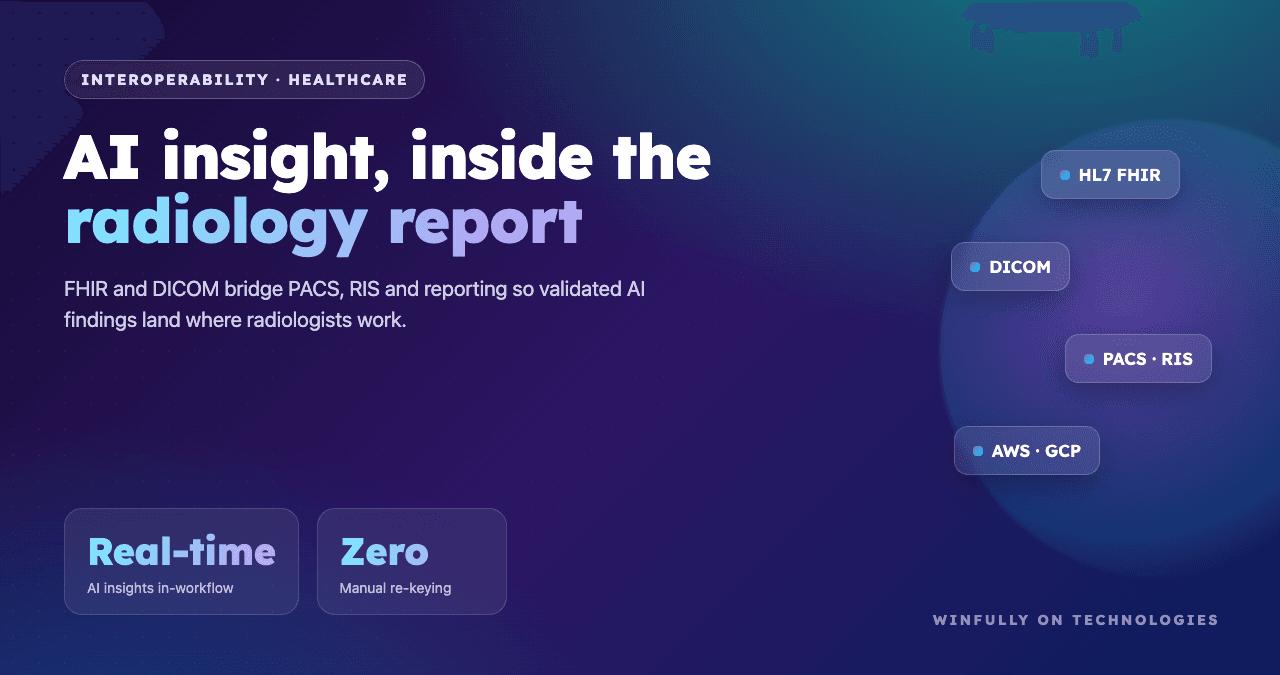
We unified fragmented PACS, RIS and HL7 systems on an HL7 FHIR and DICOM backbone so validated AI findings surface inside the radiologist's viewer and report.
Results at a glance
The situation
A global healthcare technology leader was modernizing radiology by embedding AI models into its existing diagnostic infrastructure to improve accuracy and speed up procedures. That infrastructure was fragmented: PACS, RIS and HL7-based workflows ran in isolation, with no standardized, real-time way to exchange imaging, patient context and AI insight. Imaging data also varied widely in quality, structure and completeness, and any AI integration had to meet strict clinical validation and compliance requirements without adding to the radiologist's workload.
Build a standards-based interoperability layer connecting PACS, RIS, AI engines and reporting platforms through FHIR and DICOM. Embed validated AI outputs directly into the imaging and reporting workflow while protecting data integrity, compliance and radiologist focus. Scale the pipeline to handle large volumes of high-resolution CT and MRI at real-time or near-real-time speed.
How we delivered
FHIR-based orchestration backbone
We adopted HL7 FHIR as the exchange backbone, exposing FHIR APIs that let PACS, RIS, AI engines and reporting platforms share patient context, orders and results in a standardized, real-time flow instead of point-to-point HL7 interfaces.
DICOM integration with embedded AI
We standardized image storage, retrieval and transmission on DICOM and wrote AI outputs back as native DICOM structured reports and annotations, so findings appear inside the radiologist's existing viewer with no separate tool to open.
Interoperability layer bridging FHIR and DICOM
We built a bridging layer that aligns FHIR resources with DICOM imaging metadata, keeping patient context, study data and AI insight consistently linked across every connected system.
Data quality and validation pipelines
We added preprocessing, normalization and validation pipelines to handle imaging that varied in quality, structure and completeness, ensuring AI models received clean, consistent inputs and produced clinically reliable outputs.
Elastic cloud image processing on AWS and GCP
We deployed high-throughput image processing across AWS and GCP, using elastic scaling to absorb large volumes of high-resolution CT and MRI while sustaining the performance clinicians need.
Security, compliance and reporting integration
We enforced secure transmission, role-based access control and standards compliance across the FHIR and DICOM layers, then surfaced AI insight inside the existing radiology reporting systems so it reached radiologists in their normal reporting flow.
The technical solution
A block-level view of the system we designed and delivered — data and control flowing across each stage.
What the users see
A wireframe of the experience we shipped — laid out for the people who use it every day.
Connect every EHR and clinical system
We bridge EPIC, Cerner, and the rest through a monitored interface engine — mapping HL7 and FHIR to payers, HIEs/QHINs, and patient apps.
Clinical data, flowing where it needs to go
We connect source systems, normalize to HL7 and FHIR, and route validated data to the payers, analytics, and applications that depend on it — securely and with a full audit trail.
Outcomes delivered
- PACS, RIS, HL7 workflows, AI engines and reporting platforms now communicate through a single FHIR and DICOM backbone, replacing fragmented point-to-point interfaces with standardized real-time exchange.
- Validated AI findings are embedded as DICOM structured reports and annotations and appear natively in the radiologist's viewer and report, adding insight without adding cognitive burden or a separate application.
- Elastic processing on AWS and GCP scales to large volumes of high-resolution CT and MRI while delivering AI insight in real time to near-real time.
- Preprocessing, normalization and validation pipelines improved input consistency and the clinical reliability of AI outputs across variable imaging.
- Secure transmission, role-based access control and standards compliance were maintained end to end across the FHIR and DICOM layers.
Technology stack
The platforms, frameworks, and standards behind the solution.
Interoperability standards
Imaging systems
Cloud & scale
AI & data
Security & compliance
Want results like these?
Tell us the outcome you're after. We'll scope a short, fixed-fee discovery and a plan to get there.
Ready to start your digital transformation?
Let's talk about your roadmap, your compliance needs, and where technology can move your business forward.