
Transforming Public Health Data with LLM & NLP
We built a cloud-native AI/ML platform that standardizes large-scale public health data into continuously-updating health indices for clinicians and patients.
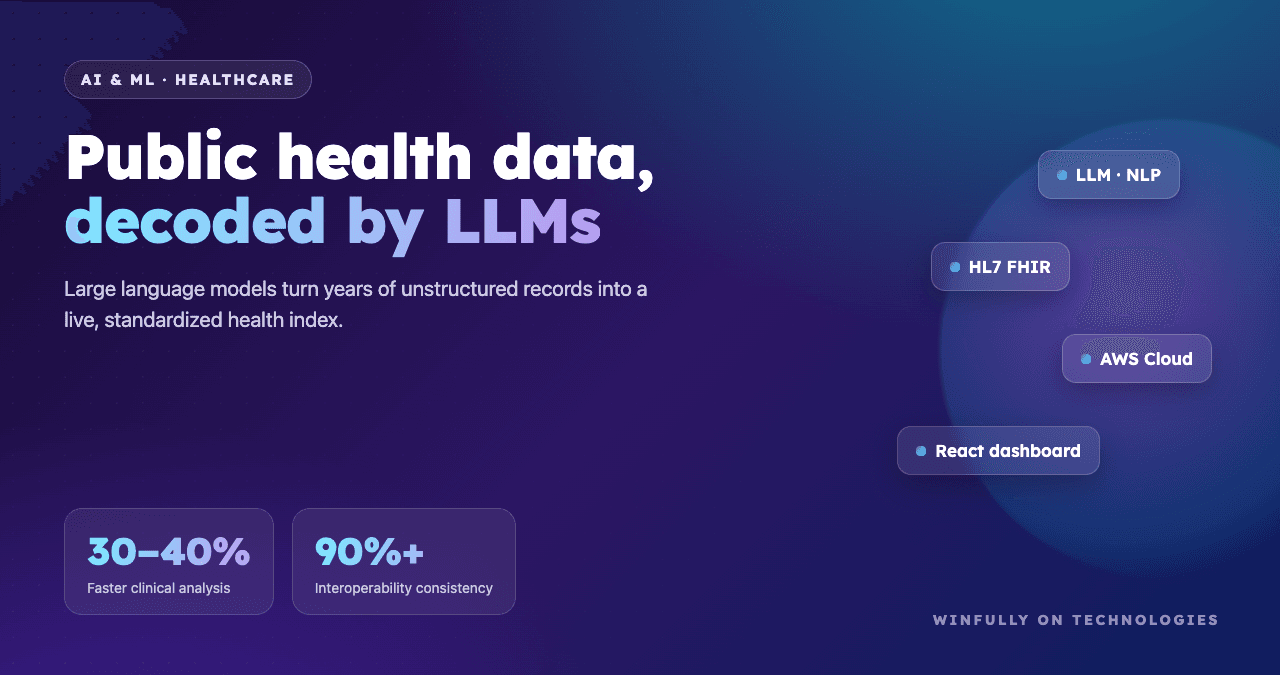
Results at a glance
The situation
A health-tech startup wanted to turn large volumes of scattered public health data into usable health indices. Records came from many systems, including TEFCA-aligned networks, in formats too inconsistent to analyze directly. With no common data model and no near real-time processing, clinical insight sat behind slow manual reconciliation. Whoever could ship compliant, trustworthy indicators at scale would win the market.
Design and build a cloud-native platform that ingests high-throughput public health data, standardizes it on HL7 FHIR, and runs AI/ML over it to produce automated, continuously-updating health indices. The interfaces had to serve clinicians and patients securely through APIs and dashboards.
How we delivered
FHIR standardization on containerized AWS services
We built HL7 FHIR translation pipelines as containerized services on AWS, normalizing data from TEFCA-aligned sources without losing accuracy or compliance.
Horizontally scalable data store
Deployed a SQL database tuned for fast, horizontally scalable storage of structured and semi-structured clinical data.
LLM and transformer AI/ML layer
Used large language models and transformer architectures for NLP over clinical text, deriving clinical indicators from mixed inputs.
Dynamic Health-Index engine
Combined LLM outputs with transformer models in a scoring engine that recomputes health indices as new data arrives.
Secure Java middleware and APIs
Routed data through Java middleware that enforced strict security and exposed REST APIs for EHR integration and downstream consumers.
Personalized ReactJS analytics dashboard
Built a ReactJS dashboard that shows personalized health indices, historical trends, and predictive insight, all under role-based access control.
The technical solution
A block-level view of the system we designed and delivered — data and control flowing across each stage.
What the users see
A wireframe of the experience we shipped — laid out for the people who use it every day.
AI that earns its place in production
We take models from data through training to deployment and monitoring, with governance and guardrails built in — not a pilot that never ships.
Governed data is the prerequisite for AI
Cataloged, quality-checked, access-controlled, and traceable — we build the data foundation that makes analytics and AI trustworthy and compliant.
Outcomes delivered
- Clinicians reached decisions faster as automated indices cut analysis time by roughly a third across common workflows.
- Patient engagement climbed once personalized indices and trends made health status easy to read and act on.
- Standardizing on FHIR kept interoperability consistently high across TEFCA-aligned data sources.
- The cloud-native architecture handled growing data volumes, adding several times more scalability headroom.
- Secure APIs and role-based access let the platform integrate cleanly with existing EHR environments without compromising compliance.
Technology stack
The platforms, frameworks, and standards behind the solution.
Cloud & Infrastructure
AI/ML
Interoperability
Backend & Data
Frontend
Want results like these?
Tell us the outcome you're after. We'll scope a short, fixed-fee discovery and a plan to get there.
Ready to start your digital transformation?
Let's talk about your roadmap, your compliance needs, and where technology can move your business forward.