
Better Patient Experience Using HL7 FHIR on Cloud
We modernized a health system's oncology app onto HL7 FHIR and cloud-native infrastructure, unifying clinical and lifestyle data into one patient profile.
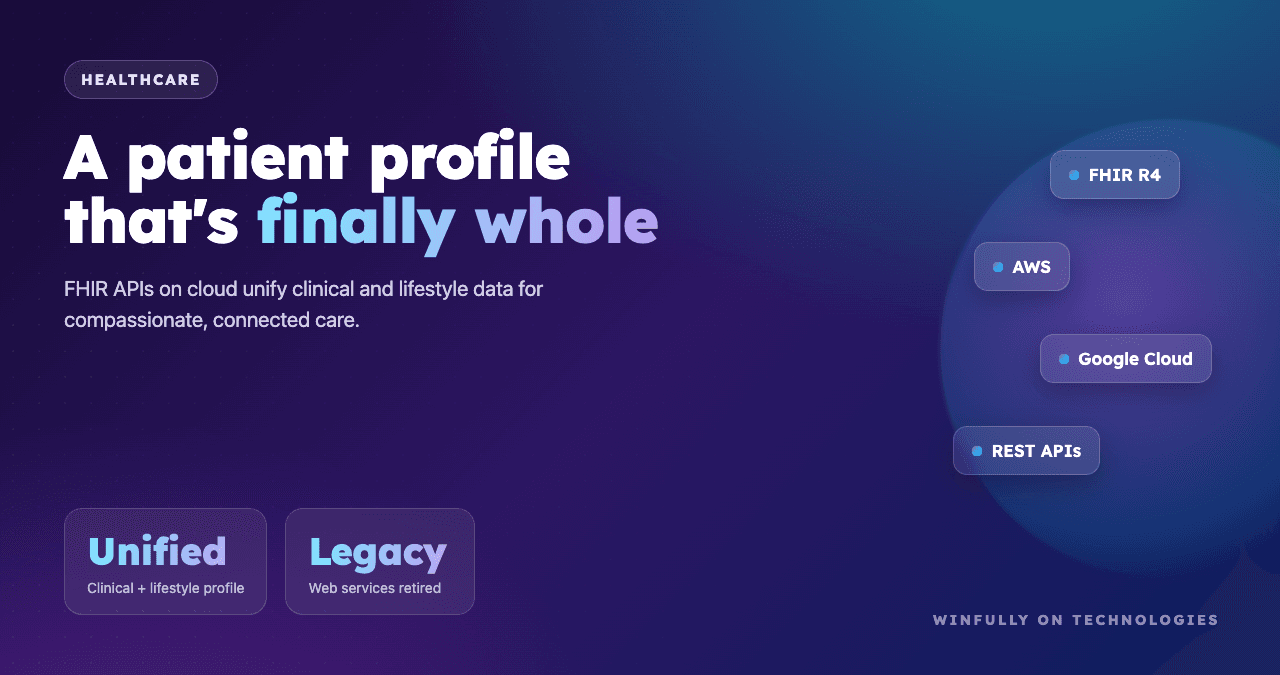
Results at a glance
The situation
A leading US health system runs a digital Family Care App that supports cancer patients and their caregivers through treatment. Its legacy EHR web services were never built for modern data exchange, which limited access to the full patient record. Clinical records, operational databases, lab systems, and personal-care apps stayed fragmented, so providers only saw part of the picture. The app also leaned heavily on clinical data and missed the lifestyle, behavioral, and emotional context that makes care feel personal.
Modernize the infrastructure to handle growing data volumes and support patients more personally. Replace brittle EHR web-service dependencies with standards-based interoperability. Bring clinical and lifestyle data together so the app can treat patients as whole people.
How we delivered
Migrate to FHIR-based APIs
Replaced legacy EHR web services with HL7 FHIR R4-compliant APIs built on standardized resources such as Patient, Medication, and Observation, establishing a consistent data contract across systems.
Build a centralized data platform
Integrated clinical records, operational systems, and lab data into one authoritative repository, resolving fragmentation and giving providers a complete, trustworthy patient profile.
Deploy cloud-native FHIR servers
Stood up scalable FHIR servers across AWS and GCP with RESTful APIs, enabling real-time data exchange that keeps pace with rising volumes and demand.
Re-engineer the application layer
Rebuilt the app to consume FHIR APIs through FHIR client libraries, removing direct legacy EHR dependencies and simplifying future integration.
Add a patient engagement layer
Captured lifestyle and personal context such as hobbies, travel preferences, family details, and pets, letting care teams engage patients with empathy beyond their clinical chart.
The technical solution
A block-level view of the system we designed and delivered — data and control flowing across each stage.
What the users see
A wireframe of the experience we shipped — laid out for the people who use it every day.
Clinical data, flowing where it needs to go
We connect source systems, normalize to HL7 and FHIR, and route validated data to the payers, analytics, and applications that depend on it — securely and with a full audit trail.
A cloud foundation built to scale and stay secure
From edge to data tier, we design layered, observable architectures with security and compliance engineered in — deployable to AWS, Azure, or GCP as single-cloud, multi-cloud, or hybrid.
Outcomes delivered
- Care coordination improved as providers gained a single, complete view of each patient across clinical and operational sources.
- Standards-based FHIR APIs replaced fragile legacy web services, making interoperability and future integrations far more reliable.
- Combining clinical and lifestyle data produced a fuller patient profile that supports more personal, compassionate engagement.
- Cloud-native FHIR servers gave the platform room to scale with growing data volumes without re-architecting again.
- Provider-patient relationships strengthened as care teams could respond to the whole person, not just the diagnosis.
Technology stack
The platforms, frameworks, and standards behind the solution.
Interoperability
APIs
Cloud
Data Platform
Want results like these?
Tell us the outcome you're after. We'll scope a short, fixed-fee discovery and a plan to get there.
Ready to start your digital transformation?
Let's talk about your roadmap, your compliance needs, and where technology can move your business forward.