
Successful Healthcare App Development
What it takes to build a successful healthcare app: deep industry insight, regulatory compliance, solid technology, and user-centered design.
Healthcare apps sit at an awkward intersection: they have to be sound engineering and genuinely humane at the same time. Building one that works is hard. You need a real grasp of how healthcare operates, strict compliance with the rules that govern patient data, solid technology underneath, and above all an honest read on what your users actually need.
This piece walks through what that takes, from regulation to design, and how to pair strong technology with empathy so the finished app earns a place in people's care rather than adding friction to it.
Understanding the Regulatory Environment
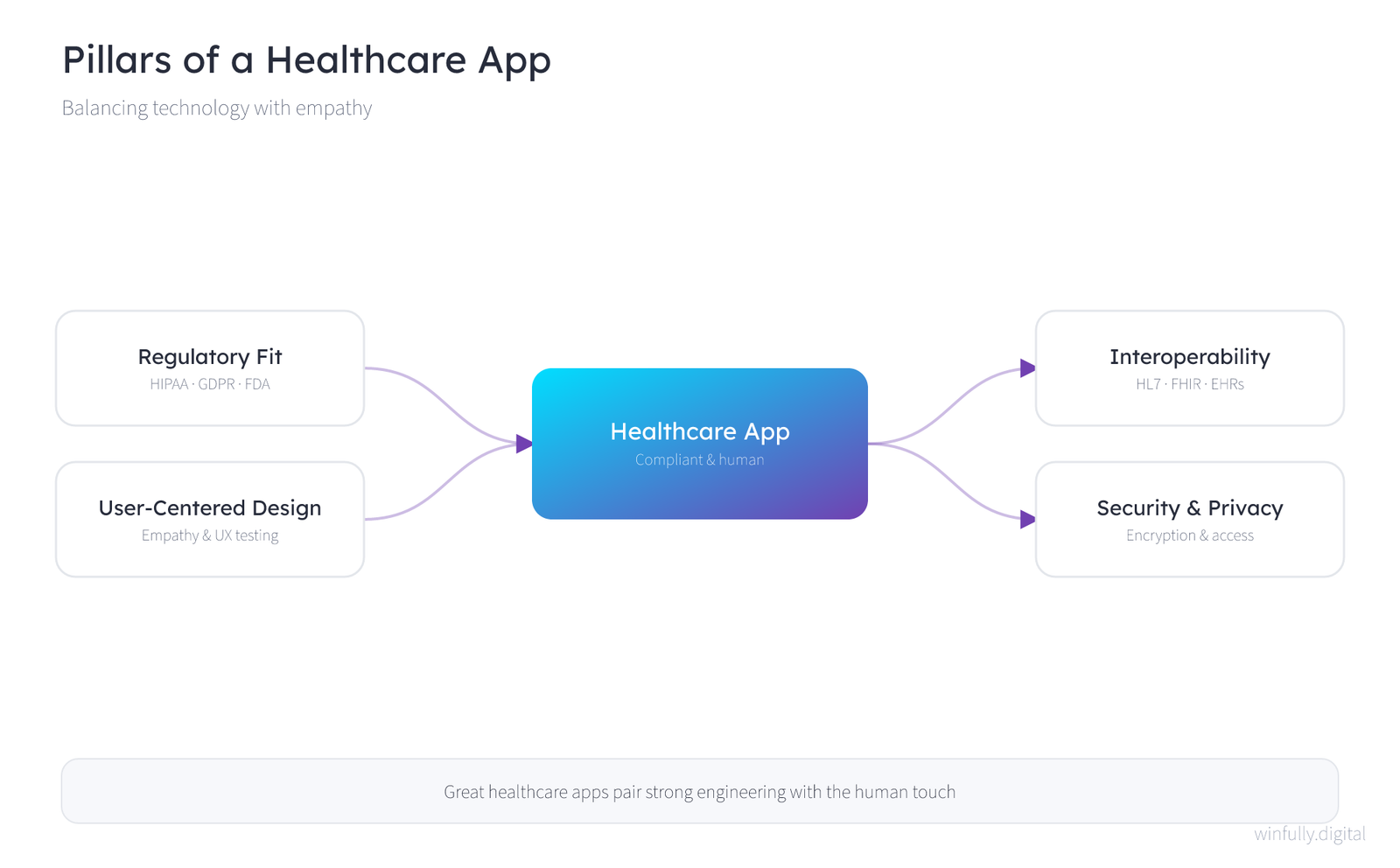
Regulation is the first thing to get right, not the last. HIPAA in the United States, GDPR in Europe, and whatever local data-protection rules apply set the boundaries your app has to live within, and they are not optional. They govern how personal health information can be used and how it must be protected.
In practice that means strong encryption, secure authentication, and tight access controls, built in from the start. If your app is meant to diagnose or treat, the FDA's guidance on mobile medical apps may apply, which can classify it as a medical device and raise the bar again. Settle where you stand legally before you write a line of code, not after.
Empathy in User-Centered Design
Whether your users are patients, clinicians, or admin staff, the app lives or dies on whether it fits their day. Empathy is the tool that gets you there. Design around what they actually need, how they feel, and where the app meets them in a healthcare journey that is often stressful to begin with.
Keep feedback flowing the whole way through, not just at the end. Run focus groups, interviews, and UX testing across the different people who will use it. What you learn should push design toward an interface that is intuitive and accessible, one that lowers a user's stress rather than adding to it.
Interoperability and Data Integration
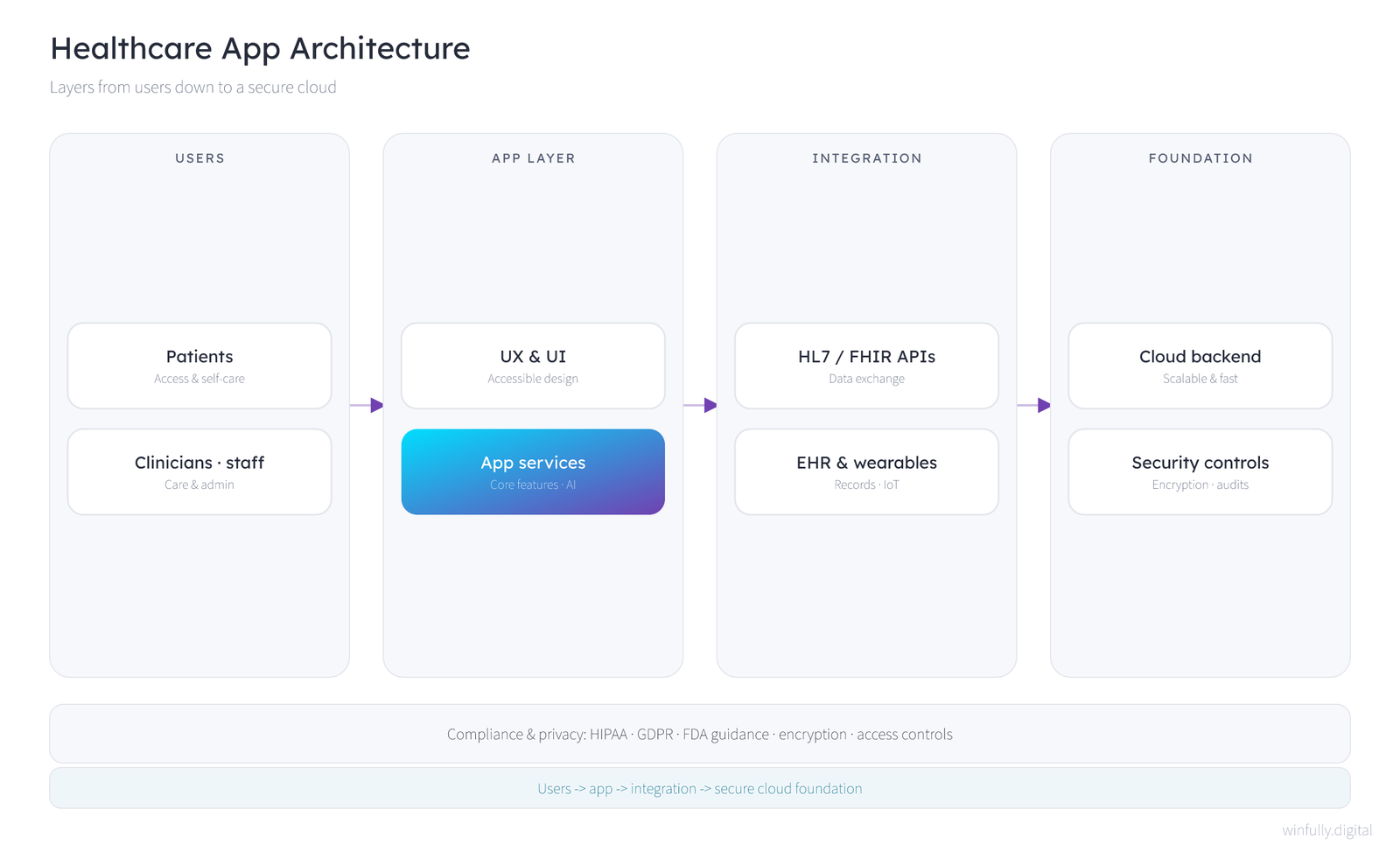
A healthcare app that cannot talk to other systems is not much use. Yours should exchange data with existing health information systems, Electronic Health Records (EHRs), and related apps. Depending on what it does, that usually means working with common protocols such as Health Level Seven (HL7), Fast Healthcare Interoperability Resources (FHIR), or Direct Project.
It also has to pull those sources together into one coherent view. A patient app might draw from several specialists' EHRs, pharmacy systems, and a wearable or two, then present it as a single, readable picture. Getting there takes real fluency in healthcare data standards, plus APIs or custom integration work where the standards fall short.
Artificial Intelligence and Advanced Technologies
AI can extend what your app does, from predictive analytics and individualized treatment plans to natural language processing that speeds up data entry. Use it carefully, though. Keep the models transparent and watch for bias, because a biased algorithm in healthcare translates directly into unequal care.
Other technologies are worth weighing too: blockchain for tamper-proof records, IoT for real-time monitoring and data collection. The test is always the same. Does it make the experience or the outcome measurably better without making the app harder to use?
Security and Privacy
Health data is about as sensitive as it gets, so security and privacy cannot be an afterthought. Beyond encryption and secure transmission, plan for regular penetration testing, real-time monitoring, and a clear, rehearsed response for the day a breach happens.
Be straight with people about how their data is collected and used. Give them a plain-language privacy policy that is easy to find, along with controls that let them adjust their own settings.
Scalability and Performance
Build for growth from the outset. The app needs to absorb rising traffic and take on new features or integrations as your user base grows and clinical practice shifts. That calls for a strong backend, often cloud-based for the flexibility, and a database designed for both speed and data integrity.
Test performance hard, too. A healthcare app has to stay responsive under heavy load and do exactly what users expect, without lag or errors, since delays here carry real clinical weight.
Utilizing Healthcare IT Consultants: Your Guide on the Journey
Given the complexity and the stakes, starting a healthcare app can feel daunting, which is where a healthcare IT consultant earns their keep. Someone with real domain knowledge brings a working view of best practices, regulatory requirements, and where the technology is heading. They help sharpen the concept against actual market needs and the care gaps your app is meant to close.
A good consultant stays useful through build and launch, keeping compliance, interoperability, and user focus on track. They help you work with industry players, find your way through healthcare's procedural maze, and plan for risk, especially around data security and privacy. The result is an app that is technically sound and genuinely fits the people, and the wider system, it serves.
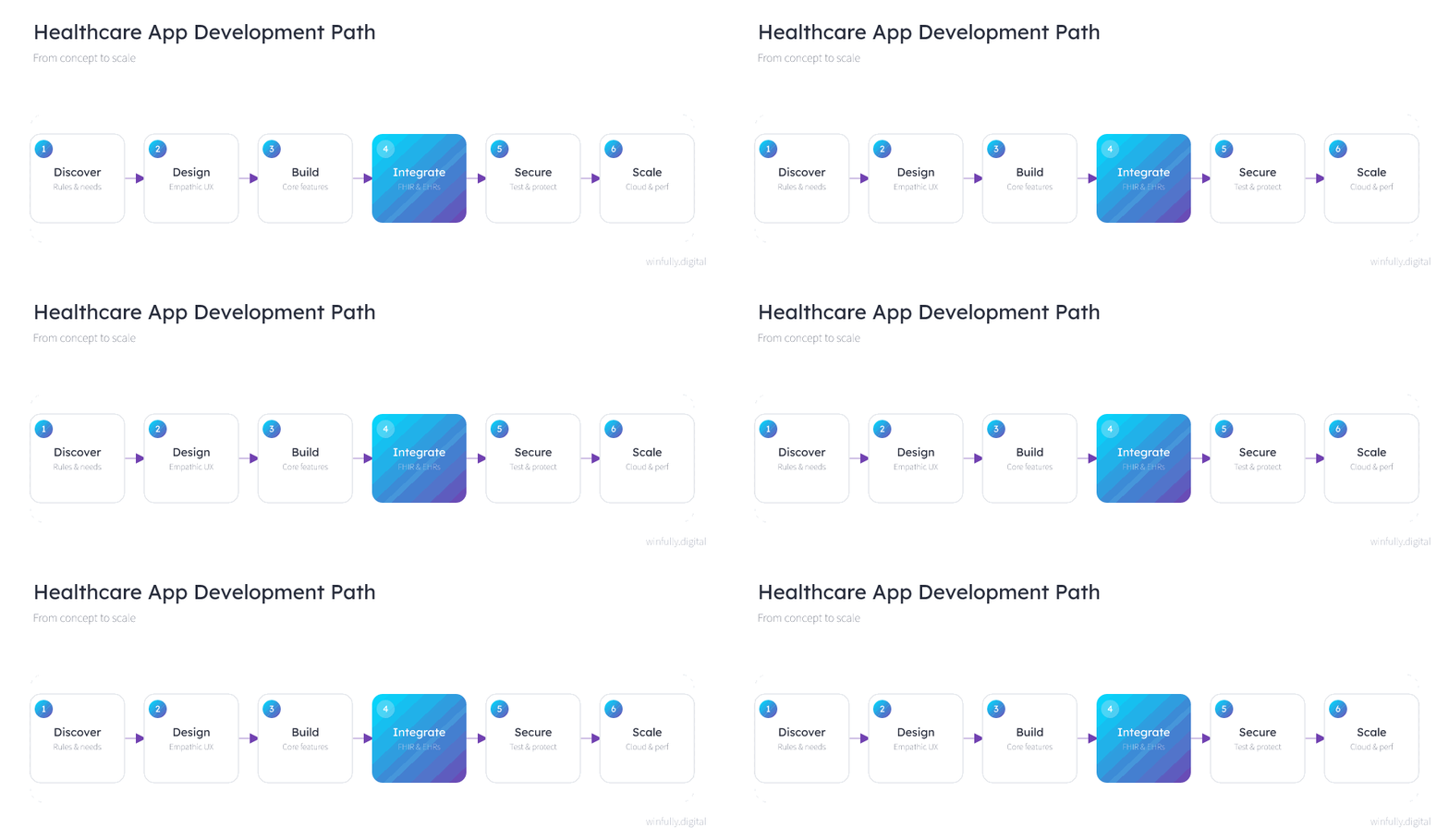
The animation below shows the development path we follow to bring these pillars together, from early discovery through to a scalable, secure release.
Conclusion
A successful healthcare app is far more than clean code. It comes from combining regulatory know-how, engineering skill, user-centered design, empathy, and some foresight about where care is heading. Balance those well and you get an app that stands out in a crowded market because it actually serves patients, clinicians, and staff alike. In this field the human touch matters as much as the technology, and a healthcare IT consultant can help make sure the finished product is compliant, secure, and easy to live with.
Need a hand with your healthcare app? Reach out to our experts (Contact Us). We work in Digital Health Strategy, Cloud Migration, and Healthcare Product Design and Development.